
이미 소장하고 있다면 판매해 보세요.
- 국내배송만 가능
- 문화비소득공제 가능
책소개
목차
|
Introduction
Innovation: The Courage to Take the Road Less Traveled Innovation in Leadership 01 The Emergence of New Leaders (Field Staff Replacing CEO as the Drivers of Innovation) Innovation that’s not top-down, but bottom-up, with all field staff taking part Innovation in Purpose 02 Increasing the Efficiency of Fiscal Operations by Focusing the Budget on the End Users Switching the standard for budget allocation from student capacity to student enrollment Innovation in Values 03 Sending a Million Youths Around the World Developing an international educator’s license to fill overseas positions for well-educated young Koreans 04 Contributing to Society through the Arts and Culture Organizing a festival called “Incheon Music: Hic et Nunc!” Innovation in Research 05 The Birth of a Globally Competitive Research Group The strategy of a Focused Research University (FRU) 06 Bootstrapping Research Ability Research-Intensive Self-motivated Education (RISE) Innovation in Education World’s first 07 The World’s Only Company-Led Educational Program Companies take the initiative at Matrix College INU’s First 08 Globalization Begins with Liberal Education Innovative reform of liberal education courses World’s first 09 Innovative Pursuit of a Global University to Train Global Talent “2+2” dual degree program with overseas universities INU’s First 10 Imparting Greater Expertise through Interdisciplinary Education A collaborative graduate program that adds the forest and nature to early child education Innovation in Administration Korea’s First 11 Alternatives for the Efficient Use of Limited Educational Space The space voucher program Korea’s First 12 Greater Transparency and Efficiency Are the Key to Success Management transparency through a maintenance, repair, and operations (MRO) program Korea’s First 13 “No Chance for Corruption” Builds Trust Ensuring integrity by releasing 100% of information on contracts and transactions Korea’s First 14 Broadening Our Perspectives through Collaboration Giving field work to technical staff for harmonious organizational development Korea’s First 15 Better Communication by Removing Barriers Reducing administrative faculty, office sizes and creating “smart offices” Innovation in Environment 16 A Smart Campus Growing in Harmony with the Songdo Eco-City Building a sustainable eco-friendly campus Innovation in Culture 17 The Age of Continuing Education: Laying the Foundation for a Second Career Staff and teaching assistants get a chance to do graduate studies and teach in the extension school 183 18 Bravo! Planning for Retirement Workers planning early retirement are given opportunities to open a start-up business on campus 187 Innovation in Symbols 19 Field Staff-Centered University with a 180-Degree Flipped Organization Chart Flipping the organizational chart upside down to show that the administration is a platform, not a regulator 192 Afterword 197 Appendix 2020 Incheon National University 2nd Innovation Case Report Table of Contents 199 |
저자 소개
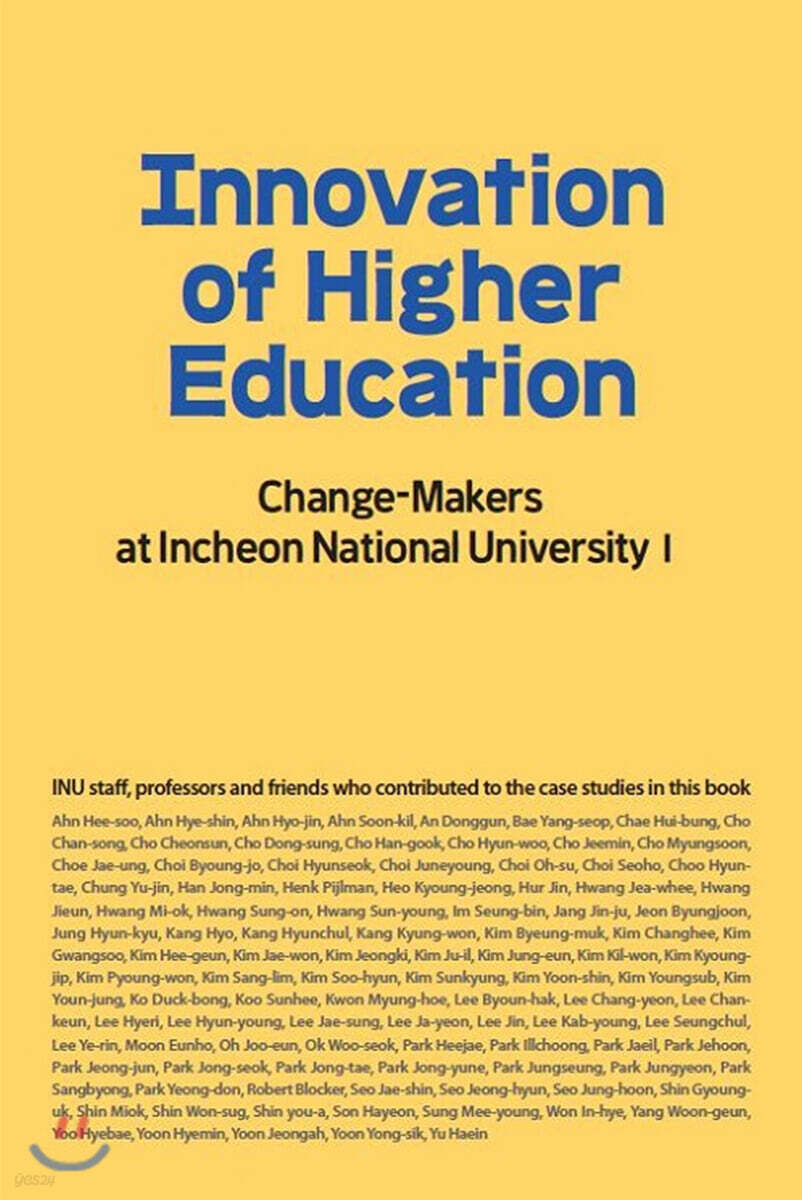
Authors : Ahn Hee-soo, Chae Hui-bung, Cho Chan-song, Cho Myungsoon, Choi Oh-su, Chung Yu-jin, Han Jong-min, Heo Kyoung-jeong, Hwang Sung-on, Hwang Sun-young, Im Seung-bin, Jang Jin-ju, Kim Ju-il, Kim
Ahn Hee-soo, General Affairs Office
Chae Hui-bung, Division of Campus Facilities Planning
Cho Chan-song, Financial and Accounting Office
Cho Dong-sung, President
Cho Myung-soon, Financial and Accounting Office
Choi Oh-su, Research and Innovation Office
Chung Yu-jin, CEO of INU Press
Han Jong-min, General Education Team
Heo Kyoung-jeong, Academic Affairs Office
Hwang Sung-on, Professor in Dept. of Early Childhood Education
Hwang Sun-young, Human Resource Development Office
Im Seung-bin, Division of Planning and Budget
Jang Jin-ju, Teaching and Learning Support Office
Kim Ju-il, Human Resource Development Office
Kim Jung-eun, Division of Planning and Budget
Kim Pyoung-won, Professor in Dept. of Korean Language Education
Kim Soo-hyun, Administrative Assistant in Dept. of Language Education Korean
Kim Yoon-shin, Professor in Dept. of Korean Language Education
Lee Byoung-hak, Innovation Center for Engineering Education
Lee Ja-yeon, College of Information Technology Office
Oh Joo-eun, Professor in Dept. of Early Childhood Education
Park Ill-choong, Research and Innovation Office
Park Jae-il, General Affairs Office
Park Sang-byong, International Office
Seo Jae-shin, Division of Campus Facilities Planning
Shin Gyoung-uk, General Affairs Office
품목정보
- 발행일
- 2020년 06월 15일
- 쪽수, 무게, 크기
- 204쪽 | 152*225*20mm
- ISBN13
- 9781624121340
출판사 리뷰
|
Focused Research University (FRU), differentiating INU from Comprehensive Research Universities (CRU) or Intensive Research Universities (IRU)
Albeit a comprehensive university, INU has chosen to become a “Focused Research University.” As an FRU, it has identified a number of university-wide themes such as biotech, post-unification integration and climate change. INU then encourages all its faculty members, regardless of their specific majors, to conduct research into one of them for more fruitful convergence among heterogeneous fields. A notable scheme in INU’s act of convergence is “permutation in reverse order.” The conventional wisdom is for scholars of hard science such as natural sciences and engineering, moving into soft science of humanities and social sciences. INU encourages the sequence the other way around. At INU’s annual Global Bio-Convergence Conference for example, more than 30 professors of English literature, history, art, and culture presented research papers on biotech. Such unconventional challenges make these papers inspirational, securing their position unique in the academic world. The Matrix College curriculum reflecting company needs For too long, the job market has seen a mismatch between the skill sets held by university graduates and the expectations of employers. Despite various efforts in the past, most companies and universities remain at odds over this issue. INU has confronted this problem head on by allowing companies and institutions to design university curricula based on their needs. This led to the launch of the innovative educational program called the Matrix College. Its model is an industry-university matrix curriculum, with the university’s intensive major curricula on the x-axis and the employment-linked curricula on the y-axis. By taking courses at the intersection of these two axes, students can prepare themselves as well-suited job candidates for desired employers. This is one of the leading innovative programs of its type in the world. Founding and implementing 76 innovative projects since 2016 This book recounts various innovative programs carried out at INU over the past four years. The concept of the focused research university, as well as the use of employment-linked curricula designed by companies and institutions, were both unprecedented moves. In August 2016, INU devised a framework for 28 new projects, which were two years later further subdivided into 72 innovation projects. In December 2019, these innovation projects were further expanded to 76 in INU’s “2nd Innovation Case Report” submitted to the Ministry of Education. Here, this book provides insight into these projects along with the step-by-step process that went into creating a culture of innovation at INU. Each project falls under the category of “world’s first,” “Korea’s first,” or “INU’s first.” The appendix includes the full list of the 76 innovation projects that readers can access for their reference. Candid discussion of challenges facing bottom-up innovation Going beyond case studies of achievements, this book engages in a candid discussion of the challenges and side-effects of innovation. The implementation of these innovation projects at INU met with some unexpected obstacles as well as “reasonable objections” among the working-level staff. These issues were duly examined by using staff inputs to reach suitable solutions. This book shares details of this problem-solving process, focusing on INU’s method for selecting and implementing projects, surveying opinions, and gathering feedback from the field. This allows the book to serve as a benchmarking tool for those universities and institutions that are seeking to make their own changes. This book is also the first of its kind in the sense that it was written not by a CEO or a professor, but by the 275 members of the INU staff as a collaborative effort, thus challenging the notion that innovation should be initiated from the top. This book embodies INU’s motto of “bottom-up innovation,” compiling the on-site records and reports from its staff. They are the driving force for innovation, the fearless change-makers at INU. |
사락 별점0
혜택 및 유의사항밑줄0
혜택 및 유의사항상품정보안내
직수입외서의 경우, 해외거래처에서 제공하는 정보가 부족하여 제목, 표지, 가격, 유통상태 등의 정보가 미비하거나 변경되는 경우가 있습니다. 정확한 확인을 원하시는 경우, 일대일 상담으로 문의하여 주시면 답변 드리겠습니다.
(판형과 판수 등이 다양한 도서는 찾으시는 도서의 ISBN을 알려 주시면 보다 빠르고 정확한 안내가 가능합니다.)
해외거래처에서 품절인 경우, 2차 거래선을 통해 유럽과 미국 출판사로 직접 수입이 진행될 수 있습니다.
수입 진행 시점으로 부터 2~3주가 추가로 소요되며, 해외에서도 유통이 원활하지 않은 도서는 품절 안내가 지연될 수 있습니다.
해당 경우, 문자와 메일로 별도 안내를 드리고 있사오니 마이페이지에서 휴대전화번호와 메일주소를 다시 한번 확인해주시기 바랍니다.
(판형과 판수 등이 다양한 도서는 찾으시는 도서의 ISBN을 알려 주시면 보다 빠르고 정확한 안내가 가능합니다.)
해외거래처에서 품절인 경우, 2차 거래선을 통해 유럽과 미국 출판사로 직접 수입이 진행될 수 있습니다.
수입 진행 시점으로 부터 2~3주가 추가로 소요되며, 해외에서도 유통이 원활하지 않은 도서는 품절 안내가 지연될 수 있습니다.
해당 경우, 문자와 메일로 별도 안내를 드리고 있사오니 마이페이지에서 휴대전화번호와 메일주소를 다시 한번 확인해주시기 바랍니다.
22,800원
총 1개
22,800원