
소득공제
수입
직수입양서
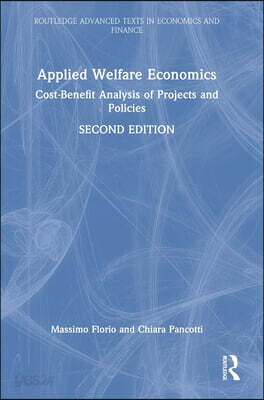
Applied Welfare Economics
Cost-Benefit Analysis of Projects and Policies
Hardback, 2nd Edition
Florio, Massimo / Pancotti, Chiara
Routledge
2022.08.30.
이미 소장하고 있다면 판매해 보세요.
- 국내배송만 가능
- 해외 거래처 사정에 의하여 품절/지연 가능
- 도서 정보 중 미표기 사항 안내?
- 문화비소득공제 가능
Routledge Advanced Texts in Economics and Finance
-
 Contemporary Issues in Quantitative Finance 이동Contemporary Issues in Quantitative Finance10% 348,270원
 -
Contemporary Issues in Quantitative Finance 이동Contemporary Issues in Quantitative Finance10% 125,520원
-
Essentials of Machine Learning in Finance and Accounting 이동Essentials of Machine Learning in Finance and Accounting10% 348,270원
-
Essentials of Machine Learning in Finance and Accounting 이동Essentials of Machine Learning in Finance and Accounting10% 85,020원
-
Financial Risk Management and Derivative Instruments 이동Financial Risk Management and Derivative Instruments10% 380,670원
-
Financial Risk Management and Derivative Instruments 이동Financial Risk Management and Derivative Instruments10% 129,570원
-
Applied Spatial Statistics and Econometrics 이동Applied Spatial Statistics and Econometrics10% 129,570원
-
Applied Spatial Statistics and Econometrics 이동Applied Spatial Statistics and Econometrics10% 348,270원
-
Introduction to Estimating Economic Models 이동Introduction to Estimating Economic Models10% 200,440원
책소개
목차
|
Chapter 1: On Social Welfare Overview 1.1. The concept of social welfare* 1.1.1 Gross Domestic Product as welfare measurement 1.1.2 Income and final consumption 1.1.3 A digression on money in welfare economics 1.2. The welfare assumptions behind GDP and NNP 1.3. Individual and social welfare 1.4. Determinants of individual welfare: goods 1.5. Determinants of social welfare: individual utilities 1.5.1 Aggregating individual utilities 1.5.2 Interpretation of welfare weights 1.6. Sen’s critique of individualistic Social Welfare Function 1.7. Paternalism and not (only) individualistic Social Welfare Functions 1.8. Happiness economics 1.9. ‘Positive’ analysis 1.10. Further reading 1.11. Summary of Chapter 1 Chapter 2: The two Fundamental Theorems re-examined Overview 2.1. Theorems versus Intuitions 2.2. The Arrow-Debreu (AD) Economy (*) 2.3. The axiomatic structure (*) 2.4. Consumers, producers and government: objectives and constraints (*) 2.5. The Walrasian equilibrium 2.6. The two Theorems without ideology 2.7. The informative structure: Stiglitz’s critique 2.8. Critical analysis of the Second Theorem 2.9. The government rediscovered in second-best economies 2.10. Further reading 2.11. Summary of Chapter 2 Appendix A2.1 ? Policies based on the Second Theorem: lump-sum transfers Appendix A3.1: Some results from Dreze and Stern (1987) Marginal social value of producer prices Marginal social value of commodity taxes Marginal social value of a production constraint Chapter 3: Shadow prices and the social planner Overview 3.1. Introductory remarks 3.2. A model for project and policy evaluation 3.3. A second best economy in the DS frame 3.4. Policy reforms and shadow prices 3.5. Multi-government setting 3.6. Why using shadow prices? 3.7. Further reading 3.8. Summary of Chapter 3 Chapter 4: The social cost of goods Overview 4.1. Observed prices and financial analysis 4.2. Accounting prices and economic analysis 4.2.1 Conversion of market prices to shadow prices 4.2.2 Extension of project boundaries: externalities and indirect effects 4.2.3 Assessing the economic performance 4.3. Empirical approaches for guessing accounting prices 4.4. The border price rule for tradable goods 4.5. The Standard Conversion Factor 4.6. The long run marginal cost 4.7. Willingness-to-pay 4.7.1 Definition and scope of application 4.7.2 Stated preferences approaches 4.7.3 Revealed preferences approaches 4.7.4 Benefit transfer approach 4.8. Further readings 4.9. Summary of Chapter 4 Appendix A4.1: Financial analysis The financial return on investment The financial return on capital Financial performance indicators Financial sustainability Dealing with taxes in the financial analysis Appendix A4.2: An example of financial and economic analysis Chapter 5: The social cost of labour Overview 5.1. Earlier literature on the social opportunity cost of labour 5.1.1 Theoretical contributions 5.1.2 Empirical contributions 5.2. A conceptual model for the social cost of labour 5.3. The shadow wage rate and labour market conditions 5.3.1 Simplifying the Little-Mirrlees formula for the SWR 5.3.2 Empirical formulae 5.4. Empirical estimation of shadow prices for EU regions 5.4.1 Data and methods 5.4.2 Estimation of the SWRs 5.5. Further reading 5.6. Summary of Chapter 5 Chapter 6: The social cost of capital Overview 6.1. Rationale for discounting 6.2. Estimating the social discount rate 6.2.1 The social rate of return on private investments (SRRI) 6.2.2 The social rate of time preference (SRTP) 6.2.3 The weighted average method 6.2.4 The shadow price of capital 6.3. The social discount rate as a function of time 6.4. Empirical estimates of the social discount rate 6.4.1 International evidence: SDRs recommended in selected countries 6.4.2 An example of SRTP estimation 6.5. The opportunity cost of public funds 6.6. Further reading 6.7. Summary of Chapter 6 Chapter 7: Welfare weights and distributional impacts Overview 7.1. Why are equity considerations needed in CBA? 7.2. Deriving welfare weights 7.3. Estimation of distributional weights 7.4. The distributional characteristic of goods 7.5. Group and regional welfare weights 7.6. Basic needs and social affordability 7.6.1 The basic needs approach 7.6.2 Social affordability analysis 7.7. Further reading 7.8. Summary of Chapter 7 Chapter 8: Risk assessment Overview 8.1. Rationale of the risk assessment 8.2. Definitions and concepts 8.3. Historical background: the World Bank model 8.4. Sensitivity analysis 8.4.1 Identification of the critical variables 8.4.2 Approaches to test the sensitivity of the CBA model 8.5. Probability analysis 8.5.1 Probability distributions of the critical variables 8.5.2 Dealing with correlations between the critical variables 8.6. Risk Analysis 8.6.1 Monte Carlo simulations 8.6.2 Evaluation of the investment’s riskiness 8.7. Further reading 8.8. Summary of Chapter 8 Appendix A8.1: Distributions of probabilities Appendix A8.2: Monte Carlo method Theoretical framework of the Monte Carlo method Choice of the number of simulations Appendix A8.3: Generating correlated random numbers Modeling dependence through conditional distributions Modeling dependence through copulas Chapter 9: International evaluation practices Overview 9.1. National traditions and operative guidelines 9.1.1 United Kingdom 9.1.2 France 9.1.3 United States of America 9.2. The use of cost-benefit analysis in the EC regional policy 9.3. Multilateral development banks 9.3.1 The European Investment Bank 9.3.2 The World Bank 9.4. Further reading 9.5. Summary of Chapter 9 Chapter 10: Ex-post project evaluation Overview 10.1. Timing and scope of CBA 10.2. Performing ex-post CBA 10.2.1 Project border identification 10.2.2 Reference scenario 10.2.3 Demand analysis 10.2.4 Willingness-to-pay 10.2.5 Shadow prices 10.2.6 The social discount rates 10.3. International practice of ex-post CBA 10.4. CBA and the decision-making process 10.5. Interpretation of variability of ex-ante vs ex-post or re-estimated internal rates of return 10.6. Comparison between ex-ante and ex-post economic rates of return 10.7. CBA and incentives 10.8. Further reading 10.9. Summary of Chapter 10 Chapter 11: The use of cost-benefit analysis in regulatory policy Overview 11.1. Adopting CBA for regulatory impact assessment: rationale and main elements 11.2. International practices 11.2.1 United States 11.2.2 United Kingdom 11.2.3 European Union 11.2.4 Other experiences 11.3. A key tool for good governance? Some critical considerations 11.4. Further reading 11.5. Summary of Chapter 11 |
관련 분류
품목정보
- 발행일
- 2022년 08월 30일
- 쪽수, 무게, 크기
- 324쪽 | 453g | 170*250mm
- ISBN13
- 9781032043005
사락 별점0
혜택 및 유의사항밑줄0
혜택 및 유의사항상품정보안내
직수입외서의 경우, 해외거래처에서 제공하는 정보가 부족하여 제목, 표지, 가격, 유통상태 등의 정보가 미비하거나 변경되는 경우가 있습니다. 정확한 확인을 원하시는 경우, 일대일 상담으로 문의하여 주시면 답변 드리겠습니다.
(판형과 판수 등이 다양한 도서는 찾으시는 도서의 ISBN을 알려 주시면 보다 빠르고 정확한 안내가 가능합니다.)
해외거래처에서 품절인 경우, 2차 거래선을 통해 유럽과 미국 출판사로 직접 수입이 진행될 수 있습니다.
수입 진행 시점으로 부터 2~3주가 추가로 소요되며, 해외에서도 유통이 원활하지 않은 도서는 품절 안내가 지연될 수 있습니다.
해당 경우, 문자와 메일로 별도 안내를 드리고 있사오니 마이페이지에서 휴대전화번호와 메일주소를 다시 한번 확인해주시기 바랍니다.
(판형과 판수 등이 다양한 도서는 찾으시는 도서의 ISBN을 알려 주시면 보다 빠르고 정확한 안내가 가능합니다.)
해외거래처에서 품절인 경우, 2차 거래선을 통해 유럽과 미국 출판사로 직접 수입이 진행될 수 있습니다.
수입 진행 시점으로 부터 2~3주가 추가로 소요되며, 해외에서도 유통이 원활하지 않은 도서는 품절 안내가 지연될 수 있습니다.
해당 경우, 문자와 메일로 별도 안내를 드리고 있사오니 마이페이지에서 휴대전화번호와 메일주소를 다시 한번 확인해주시기 바랍니다.
348,270원
총 1개
348,270원