
소득공제
수입
직수입양서
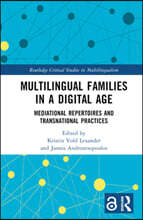
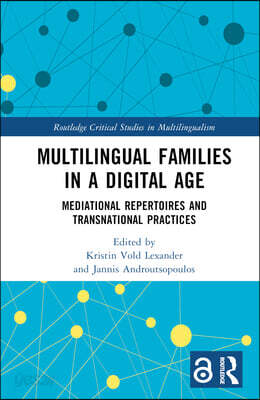
Multilingual Families in a Digital Age
Mediational Repertoires and Transnational Practices
Hardback, 1st Edition, Illustrations, Color
Lexander, Kristin Vold / Androutsopoulos, Jannis
Routledge
2023.05.23.
이미 소장하고 있다면 판매해 보세요.
- 국내배송만 가능
- 해외 거래처 사정에 의하여 품절/지연 가능
- 도서 정보 중 미표기 사항 안내?
- 문화비소득공제 가능
Routledge Critical Studies in Multilingualism
-
 Re-imagining Language and Communication in Collaborative Projects 이동Re-imagining Language and Communication in Collaborative Projects10% 100,950원
 -
Absencing and Haunting in Semiotic Landscapes 이동Absencing and Haunting in Semiotic Landscapes20% 321,610원
-
Minority Language Learning for Adult Migrants in Europe 이동Minority Language Learning for Adult Migrants in Europe20% 84,120원
-
Re-imagining Language and Communication in Collaborative Projects 이동Re-imagining Language and Communication in Collaborative Projects20% 321,610원
-
Migration, Adult Language Learning and Multilingualism 이동Migration, Adult Language Learning and Multilingualism10% 100,950원
-
Literary Multilingualism in the Borderlands 이동Literary Multilingualism in the Borderlands10% 92,530원
-
Multilingual Texts and Practices in Early Modern Europe 이동Multilingual Texts and Practices in Early Modern Europe10% 92,530원
-
Minority Language Learning for Adult Migrants in Europe 이동Minority Language Learning for Adult Migrants in Europe10% 361,810원
-
Language Education in Multilingual Colombia 이동Language Education in Multilingual Colombia10% 92,530원
-
Migration, Adult Language Learning and Multilingualism 이동Migration, Adult Language Learning and Multilingualism10% 361,810원
-
Literary Multilingualism in the Borderlands 이동Literary Multilingualism in the Borderlands10% 361,810원
-
Multilingual Texts and Practices in Early Modern Europe 이동Multilingual Texts and Practices in Early Modern Europe10% 307,120원
-
Language Education in Multilingual Colombia 이동Language Education in Multilingual Colombia10% 361,810원
책소개
목차
|
List of tables, images, and figures Preface Acknowledgments 1 Introduction: Doing family and language in a digital age 1.1 A day in the digital life of a young multilingual family member 1.2 Theoretical dimensions: Family multilingualism, digital interaction, and polymedia 1.3 Fieldwork for this book 1.4 Outline of the book 2 Multilingual families online: Repertoires and practices 2.1 Multilingual practices 2.1.1 Practice approaches to multilingualism 2.1.2 Repertoires and registers 2.2 Family multilingualism 2.2.1 Family language policy and practice 2.2.2 Heritage language practices and heritage language socialisation 2.2.3 The discursive construction of the multilingual family space 2.2.4 A ‘digital turn’ in FLP literature 2.3 Multilingualism online 2.3.1 Code-switching approaches 2.3.2 Networked multilingualism and digital translanguaging 2.3.3 Affordances for mediated interaction in the digital ecology 2.4 Transnational families and digitally mediated communication 2.4.1 ‘Doing family’ transnationally 2.4.2 Digital co-presence in transnational families 2.2.3 Polymedia: An ecology of media choices 2.2.4 Language and media in family-making practices 2.5 Conclusion: Towards the study of mediational repertoires 3 Media and language use in multilingual families: An ethnographic study in Norway 3.1 Sociolinguistic research with Senegalese migrants in Norway 3.1.1 Language and society in Senegal 3.1.2 Language and immigration in Norway 3.1.3 Senegalese immigrants in Norway 3.2 Presentation of participants 3.2.1 The Diagne family 3.2.2 The Ba family 3.2.3 The Sagna family 3.2.4 The Coly family 3.3 The families’ linguistic repertoires 3.3.1 Wolof 3.3.2 Joola 3.3.3 Peul 3.3.4 French 3.3.5 Arabic 3.3.6 English 3.3.7 Norwegian 4 Visualising languages, modalities, and media: From language portraits to mediagrams 4.1 Visualizing repertoires 4.1.1 Language portraits and network graphs 4.1.2 Media maps 4.1.3 Mediagrams 4.2 Data collection 4.3 Developing mediagrams 4.4 Data analysis 4.5 Ethical considerations and other challenges 5 Analyzing mediagrams: Mediational choices in polymedia environments 5.1 Pleasure and pressure: Balancing co-presence 5.2 Multilingualism and multimodality: Managing a network of generations 5.3 Media, language, and connectedness: A comparison of three fathers 5.4 Media choices 5.5 Conclusions 6 ‘Doing family’ online: Translocality, connectivity, and affection 6.1 Language, power, morality, and solidarity in the family 6.2 Translocal connectivities 6.2.1 Mediated interaction in the household: Coordinating family issues 6.2.2 Translocal household interaction: Making decisions and sharing 6.2.3 Transnational family-making: Power, solidarity, and teasing 6.3 Multilingual expressions of affection 6.3.1 Wife and husband 6.3.2 Parents and children 6.3.3 Extended family and beyond 6.4 Conclusions 7 Transnational families, diaspora practices, and digital polycentricity 7.1 Diaspora and digital diaspora 7.2 Digital diaspora and polycentricity 7.3 Polycentric participation: A kaleidoscope of practices 7.3.1 Digital spaces of diasporic sociality 7.3.2 The Senegalese public sphere 7.3.3 Religious discourse 7.3.4 Beyond diaspora: Traces of Norway and global pop culture 7.4 Conclusions 8 Heritage language repertoires 8.1 Parents’ ideologies of linguistic heritage 8.2 Heritage language repertoires in time and space 8.3 Children’s transnational heritage language practices 8.3.1 Heritage repertoires by interlocutors 8.3.2 Heritage language registers 8.3.3 Learning Wolof through online interaction 8.4 Conclusions: Heritage languages and mediational repertoires 9 Conclusions 9.1 Multi-sited ethnography: Studying mediational repertoires 9.2 Transnational connectivity and family multilingualism 9.3 A digital perspective on heritage language repertoires References Index |
품목정보
- 발행일
- 2023년 05월 23일
- 쪽수, 무게, 크기
- 238쪽 | 700g | 150*230mm
- ISBN13
- 9781032130248
사락 별점0
혜택 및 유의사항밑줄0
혜택 및 유의사항상품정보안내
직수입외서의 경우, 해외거래처에서 제공하는 정보가 부족하여 제목, 표지, 가격, 유통상태 등의 정보가 미비하거나 변경되는 경우가 있습니다. 정확한 확인을 원하시는 경우, 일대일 상담으로 문의하여 주시면 답변 드리겠습니다.
(판형과 판수 등이 다양한 도서는 찾으시는 도서의 ISBN을 알려 주시면 보다 빠르고 정확한 안내가 가능합니다.)
해외거래처에서 품절인 경우, 2차 거래선을 통해 유럽과 미국 출판사로 직접 수입이 진행될 수 있습니다.
수입 진행 시점으로 부터 2~3주가 추가로 소요되며, 해외에서도 유통이 원활하지 않은 도서는 품절 안내가 지연될 수 있습니다.
해당 경우, 문자와 메일로 별도 안내를 드리고 있사오니 마이페이지에서 휴대전화번호와 메일주소를 다시 한번 확인해주시기 바랍니다.
(판형과 판수 등이 다양한 도서는 찾으시는 도서의 ISBN을 알려 주시면 보다 빠르고 정확한 안내가 가능합니다.)
해외거래처에서 품절인 경우, 2차 거래선을 통해 유럽과 미국 출판사로 직접 수입이 진행될 수 있습니다.
수입 진행 시점으로 부터 2~3주가 추가로 소요되며, 해외에서도 유통이 원활하지 않은 도서는 품절 안내가 지연될 수 있습니다.
해당 경우, 문자와 메일로 별도 안내를 드리고 있사오니 마이페이지에서 휴대전화번호와 메일주소를 다시 한번 확인해주시기 바랍니다.
361,810원
총 1개
361,810원