


소득공제
수입
직수입양서
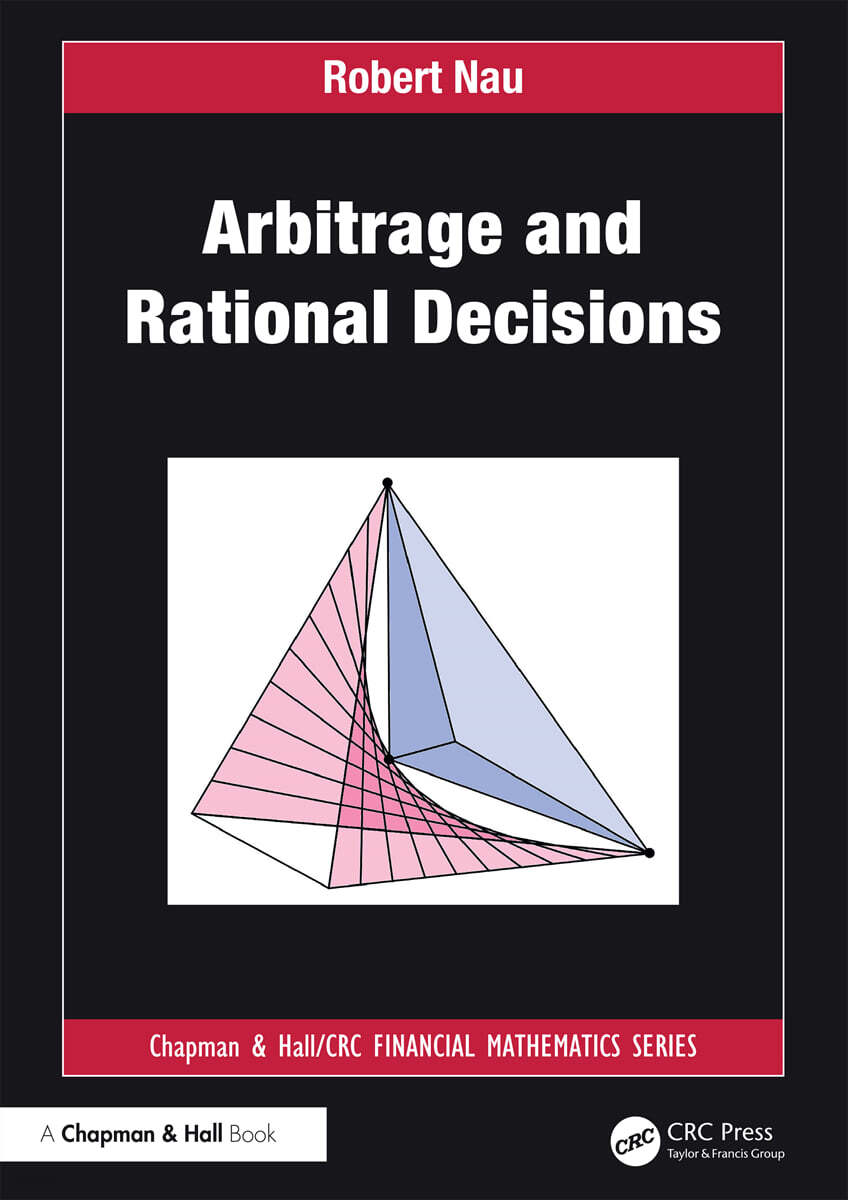
Arbitrage and Rational Decisions
Hardback, 1st Edition
Robert Na
Chapman and Hall/CRC
2025.01.31.
이미 소장하고 있다면 판매해 보세요.
- 국내배송만 가능
- 해외 거래처 사정에 의하여 품절/지연 가능
- 도서 정보 중 미표기 사항 안내?
- 문화비소득공제 가능
Chapman and Hall/CRC Financial Mathematics Series
-
 Poisson Process and its Fractional Extensions with Applications 이동Poisson Process and its Fractional Extensions with Applications10% 210,570원
 -
Foundations of Quantitative Finance, Book VII: Brownian Motion and Other Stochastic Processes 이동Foundations of Quantitative Finance, Book VII: Brownian Motion and Other Stochastic Processes10% 168,040원
-
Foundations of Quantitative Finance, Book VII: Brownian Motion and Other Stochastic Processes 이동Foundations of Quantitative Finance, Book VII: Brownian Motion and Other Stochastic Processes10% 425,250원
-
Handbook of Quantitative Sustainable Finance 이동Handbook of Quantitative Sustainable Finance10% 253,090원
-
Quantitative Finance with Case Studies in Python 이동Quantitative Finance with Case Studies in Python10% 253,090원
-
Foundations of Quantitative Finance, Book VI: Densities, Transformed Distributions, and Limit Theorems 이동Foundations of Quantitative Finance, Book VI: Densities, Transformed Distributions, and Limit Theorems10% 168,040원
-
Foundations of Quantitative Finance, Book VI: Densities, Transformed Distributions, and Limit Theorems 이동Foundations of Quantitative Finance, Book VI: Densities, Transformed Distributions, and Limit Theorems10% 425,250원
-
Data Science and Risk Analytics in Finance and Insurance 이동Data Science and Risk Analytics in Finance and Insurance10% 170,070원
-
Pricing Models of Volatility Products and Exotic Variance Derivatives 이동Pricing Models of Volatility Products and Exotic Variance Derivatives10% 103,240원
-
Foundations of Quantitative Finance: Book V General Measure and Integration Theory 이동Foundations of Quantitative Finance: Book V General Measure and Integration Theory10% 380,670원
-
Foundations of Quantitative Finance: Book V General Measure and Integration Theory 이동Foundations of Quantitative Finance: Book V General Measure and Integration Theory10% 145,770원
-
Foundations of Quantitative Finance Book IV: Distribution Functions and Expectations 이동Foundations of Quantitative Finance Book IV: Distribution Functions and Expectations10% 475,870원
책소개
목차
|
1 Introduction 1.1 Social physics 1.2 The importance of having money 1.3 The impossibility of measuring beliefs 1.4 Risk-neutral probabilities 1.5 No-arbitrage as common knowledge of rationality 1.6 A road map of the book 2 Preference axioms, fixed points, and separating hyperplanes 2.1 The axiomatization of probability and utility 2.2 The independence axiom 2.3 The difficulty of measuring utility 2.4 The fixed point theorem 2.5 The separating hyperplane theorem 2.6 Primal/dual linear programs to search for arbitrage opportunities 2.7 No-arbitrage and the fundamental theorems of rational choice 3 Subjective probability 3.1 Elicitation of beliefs 3.2 A 3-state example of probability assessment 3.3 The fundamental theorem of subjective probability 3.4 Bayes’ theorem and (not) learning over time 3.5 Incomplete preferences and imprecise probabilities 3.6 Continuous probability distributions 3.7 Prelude to game theory: no-ex-post-arbitrage and zero probabilities 4 Expected utility 4.1 Elicitation of tastes 4.2 The fundamental theorem of expected utility 4.3 Continuous payoff distributions and measurement of risk aversion 4.4 The fundamental theorem of utilitarianism (social aggregation) 5 Subjective expected utility 5.1 Joint elicitation of beliefs and tastes 5.2 The fundamental theorem of subjective expected utility 5.3 (In)separability of beliefs and tastes (state-dependent utility) 5.4 Incomplete preferences with state-dependent utilities 5.5 Representation by sets of probability/utility pairs 6 State-preference theory, risk aversion, and risk-neutral probabilities 6.1 The state-preference framework for choice under uncertainty 6.2 Examples of utility functions for risk-averse agents 6.3 The fundamental theorem of state-preference theory 6.4 Risk-neutral probabilities and their matrix of derivatives 6.5 The risk aversion matrix 6.6 A generalized risk premium measure 6.7 Risk-neutral probabilities and the Slutsky matrix 7 Ambiguity and source-dependent risk aversion 7.1 Introduction 7.2 Ellsberg’s paradox and smooth non-expected-utility preferences 7.3 Source-dependent utility revealed by risk-neutral probabilities 7.4 A 3x3 example of a two-source model 7.5 The second-order-uncertainty smooth model 7.6 Discussion 7.7 Some history of non-expected-utility 8 Noncooperative games 8.1 Introduction 8.2 Solution of a 1-player game by no-arbitrage 8.3 Solution of a 2-player game by no-arbitrage 8.4 Games of coordination: chicken, battle of the sexes, and stag hunt 8.5 An overview of correlated equilibrium and its properties 8.6 The fundamental theorem of noncooperative games 8.7 Examples of Nash and correlated equilibria 8.8 Correlated equilibrium vsNash equilibrium and rationalizability 8.9 Risk aversion and risk-neutral equilibria 8.10 Playing a new game 8.11 Games of incomplete information 8.12 Discussion 9 Asset pricing 9.1 Introduction 9.2 Risk-neutral probabilities and the fundamental theorem 9.3 The multivariate normal/exponential/quadratic model 9.4 Market aggregation of means and covariances 9.5 The subjective capital asset pricing model (CAPM) 10 Summary of the fundamental theorems and models 10.1 Perspectives on the foundations of rational choice theory 10.2 Axioms for preferences and acceptable bets 10.3 Subjective probability theory 10.4 Expected utility theory 10.5 Subjective expected utility theory 10.6 State-preference theory and risk-neutral probabilities 10.7 Source-dependent utility and ambiguity aversion 10.8 Noncooperative game theory 10.9 Asset pricing theory 11 Linear programming models for seeking arbitrage opportunities 11.1 LP models for arbitrage in subjective probability theory 11.2 LP model for for arbitrage in expected utility theory 11.3 LP model for for arbitrage in subjective expected utility theory 11.4 LP model for ex-post-arbitrage and correlated equilibria in games 11.5 LP model for arbitrage in asset pricing theory 12 Selected proofs Bibliography Index |
관련 분류
품목정보
- 발행일
- 2025년 01월 31일
- 쪽수, 무게, 크기
- 328쪽 | 680g | 170*250mm
- ISBN13
- 9781032863511
사락 별점0
혜택 및 유의사항밑줄0
혜택 및 유의사항상품정보안내
직수입외서의 경우, 해외거래처에서 제공하는 정보가 부족하여 제목, 표지, 가격, 유통상태 등의 정보가 미비하거나 변경되는 경우가 있습니다. 정확한 확인을 원하시는 경우, 일대일 상담으로 문의하여 주시면 답변 드리겠습니다.
(판형과 판수 등이 다양한 도서는 찾으시는 도서의 ISBN을 알려 주시면 보다 빠르고 정확한 안내가 가능합니다.)
해외거래처에서 품절인 경우, 2차 거래선을 통해 유럽과 미국 출판사로 직접 수입이 진행될 수 있습니다.
수입 진행 시점으로 부터 2~3주가 추가로 소요되며, 해외에서도 유통이 원활하지 않은 도서는 품절 안내가 지연될 수 있습니다.
해당 경우, 문자와 메일로 별도 안내를 드리고 있사오니 마이페이지에서 휴대전화번호와 메일주소를 다시 한번 확인해주시기 바랍니다.
(판형과 판수 등이 다양한 도서는 찾으시는 도서의 ISBN을 알려 주시면 보다 빠르고 정확한 안내가 가능합니다.)
해외거래처에서 품절인 경우, 2차 거래선을 통해 유럽과 미국 출판사로 직접 수입이 진행될 수 있습니다.
수입 진행 시점으로 부터 2~3주가 추가로 소요되며, 해외에서도 유통이 원활하지 않은 도서는 품절 안내가 지연될 수 있습니다.
해당 경우, 문자와 메일로 별도 안내를 드리고 있사오니 마이페이지에서 휴대전화번호와 메일주소를 다시 한번 확인해주시기 바랍니다.
210,570원
총 1개
210,570원