
소득공제
수입
직수입양서
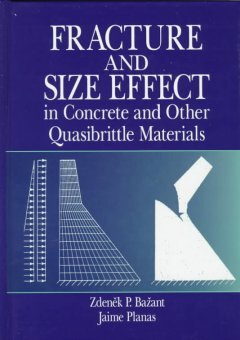
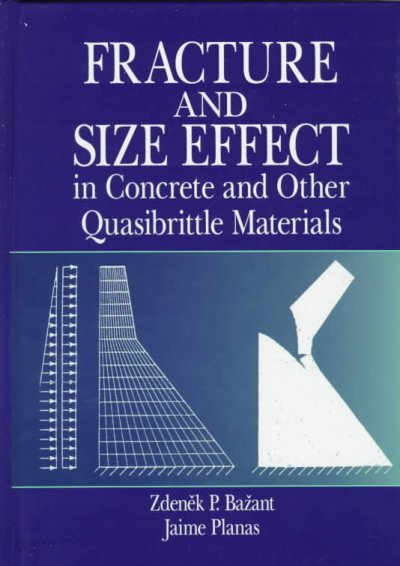
Fracture and Size Effect in Concrete and Other Quasibrittle Materials
Hardback, 1st Edition
Bazant, Zdenek P. / Bazant, Z. P. / Planas, Jaime
Routledge
1997.12.29.
- 주문 제작 (POD) 도서로 제본 및 인쇄 품질이 다소 미흡할 수 있습니다 (해당 사유 반품 불가)
이미 소장하고 있다면 판매해 보세요.
- 국내배송만 가능
- 해외 거래처 사정에 의하여 품절/지연 가능
- 도서 정보 중 미표기 사항 안내?
- 문화비소득공제 가능
New Directions in Civil Engineering
-
 Analysis and Software of Cylindrical Members 이동Analysis and Software of Cylindrical Members10% 97,170원
 -
Fracture and Size Effect in Concrete and Other Quasibrittle Materials 이동Fracture and Size Effect in Concrete and Other Quasibrittle Materials10% 587,250원
-
Artificial Intelligence and Expert Systems for Engineers 이동Artificial Intelligence and Expert Systems for Engineers10% 425,250원
-
Analysis and Software of Cylindrical Members 이동Analysis and Software of Cylindrical Members10% 425,250원
-
Response Spectrum Method in Seismic Analysis and Design of Structures 이동Response Spectrum Method in Seismic Analysis and Design of Structures10% 587,250원
책소개
목차
|
Why Fracture Mechanics?, Historical Perspective, Reasons for Fracture Mechanics Approach, Sources of Size Effect on Structural Strength, Quantification of Fracture Mechanics Size Effect, Experimental Evidence for Size Effect, Essentials of LEFM, Energy Release Rate and Fracture Energy, LEFM and Stress Intensity Factor, Size Effect in Plasticity and in LEFM, Determination of LEFM Parameters, Setting Up Solutions from Closed-Form Expressions, Approximate Energy-Based Methods, Numerical and Experimental Procedures to Obtain KI and G, Experimental Determination of KIc and Gf, Calculation of Displacements from KI-Expressions, Advanced Aspects of LEFM, Complex Variable Formulation of Plane Elasticity Problems, Plane Crack Problems and Westergaard's Stress Function, The General Near Tip Fields, Path-Independent Contour Integrals, Mixed Mode Fracture Criteria, Equivalent Elastic Cracks and R-Curves, Variability of Apparent Fracture Toughness for Concrete, Types of Fracture Behavior and Nonlinear Zone, The Equivalent Elastic Crack Concept, Fracture Toughness Determination Based on Equivalent Crack Concepts, Two Parameter Model of Jenq and Shah, R-Curves, Stability Analysis in the R-Curve Approach, Determination of Fracture Properties from Size Effect, Size Effect in Equivalent Elastic Crack Approximations, Size Effect Law in Relation to Fracture Characteristics, Size Effect Method: Detailed Experimental Procedures, Determination of R-Curve from Size Effect, Cohesive Crack Models, Basic Concepts in Cohesive Crack Model, Cohesive Crack Models Applied to Concrete, Experimental Determination of Cohesive Crack Properties, Pseudo-Boundary-Integral Methods for Mode I Crack Growth, Boundary-Integral Methods for Mode I Crack Growth, Crack Band Models and Smeared Cracking, Strain Localization in the Series Coupling Model, Localization of Strain in a Softening Bar, Basic Concepts in Crack Band Model
|
관련 분류
품목정보
- 발행일
- 1997년 12월 29일
- 쪽수, 무게, 크기
- 640쪽 | 1380g | 180*250mm
- ISBN13
- 9780849382840
사락 별점0
혜택 및 유의사항밑줄0
혜택 및 유의사항상품정보안내
직수입외서의 경우, 해외거래처에서 제공하는 정보가 부족하여 제목, 표지, 가격, 유통상태 등의 정보가 미비하거나 변경되는 경우가 있습니다. 정확한 확인을 원하시는 경우, 일대일 상담으로 문의하여 주시면 답변 드리겠습니다.
(판형과 판수 등이 다양한 도서는 찾으시는 도서의 ISBN을 알려 주시면 보다 빠르고 정확한 안내가 가능합니다.)
해외거래처에서 품절인 경우, 2차 거래선을 통해 유럽과 미국 출판사로 직접 수입이 진행될 수 있습니다.
수입 진행 시점으로 부터 2~3주가 추가로 소요되며, 해외에서도 유통이 원활하지 않은 도서는 품절 안내가 지연될 수 있습니다.
해당 경우, 문자와 메일로 별도 안내를 드리고 있사오니 마이페이지에서 휴대전화번호와 메일주소를 다시 한번 확인해주시기 바랍니다.
(판형과 판수 등이 다양한 도서는 찾으시는 도서의 ISBN을 알려 주시면 보다 빠르고 정확한 안내가 가능합니다.)
해외거래처에서 품절인 경우, 2차 거래선을 통해 유럽과 미국 출판사로 직접 수입이 진행될 수 있습니다.
수입 진행 시점으로 부터 2~3주가 추가로 소요되며, 해외에서도 유통이 원활하지 않은 도서는 품절 안내가 지연될 수 있습니다.
해당 경우, 문자와 메일로 별도 안내를 드리고 있사오니 마이페이지에서 휴대전화번호와 메일주소를 다시 한번 확인해주시기 바랍니다.
587,250원
총 1개
587,250원
