




이미 소장하고 있다면 판매해 보세요.
- 국내배송만 가능
- 문화비소득공제 가능
이 상품의 시리즈 4
이 상품의 시리즈 알림신청



목차
|
연도별 통사/의미론 기출 Themes & Items를 한 눈에~ 09
역대 통사/의미론 Sample Answers를 한 눈에 ~ 24 PART 1. Syntax CHAPTER 1. Constituency (성분성) & Categorization (범주성) 44 [S 1] Syntax & Constituent ※ [S 1] = [Section 1] 46 [1.1] Syntax 46 [1.2] Constituent 49 1.2.1. Informal Definition 49 1.2.2. Formal Definition 50 [S 2] Category 52 [2.1] Lexical Category {23.B.2} ※ { 년도. A/B형. 번호 }속은 기출정보임 53 2.1.1. Lexical Category의 유형과 정의 (N의 definition 등) 53 2.1.2. Lexical Category 설정근거 1: Syntactic Evidence 57 2.1.3. Lexical Category 설정근거 2: Non-syntactic Evidence 57 [2.2] Phrasal Category 61 2.2.1. Phrasal Category 설정근거 1: Syntactic Evidence 61 2.2.2. Phrasal Category 설정근거 2: Non-syntactic Evidence 62 [2.3] Role (Grammatically relational) Categories (+ 주어 등의 정의) 66 [2.4] Structural Categories (Head/Complement/Adjunct) 69 [S 3] Constituency Test 71 [3.1] Answer Test 71 [3.2] Substitution Test (Ellipsis included) {22.A.7}{14.A.서.4}{09.27}{08.공청.31} 71 [3.3] Coordination Test {22.A.7}{21.B.5}{18.A.12} 73 [3.4] Adverb Insertion Test 75 [3.5] Movement Test {14.A.서.4}{10.28번}{06.전국.7} 75 [3.6] Cleft/Pseudo-Cleft construction Test {21.B.5} 76 [3.7] Case Study (Phrasal/Prepositional verb의 성분성) {11.34번} 77 CHAPTER 2. Syntactic Structure (통사구조) 85 [S 1] Structural nature 88 [1.1] Linearity 88 [1.2] Hierarchy & PS Rules/Markers 89 1.2.1. Hierarchy 89 1.2.2. PS Rules/Markers (+dominate/precede/c-command) {20.A.6}{17.B.6} 90 [1.3] Ambiguity {24.B.5}{23.A.7}{20.A.6}{18.A.9}{11.30번}{06.서울.21} 93 [S 2] X-bar Structure {08.전국.15} 96 [2.1] X-bar structure: (one 대치, do-so 대치) {22.A.7}{09.27번} 96 [2.2] Complement/ Adjunct {22.A.7}{21.A.3}{16.B.6}{10.36}{09.32}{08.전국.15} 100 2.2.1. Adjacency Condition 100 2.2.1. Coordination 100 2.2.1. Stackability 101 2.2.1. Extraposition 101 [2.3] Specifier {20.B.1} 103 [S 3] More on X-bar Structure 105 [3.1] IP(TP) {07.서울.14}{19.A.9} 105 3.1.1. I(T) & IP(TP) 105 3.1.2. Finiteness {12.2차논술}{07.서울.14} 107 [3.2] C & CP {21.B.5}{18.A.12} 110 [S 4] Lexicon (Constraining X-bar structure) 113 [4.1] Categorial Feature 114 [4.2] Argument Structure & Subcategorization 115 [4.3] Selection {09.29번} 117 [4.4] Thematic Structure & D-structure {14.A.13}{12.21번}{08.서울.17} 121 CHAPTER 3. Transformation (구조 변형) 136 [S 1] Transformations of structures(Deep to Surface) 138 [1.1] Transformation 138 [1.2] Head-Movement 140 1.2.1. I(T)-Movement 140 1.2.2. V-Movement {22.B.2} 143 [1.3] WH-Movement 145 [1.4] NP-Movement 148 1.4.1. Passive (unaccusative) {25.A.7}{24.A.7}{14.A.서.4}{10.28번} 149 1.4.2. Raising {25.A.7} {12.21번} {10.32번} 150 [S 2] Other Transformations(Movements) 157 [2.1] Pre-posing/Extra-position 157 2.1.1. VP-preposing {19.A.9} 157 2.1.2 Topicalization(TopicP-preposing) 158 2.1.3. Extra-position {19.A.9} 159 [2.2] Particle movement 162 [2.3] Dative movement 164 CHAPTER 4. Rule & Theory(Principle, Condition, Constraint) 168 [S 1] Movement Constraints 170 [1.1] Coordinate Structure Constraint {22.A.7} {21.B.5} 170 [1.2] Unit movement Constraint 173 [1.3] Subjacency Constraint {22.B.5} 173 [1.4] Tensed-S Constraint 175 [S 2] Semantic constraints & ?-Theory (의미역 이론) 176 [2.1] Semantic Constraint (Selection) {07.전국.16} 176 [2.2] ?-Theory (Theta Criterion) {25.B.5} 178 [S 3] Case Theory (격 이론) {08.공청.19} {10.31번} {24.A.7} 183 [S 4] Binding Theory (결속 이론) {08.공청.30} {13.35} {15.10} {17.B.6} {18.B.6} 189 4.4.1 Definition of Binding (결속의 정의) 189 4.4.2 Binding Conditions (결속 조건들) 189 [S 5] Control Theory (통제 이론) {19.B.6} 198 [5.1] Raising/ Control predicate Construction {25.A.7} 198 [5.2] PRO Control Theory {19.B.6} 199 PART 2. Semantics & Pragmatics CHAPTER 1. Semantics (의미론) 205 [S 1] Lexical Semantics (어휘 의미론) 207 [1.1] Meaning 207 1.1.1. Reference & Sense 207 1.1.2. Semantic Feature 207 [1.2] Lexical Semantics 209 1.2.1. Synonyms 209 1.2.2. Antonyms {11.32번} 209 [S 2] Sentential Semantics (문장 의미론) 211 [2.1] Sentential Meaning 211 2.1.1. Compositional Semantics 211 2.1.2. Truth-Conditional Semantics 212 (1) Analytic & Synthetic Sentences 212 (2) Paraphrase 215 (3) Entailment & Implicative predicate {10.35번} {25.B.1} 215 (4) Presupposition & its Triggers (Factive verb) {06.전국.9} 220 [2.2] Sentential Ambiguity 222 2.2.1. Structural ambiguity {15.서술.4} {08.전국.18} 222 2.2.2. Scope ambiguity {18.A.9} {24.B.5} 223 CHAPTER 2. Pragmatics (화용론) 226 [S 1] Context (화맥) 228 [1.1] Context & Deixis {10.34번} 228 [1.2] Discourse Principles 230 1.2.1. End-Focus {08.공청.35} 230 1.2.2. End-Weight 231 [S 2] Maxim (격률) {09.35번} 232 [2.1] Maxim 232 [2.2] Maxim & Conversational Implicature {25.A.2} {13.33번} 232 2.2.1. Quantity Flouting & Implicature 232 2.2.2. Quality Flouting & Implicature 233 2.2.3. Relevance Flouting & Implicature 233 2.2.4. Manner Flouting & Implicature 233 [S 3] Speech Act (화행) {09.35번} 236 [3.1] 3-Type Speech Act {07.18번} 236 [3.2] Direct/Indirect Speech Act {12.34번} 239 [3.3] Classification of illocutionary acts 242 [3.4] Performative Verb 243 [3.5] Felicity Condition 244 부록1 실용(학교)문법 관련 기출문제 246 부록2 동의어 & 반의어 272 |
저자 소개 1
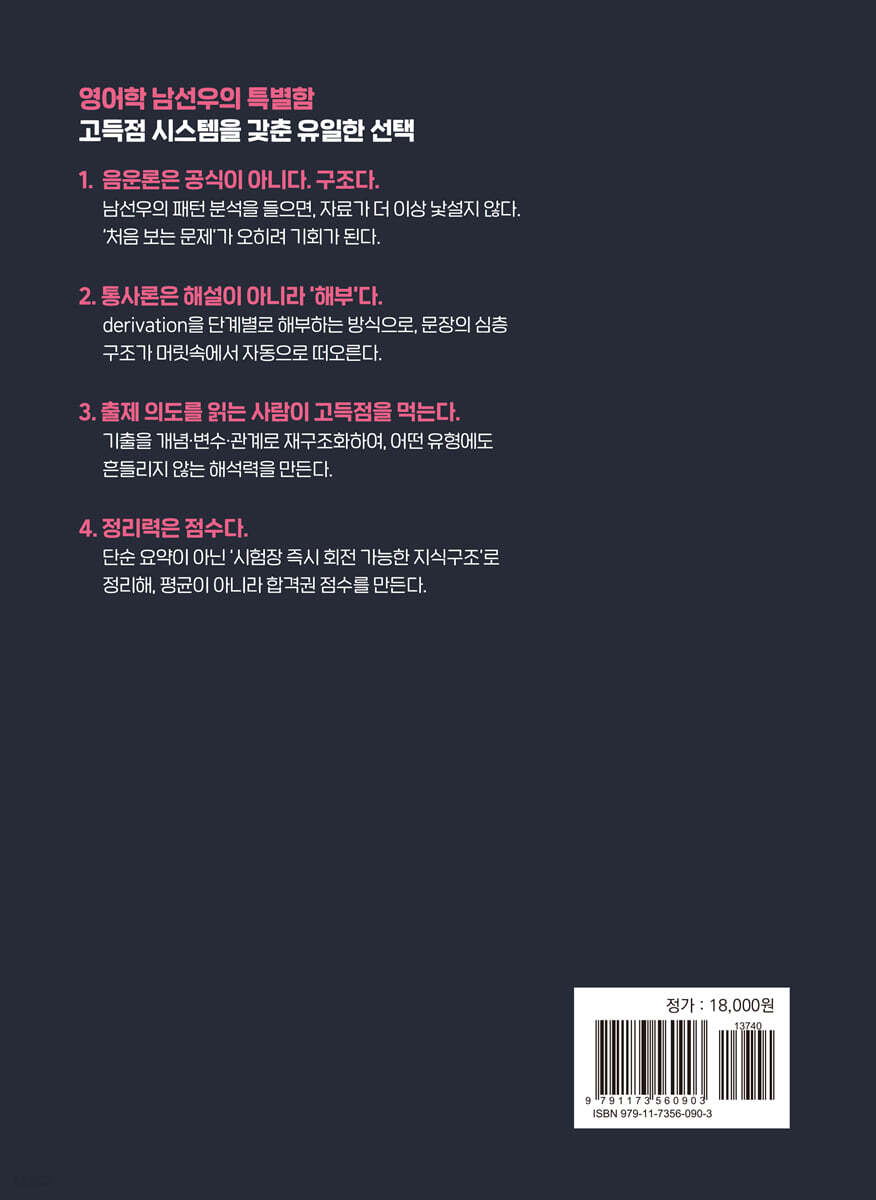
『THE 영어학 통사론 EDGE』의 저자이다.
남선우의 다른 상품





품목정보
- 발행일
- 2025년 12월 12일
- 쪽수, 무게, 크기
- 284쪽 | 190*260*20mm
- ISBN13
- 9791173560903