

이미 소장하고 있다면 판매해 보세요.
- 국내배송만 가능
- 문화비소득공제 가능
이 상품의 태그
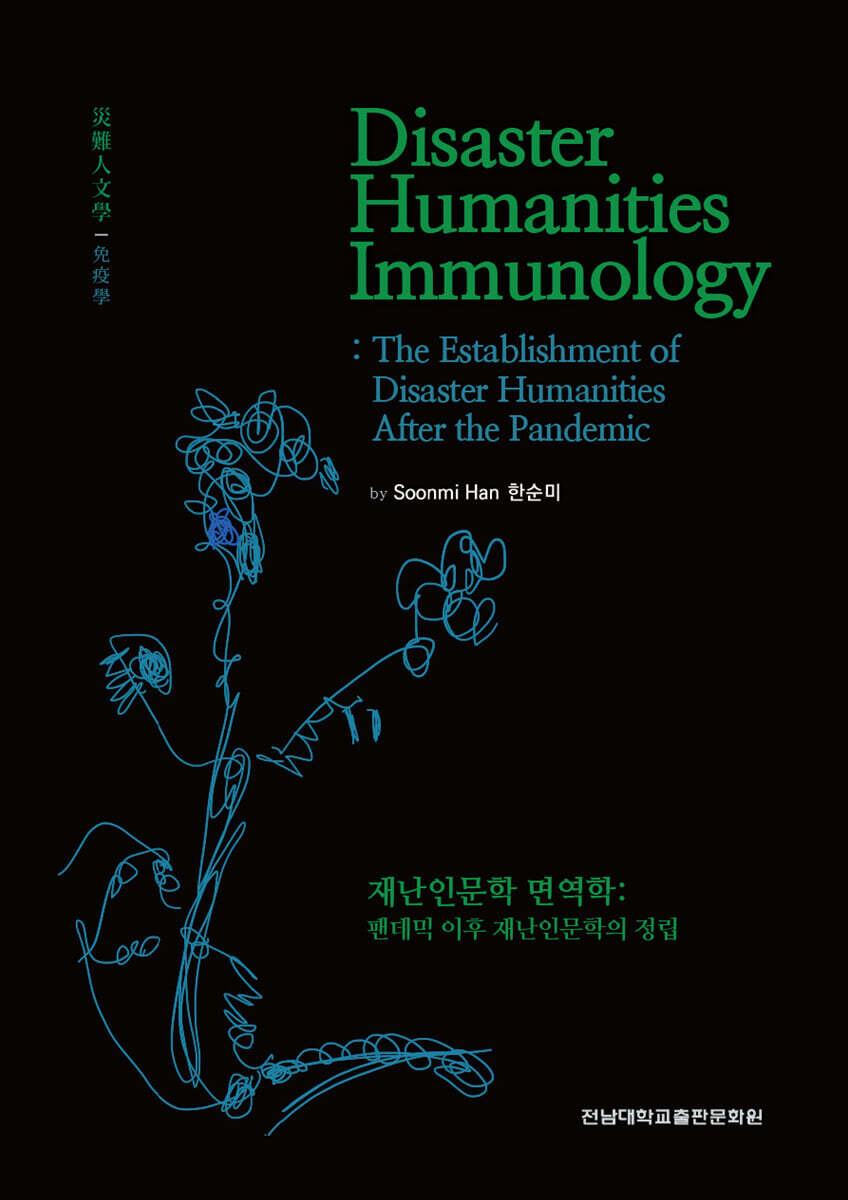
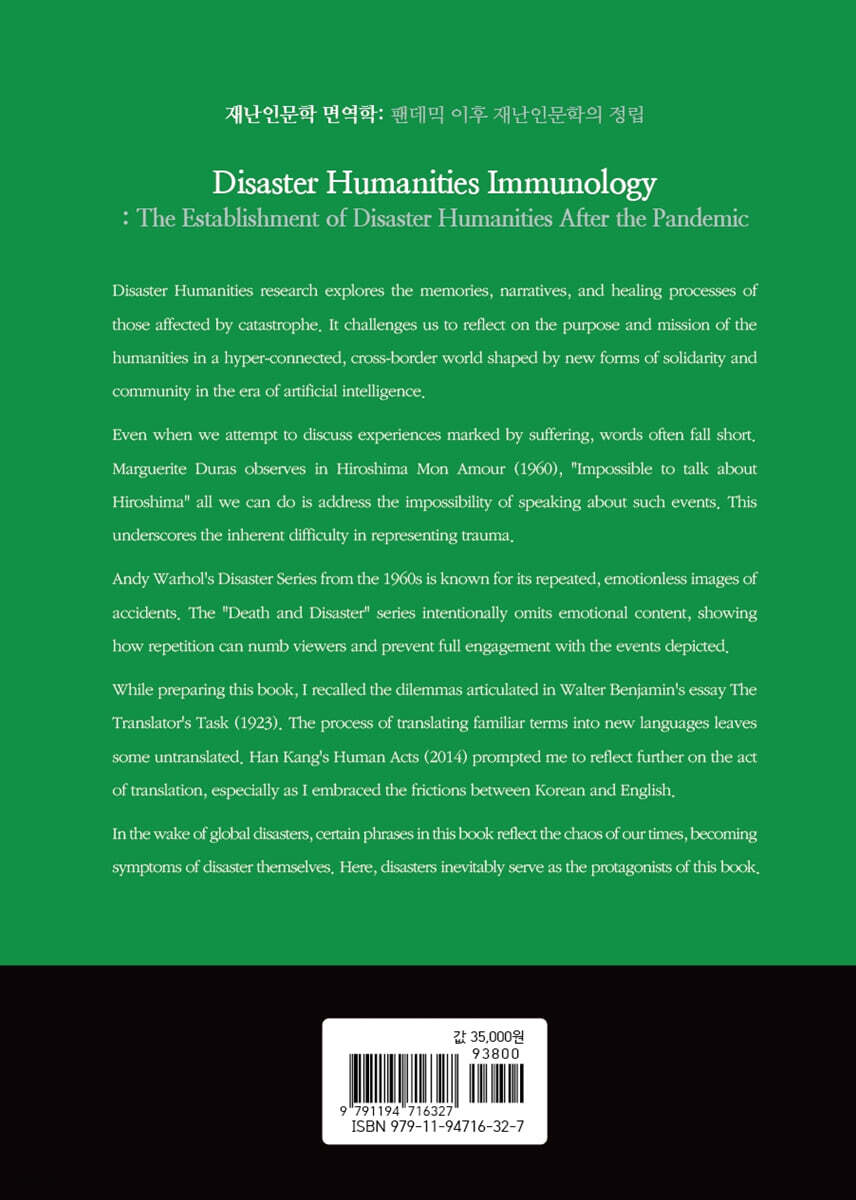
책소개
목차
|
ㆍRecommendations / 4
ㆍAcknowledgement / 6 ㆍPreface: Disaster Humanities/Humanities Immunology / 10 # Immune: "Immunity/Hypersensitivity" / 10 # Disaster Humanities is Ultimately Humanities Immunology / 11 # Words Infected With a Virus / 12 # Disasters Are The Protagonists of This Book, 'Inevitably' / 13 PART 1 Navigating Disaster Humanities After the Pandemic: Essential Questions and New Approaches Ⅰ. Along with Disasters, the Post-Disaster Society / 24 Ⅱ. Connection and Solidarity / 36 PART 2-1 Disaster Humanities as a Multifocal Lens: How to Think about Post-Disaster Society Ⅰ. Sensitive Tentacles of Thought that Trace the Scars Left by Disasters / 8 Ⅱ. Stories That Blossomed From the Pandemic: The Infinite Possibilities of Conversation / 52 PART 2-2 Disaster Humanities as a Multifocal Lens: How to Represent Post-Disaster Society Ⅰ. How to "Use" Love: 1980 May 18, To Transcribe Your Memories / 58 Ⅱ. Interface and Interconnection as Healing Rituals: Sensory Representations of Trauma / 76 Ⅲ. Nothing Disappeared: The Representation of Disaster Trauma and Testimony as the Image / 94 PART 3 Body and Handicapped: Interpreting Korean Hansen's Disease Memories and Records Ⅰ. Faces of a Korean Hansen's Disease Patient: Stories of Double Expelled / 112 Ⅱ. Social Integration for Recovered Patients: Multiple Perspectives / 129 PART 4 Local and Global Perspectives on Infectious Disease Disaster: Examining Korean Hansen's Disease Memories and Records Ⅰ. Telling with "You": Designing the Enlightenment Project of Hansen's Disease Listening from the Autobiographical Memory of Dr. Joon Lew / 154 Ⅱ. Disaster Healing Communities Grounded in Spirituality in a Cross-Border, Hyper-Connected Era: The Leprosy Treatment Project in Kangwon Province Since the 1960s / 172 Ⅲ. DDS (Diaminodiphenyl sulfone) and Cosmetics: Exploring the Life History of Hansen's Disease Sanatoriums, Focusing on National Sorokdo Hospital / 190 ㆍAppendix 1_Disaster Humanities: The Memory, Narrative, and Healing of East Asian Disaster 재난인문학: 동아시아 재난의 기억, 서사, 치유 / 216 ㆍAppendix 2_After Walking Through Ashes: How Can Disaster Become an Agenda of Humanities 잿빛을 통과한 그날 이후: 재난은 어떻게 인문학의 주제가 될 수 있는가? / 233 ㆍAppendix 3_Primary Sources (2018-2025): Disaster Humanities Research Abstract / 270 ㆍBibliography / 292 ㆍGlossary / 324 ㆍArticle List / 343 ㆍEndnote / 347 |
저자 소개 1
전남대학교 인문대학 국어국문학과에서 <이청준 소설의 언어 인식 연구>로 박사학위를 받았다. 전남대학교 호남학연구원 HK연구교수를 지냈으며 현재 조선대학교 인문학연구원 교수로 재직하고 있다. 한국근현대문학 및 문화, 한센병 역사문화 기록 연구를 비롯해 재난인문학, 트라우마의 재현과 치유, 소수자 타자의 서사에 관심을 두고 있다.
대표적인 논문과 저서로는 『우리 시대의 사랑』(공저), 『미적 근대의 주변부: 추방당한 자들의 귀환』, 『다초점 렌즈로서의 재난인문학:그물망과 교차점』, 「“달과 별이 없어도 밝은 밤”-한센병의 감각과 증언」, 「위생, 안보, 복지: 1970년대 나
전남대학교 인문대학 국어국문학과에서 <이청준 소설의 언어 인식 연구>로 박사학위를 받았다. 전남대학교 호남학연구원 HK연구교수를 지냈으며 현재 조선대학교 인문학연구원 교수로 재직하고 있다. 한국근현대문학 및 문화, 한센병 역사문화 기록 연구를 비롯해 재난인문학, 트라우마의 재현과 치유, 소수자 타자의 서사에 관심을 두고 있다.
대표적인 논문과 저서로는 『우리 시대의 사랑』(공저), 『미적 근대의 주변부: 추방당한 자들의 귀환』, 『다초점 렌즈로서의 재난인문학:그물망과 교차점』, 「“달과 별이 없어도 밝은 밤”-한센병의 감각과 증언」, 「위생, 안보, 복지: 1970년대 나병 계몽 운동의 변곡점-잡지 『새빛』 수록 나병 계몽 운동 자료 검토(1970~1979)」 등이 있다.
대표적인 논문과 저서로는 『우리 시대의 사랑』(공저), 『미적 근대의 주변부: 추방당한 자들의 귀환』, 『다초점 렌즈로서의 재난인문학:그물망과 교차점』, 「“달과 별이 없어도 밝은 밤”-한센병의 감각과 증언」, 「위생, 안보, 복지: 1970년대 나병 계몽 운동의 변곡점-잡지 『새빛』 수록 나병 계몽 운동 자료 검토(1970~1979)」 등이 있다.
한순미의 다른 상품

관련 분류
- 카테고리 분류
품목정보
- 발행일
- 2025년 11월 28일
- 쪽수, 무게, 크기
- 364쪽 | 152*215*30mm
- ISBN13
- 9791194716327
책 속으로
|
1. Trauma that Persists:
Along with Disasters, the Post-Disaster Society Who is responsible for documenting memories of profound pain? Uncertain casualty counts highlight the scale of the disaster. After a catastrophe, people are classified as dead, missing, witnesses, or survivors. Preserving disaster memories relies on historical records, testimonies, media, and art. This documentation strengthens com- munity cohesion and supports recovery. Trauma endures long after disasters. Ruins remain, and entire communities may disappear without a trace. Formerly accessible paths are blocked, boundaries are unclear, and time feels disrupted. Ruins evoke memories of disasters; still, the future remains uncertain. Disasters alter both the environment and our perceptions. Daily life is shaped by memories and trauma of catastrophe. Ongoing trauma prompts new questions about humanity, society, history, and our world. Disasters worldwide, past and present, reshape our reality. Events such as earthquakes, volcanic eruptions, famines, heat waves, climate change, epidemics, and historical disasters like the 5.18 Gwangju Uprising, the Killing Fields, Hiroshima, Auschwitz, Chernobyl, and Fukushima influence the lasting impact of global crises. Post-disaster societies experience disorder and chaos. Disasters in the past remind us of significant events such as the Jeju April 3 Incident, the May 18 Gwangju Uprising, the April 16 Sewol Ferry Disaster, the September 11 attacks, and the March 11 East Japan Earthquake. Also, incidents including the 2014 Sewol Ferry Disaster, MERS and SARS outbreaks, and the 2016 and 2017 Gyeongju and Pohang earthquakes, show that our environments remain vulnerable. Nothing disappears after a disaster. We must carefully consider how to address the aftermath. In this context, the responses of intel- lectuals following the April 16 Sewol Ferry Disaster and the March 11 East Japan Earthquake are particularly noteworthy. 2. Thinking With/In Pain Since the Fourth Industrial Revolution, relationships among humans, machines, and other beings have become central to the humanities. These changes encourage us to reconsider what defines humanity and gives life value. Disasters disrupt daily life and deepen our reflection on these questions, challenging and reshaping our understanding of what it means to be human. Disaster Humanities research examines the experiences of those affected by disasters, prompting us to reconsider the concept of 'human.' In the age of Artificial Intelligence, understanding the meaning and role of Disaster Humanities is closely linked to how disasters reshape our views on human value and existence. French philosopher Maurice Blanchot proposed 'the writing of the disaster (L'Ecriture du desastre)' in response to Auschwitz. For Blanchot, disaster is not only an event, but an inherent part of human existence. He states that humans already live with or within disaster. Blanchot writes, 'We must learn to think with/in pain. … we must think, and we must not be sure of our thinking.' During ongoing disasters, we seek clarity and logic despite suffering. Our thoughts remain uncertain, yet we continue to yearn for stability when disaster strikes. Our thoughts and words become restless and chaotic. Thinking resembles the probing tentacles of a sea anemone: searching, swallowing, and moving. This process changes how we perceive the world. I recall reading about the sinking of the Sewol ferry on April 16, 2014, and watching the events that morning. For those who witnessed the disaster, the memory of those who did not return is unfor- gettable and leaves lasting trauma. 3. Cross-Reading the Memory/Record of a Disaster: The Main Research Topics and Methodologies of Disaster Humanities The primary research topics, subjects, and methodologies in Disaster Humanities can be grouped as follows. A humanities approach to historical disaster records focuses on how disasters shape human experience, memory, and narrative, rather than simply collecting or classifying materials. After a disaster, we interpret urgent situations by documenting the fragments that remain. While existing records provide a chronological overview of responses, they often lack detailed accounts of the disaster itself. Comparing diverse records can reveal more specific aspects of global disasters. Natural, social, and historical disasters often intersect. Infectious diseases may arise alongside political and social changes, including war, terror, and revolution. Studying the history of infectious diseases involves examining their causes, societal responses, and changes in management policies and systems. A humanities-based disaster archives differs from research on survival strategies, safeguards, or management systems. Disaster Humanities explores historical, social, and cultural changes in individuals, communities, and the contexts where disasters become routine. This approach traces how disasters have transformed human life and evokes reflection on what it means to be human, a nation, and a global community. 4. Art and Culture in the Wake of Disaster: Healing Through Samguk Yusa (Korea) and Shan Hai Jing, the Classic of Mountains and Seas (China) The Korean classic Samguk Yusa (三國遺事) contains rituals, beliefs, songs, myths, and legends, including stories of overcoming and healing from disasters. The legend of Manpasikjeok (萬波息笛) high- lights the role of music in disaster response. The flute's name signifies that when played, "droughts rain, rainfall discontinues, winds calm, and waves subside." This story illustrates the belief that music can resolve disasters and alleviate fear. The hyangga (鄕歌) "Hyeseongga (彗星歌)," sung by the monk Yungcheonsa (融天師) of the Silla dynasty (新羅), symbolized efforts to resolve the disaster of two comets appearing in the sky. The Silla people viewed two comets as an ominous sign. Hyeseongga's narrative shows how they addressed the appearance of two comets, the King's political crisis, and a Japanese pirate invasion. These connections between astronomical events and political turmoil highlight the importance of music and storytelling in mediating disaster and restoring order. The Chinese classic Shan Hai Jing (山海經) can also be examined from a Disaster Humanities perspective. Rich in imagery and stories, it has influenced East Asian literature and art. The text offers unique interpretations of places, customs, medicine, fortune-telling, and religious rituals in ancient China and neighboring regions. For example, the following passage describes various creatures, their traits, diseases, treatments, and responses to disasters. --- 「Ⅰ. Along with Disasters, the Post-Disaster Society」 중에서 |
사락 별점0
혜택 및 유의사항밑줄0
혜택 및 유의사항
33,250원
총 1개
33,250원