
이미 소장하고 있다면 판매해 보세요.
- 국내배송만 가능
- 문화비소득공제 가능
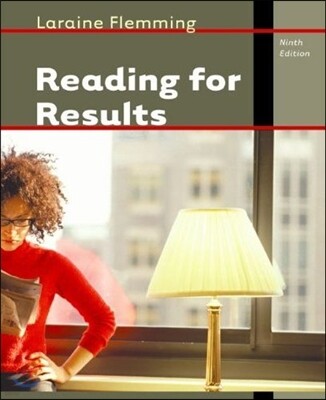
이 상품의 시리즈 2
이 상품의 시리즈 알림신청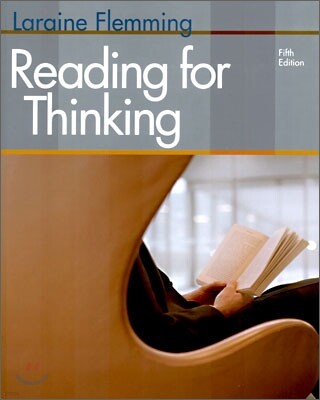
책소개
목차
|
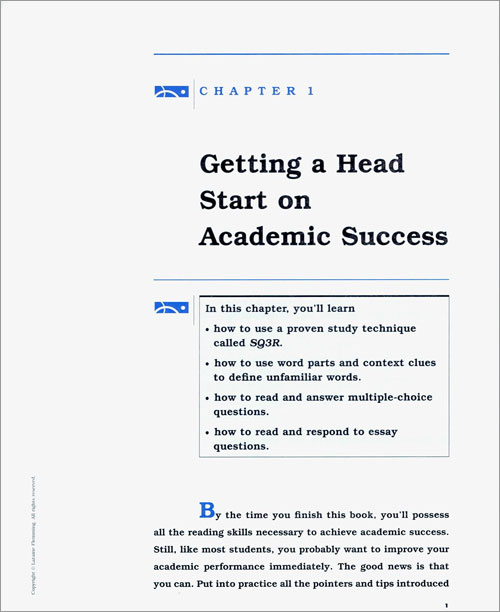
1. Getting a Head Start on Academic Success
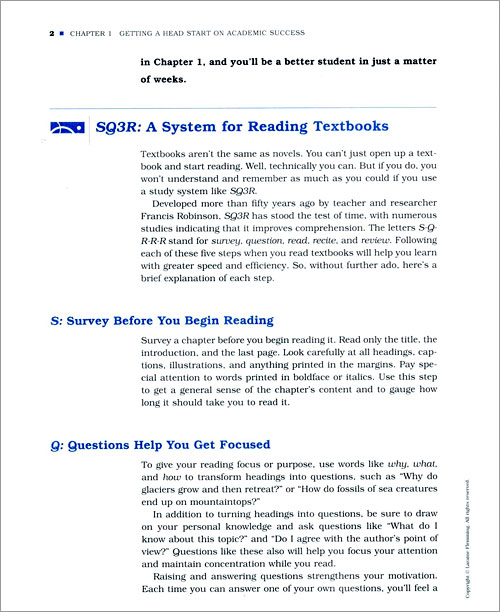
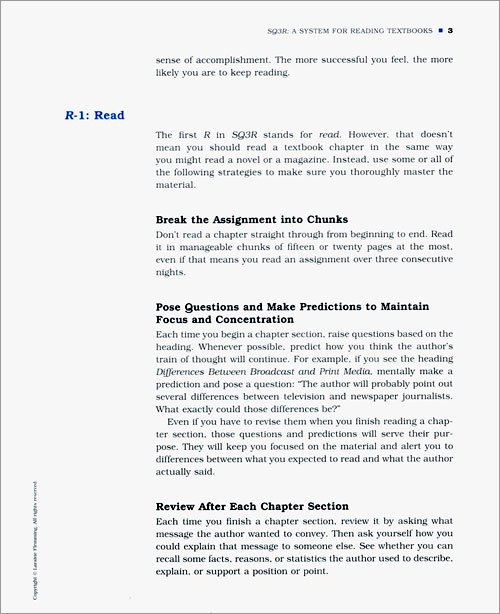
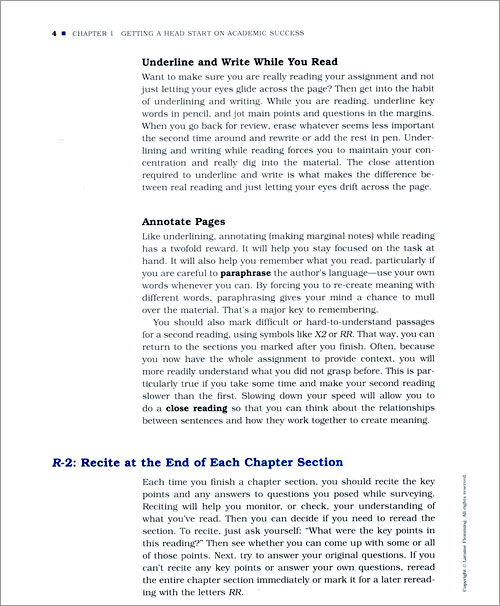
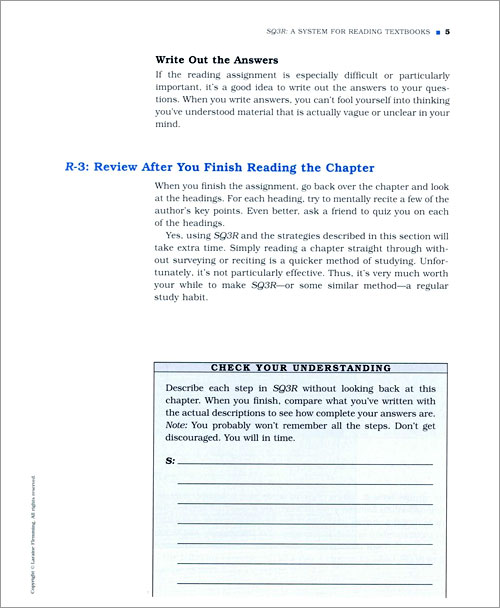
SQ3R: A System for Reading Textbooks Adapting SQ3R to Shorter Readings Building Your Academic Vocabulary Using Context Clues Turning to the Dictionary Reading and Responding to Multiple Choice Reading and Responding to Essay Questions Digging Deeper: The New Case for Latin Word Notes: One Prefix, Many Meanings Test 1: Reviewing the Key Points Test 2: Using SQ3R Test 3: Using Context Clues Test 4: Using Context Clues and Word Parts 2. Power Tools for Learning: Annotating and Paraphrasing Annotating Pages Good and Bad Paraphrasing Paraphrasing and Plagiarism Digging Deeper: Ethics in America Word Notes: Morals and Mores Test 1: Reviewing the Key Points Test 2: Recognizing an Accurate Paraphrase Test 3: Recognizing an Accurate Paraphrase Test 4: Paraphrasing with Accuracy 3. Reviewing Paragraph Essentials Starting with the Topic From Topic to Main Idea Recognizing Topic Sentences The Function of Supporting Details Recognizing Patterns of Organization Digging Deeper: Mr. Polk's War Word Notes: Words and Myths Test 1: Reviewing the Key Points Test 2: Recognizing Topic Sentences Test 3: Recognizing Topic Sentences and Evaluating Paraphrases Test 4: Recognizing and Paraphrasing Topic Sentences Test 5: Topic Sentences and Supporting Details Test 6: Recognizing Organizational Patterns Test 7: Recognizing Organizational Patterns Test 8: Taking Stock 4. Understanding and Outlining Longer Readings Understanding Longer Readings Major and Minor Details Thesis Statements and Major Details Outlining Longer Readings Digging Deeper: The Tragedy of Japanese Internment Word Notes: Two Commonly Confused Words Test 1: Reviewing the Key Points Test 2: Underlining Thesis Statements Test 3: Thesis Statements and Supporting Details Test 4: Outlining Longer Readings Test 5: Thesis Statements and Supporting Details Test 6: Taking Stock 5. Summarizing and Synthesizing: Two More Strategies for In-Depth Learning Writing Chapter Summaries Reviewing Through Summary Writing Synthesizing Sources Digging Deeper, Reading 1: Reexamining Truman's Motives Digging Deeper, Reading 2: Truman's Choice Word Notes: Borrowing from the French Test 1: Reviewing the Key Points Test 2: Selecting the Better Summary Test 3: Writing Summaries Test 4: Writing Synthesis Statements Test 5: Taking Stock 6. Reading Between the Lines: Drawing Inferences and Conclusions Inferring Main Ideas in Paragraphs Implied Main Ideas in Longer Readings Inferring Supporting Details Drawing Logical Conclusions Digging Deeper: Doris Haddock's Recipe for Political Reform Word Notes: Pun Intended Test 1: Reviewing the Key Points Test 2: Recognizing Effective Inferences Test 3: Recognizing Effective Inferences Test 4: Drawing an Effective Inference Test 5: Inferring Supporting Details Test 6: Drawing Your Own Conclusions Test 7: Recognizing Implied Main Ideas in Longer Readings Test 8: Inferring Implied Main Ideas in Longer Readings Test 9: Taking Stock 7. Defining the Terms Fact and Opinion Facts Versus Opinions Connotative Language Is a Clue Informed Versus Uninformed Opinions Fact and Opinion in Textbooks Digging Deeper: Policing the Language Word Notes: Searching for Truth Test 1: Reviewing the Key Points Test 2: Distinguishing Between Fact and Opinion Test 3: Recognizing Informed and Uninformed Opinions Test 4: Recognizing Circular Reasoning and Irrelevant Facts Test 5: Taking Stock 8. Identifying Purpose and Tone Understanding the Difference Between Informative Writing and Persuasive Writing The Importance of Purpose Predicting Purpose The Main Idea Is the Clincher The Effect of Purpose on Tone Learning to Recognize Irony Digging Deeper: Bilingual Education Word Notes: Types of Irony Test 1: Reviewing the Key Points Test 2: Identifying Purpose and Tone Test 3: Recognizing Purpose and Tone Test 4: Taking Stock 9. Recognizing and Evaluating Bias Bias and Context Recognizing Bias in Informative Writing Responding to Bias in Persuasive Writing Bias and Careless Thinking Digging Deeper: The Ethics of Television Talk Shows Word Notes: Berating Synonyms Test 1: Reviewing the Key Points Test 2: Recognizing Bias Test 3: Taking Stock 10. Understanding and Evaluating Arguments What's the Point of the Argument? Four Common Types of Support Flawed Arguments Identifying the Opposing Point of View Digging Deeper: Eat French Fries at Your Peril Word Notes: Speaking of Sanctions Test 1: Reviewing the Key Points Test 2: Analyzing Arguments Test 3: Analyzing Arguments Test 4: Analyzing Arguments Test 5: Taking Stock Putting It All Together Reading 1. Becoming an Ethical Thinker, Joseph Turow Reading 2. Conformity, Compliance, and Obedience, Douglas Bernstein and Peggy Nash Reading 3. Culture and Communication, Joseph DeVito Reading 4. Tall Tales of Appalachia, John O'Brien Reading 5. Five Ways to Deal with Conflict and the Art of Apologizing, Roy Berko, Andrew D. Wolvin, and Darlyn R. Wolvin Reading 6. Extreme Philanthropy, Stephanie Strom Reading 7. Understanding Cultural Metaphors, Martin J. Gannon Reading 8. The Role of the Group in Japan, Martin J. Gannon |
저자 소개
저자 : Laraine E. Flemming
After receiving her B.S. at Southern Connecticut State University, where she was certified as a teacher of secondary reading, Laraine Flemming went on to earn an M.A. in English literature at Boston College and a Ph.D. in American literature at the State University of New York in Buffalo. During her career, Flemming has taught students from elementary to graduate school--covering subjects as varied as reading and writing, American literature, time management, speed reading, and study skills. She began writing textbooks while working as Director of the Reading and Writing Center at Dean Junior College. In need of a reading textbook that had lots of exercises combined with genuinely thought-provoking readings, Flemming decided to write her own. You can contact Laraine Flemming by visiting her website at http://www.laflemm.com.
품목정보
- 발행일
- 2006년 01월 01일
- 쪽수, 무게, 크기
- 651쪽 | 크기확인중
- ISBN13
- 9780618528691
출판사 리뷰
|
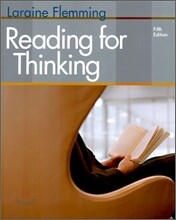
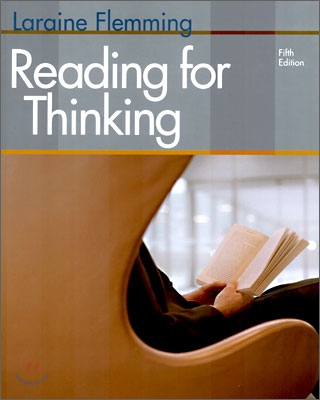
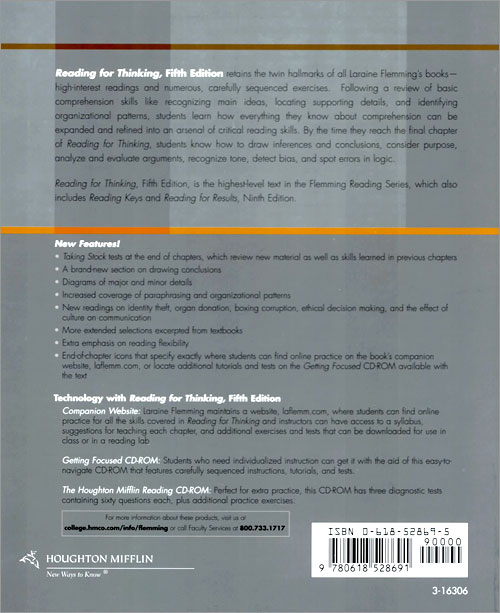
The Fifth Edition of Reading for Thinking continues to focus on developing students' comprehension and critical-thinking skills. Flemming uses a carefully designed sequence of explanations and exercises that allows students to approach critical reading as a natural extension of essential comprehension skills, rather than a discrete set of new strategies. Armed with the ability to both analyze and evaluate a writer's work, students are encouraged to apply those twin intellectual tools to Flemming's trademark high-interest readings to determine purpose, analyze evidence, detect bias, recognize tone, and compare opposing points of view.
- "Taking Stock" tests quiz students on new material while reviewing the skills they acquired in previous chapters. - New! Material on drawing conclusions and paraphrasing has been added, and coverage of organizational patterns, allusions, and reading flexibility has been increased. - New! Updated readings feature high-interest topics including ethical decision making, the effect of culture on communication, and the growing problem of identity theft. - New! The Fifth Edition features additional extended selections drawn from textbook sources. - New! Text Icons direct students to both the Reading for Thinking Web Site and the Getting Focused CD-ROM for additional exercises, reviews, and tests. - Lively, informative readings encourage critical thinking and discussion. - Clear explanations are accompanied by numerous models, illustrations, and writing assignments. - A clean layout makes it easy for students to read, grasp, and remember the information. |
사락 별점0
혜택 및 유의사항밑줄0
혜택 및 유의사항상품정보안내
직수입외서의 경우, 해외거래처에서 제공하는 정보가 부족하여 제목, 표지, 가격, 유통상태 등의 정보가 미비하거나 변경되는 경우가 있습니다. 정확한 확인을 원하시는 경우, 일대일 상담으로 문의하여 주시면 답변 드리겠습니다.
(판형과 판수 등이 다양한 도서는 찾으시는 도서의 ISBN을 알려 주시면 보다 빠르고 정확한 안내가 가능합니다.)
해외거래처에서 품절인 경우, 2차 거래선을 통해 유럽과 미국 출판사로 직접 수입이 진행될 수 있습니다.
수입 진행 시점으로 부터 2~3주가 추가로 소요되며, 해외에서도 유통이 원활하지 않은 도서는 품절 안내가 지연될 수 있습니다.
해당 경우, 문자와 메일로 별도 안내를 드리고 있사오니 마이페이지에서 휴대전화번호와 메일주소를 다시 한번 확인해주시기 바랍니다.
(판형과 판수 등이 다양한 도서는 찾으시는 도서의 ISBN을 알려 주시면 보다 빠르고 정확한 안내가 가능합니다.)
해외거래처에서 품절인 경우, 2차 거래선을 통해 유럽과 미국 출판사로 직접 수입이 진행될 수 있습니다.
수입 진행 시점으로 부터 2~3주가 추가로 소요되며, 해외에서도 유통이 원활하지 않은 도서는 품절 안내가 지연될 수 있습니다.
해당 경우, 문자와 메일로 별도 안내를 드리고 있사오니 마이페이지에서 휴대전화번호와 메일주소를 다시 한번 확인해주시기 바랍니다.