

소득공제
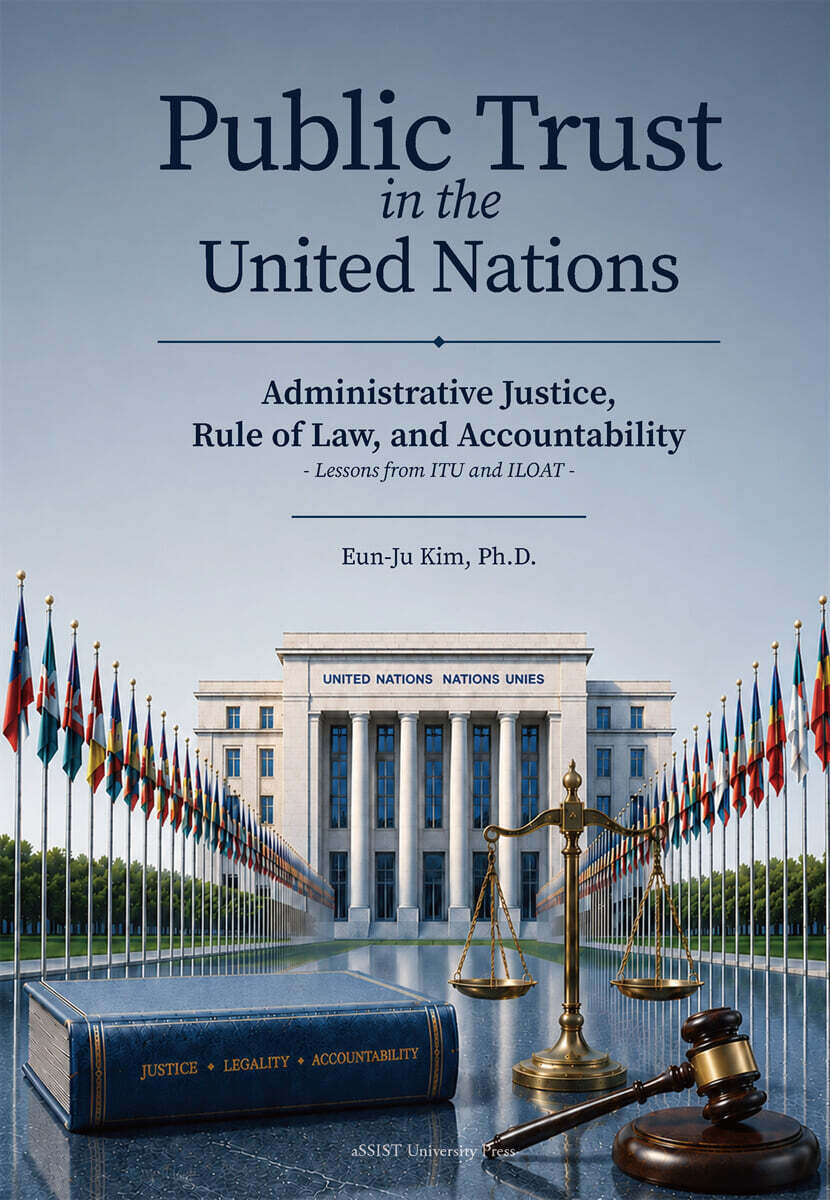
Public Trust in the United Nations
Administrative Justice, Rule of Law, and Accountability - Lessons from ITU and ILOAT-
aSSIST University Press
2026.08.31.
- 국내배송만 가능
- 예약상품과 함께 주문 시 제품 출시일에 함께 배송됩니다. (제작사의 사정으로 출시 지연 가능)
- 문화비소득공제 가능
책소개
목차
|
TABLE OF CONTENTS
FRONT MATTER Copyright Disclaimer Foreword Prologue Acknowledgements Table of Contents PART I Foundations: Public Trust in the United Nations CHAPTER 1 Introduction: Administrative Justice, Rule of Law, and Accountability A. The United Nations and the Evolution of Global Governance B. The Rule of Law and Accountability in International Organizations C. The ILOAT and the Evolution of Jurisprudence in International Administrative Justice Table 1.1. Indicative ILOAT Judgment-Volume Profile for Selected High-Volume Organizations (16 July 2026) Table 1.2. Trends in International Administrative Justice: ILOAT Cases by Decade Table 1.3. Principal Categories of Administrative Disputes Before the ILOAT D. The ITU as a Case Study in Governance in the Digital Era Table 1.4. Evolution of the ITU: From Global Telecommunications to Digital Transformation Table 1.5. Evolution of ITU-Related Cases before the ILOAT (16 July 2020) Table 1.6. Changing Nature of ITU-Related Disputes Table 1.7. Selected Post-2019 ILOAT Judgments Relevant to ITU Governance E. Objectives, Scope, and Methodology F. Literature Review and Theoretical Positioning G. Structure of the Book PART II Lessons from ILOAT Jurisprudence: ITU as a Case Study in Administrative Justice, Rule of Law, and Accountability CHAPTER 2 Administrative Justice and Due Process: Lessons from ILOAT Judgments Nos. 4832 and 5117 A. Case Study I: ILOAT Judgment No. 4832 B. Case Study I: ILOAT Judgment No. 5117 C. Case Study I: Facts of the Case D. Case Study I: Analysis of the Proceedings and ILOAT Jurisprudence - Introduction: From Fraud to Administrative Justice - Methodological Caution: Judicial Findings, Factual Record, and Analytical Inference - Institutional Governance, Internal Controls, and the Attribution of Responsibility - Due Process and the Unlawful Additional Layer of Investigation - Evidence, Serious Misconduct, Gross Negligence, and the Standard of Proof - Proportionality, Human Dignity, and Consequential Harm - Advisory Bodies, Executive Authority, and Reasoned Decision-Making - Judgment Implementation, Remedial Precision, and Judgment No. 5117 - Interconnection with Judgments Nos. 5118, 5213, and 5214 - Accountability, Leadership Responsibility, Financial Stewardship, and Public Trust - Lessons for International Organizations and Future Generations - Conclusion: Administrative Justice as Lawful Process, Effective Remedy, and Institutional Learning Table 2.1. Summary of Core Lessons and Cross-Chapter Connections CHAPTER 3 The Rule of Law and Investigative Duties: Lessons from ILOAT Judgments Nos. 5118 and 5213 A. Case Study II: ILOAT Judgment No. 5118 B. Case Study II: ILOAT Judgment No. 5213 C. Case Study II: Facts of the Case D. Case Study II: Analysis of the Proceedings and ILOAT Jurisprudence - Introduction: From a Harassment Complaint to a Rule-of-Law Failure - Methodological Caution: Judicial Findings, Allegations, and Analytical Inference - The Governing Rule: Mandatory Investigation Was Not Optional - Non-Retroactivity, Regulatory Gaps, and Unequal Procedural Protection in the Over sight Rules - Repeated Closure, Bifurcation, and Res Judicata - The Pleaded Pattern and the Need for Cumulative Fact-Finding - Investigative Asymmetry, Equality Before Internal Law, and Leadership Accountability - Motive, Institutional Incentives, and Geopolitical Context: Questions, Not Findings - The ILOAT’s Judicial Role: Judicial Correction, Principled Deference, and Effective Remedy - Procedural Burden, Institutional Harm, Financial Stewardship, and Public Trust - Interconnection with Judgments Nos. 4832, 5117, and the Later Chapters - Lessons for International Organizations, Member States, and Future Generations - Conclusion: Effective Judicial Protection and Accountability Table 3.1. Summary of Core Lessons and Cross-Chapter Connections CHAPTER 4 Accountability and Leadership Responsibility: Lessons from ILOAT Judgment No. 5214 A. Case Study III: ILOAT Judgment No. 5214 B. Case Study III: Facts of the Case C. Case Study III: Analysis of the Proceedings and ILOAT Jurisprudence - Introduction: Accountability Beyond the Outcome of a Single Case - Methodological Caution: Judicial Findings, Documentary Facts, and Analytical Inference - Judgment No. 5214: Governing Framework, Holdings, and Narrow Legal Effect - The Judicially Established Context: Judgments Nos. 4832, 5118, and 5213 - The Accountability Threshold: Prima Facie Review and the Manifest-Error Standard - Apparent Tension among the Judgments and the Temporal Qualification - Judgments Nos. 4516 and 5214: Two Different Preliminary-Review Frameworks - Leadership Responsibility, Investigative Asymmetry, and Equal Application of the Rules - Conflict of Interest, Structural Independence, and the Appearance of Fairness - Procedural Integrity: Routing, Delay, Disclosure, Decision-Making Authority, and Internal Appeal - Discrimination, Abuse of Authority, and the Need for Cumulative Analysis - The ILOAT’s Judicial Role: Deference, Coherence, and Effective Accountability - Institutional Accountability, Reform, and Member State Oversight - Lessons for International Organizations, Member States, and Future Generations - Conclusion: From Administrative Legality to Accountable Governance Table 4.1. Summary of Core Findings, Analytical Tensions, and Cross-Chapter Lessons PART III Toward Governance Reform in the United Nations CHAPTER 5 Conclusion: Rebuilding Public Trust in the United Nations Integrated Analysis and Conclusions A. Rule of Law, Accountability, and Transparency B. Oversight and Institutional Integrity C. Member States and Governance Responsibilities D. Governance Reform in the UN System 1. Strengthen independent, equal, and timely investigation of allegations in accordance with the rule of law 2. Define responsibilities and decision-making authority clearly 3. Mandatory investigative obligations must not be circumvented 4. Strengthen implementation of judgments and oversight recommendations 5. Increase transparency while protecting confidentiality and due process 6. Strengthen financial accountability in exceptional cases 7. Reconsider the adequacy of the international administrative justice framework 8. Strengthen the ILOAT’s role in judicial correction, principled deference, and effective remedy E. Trust, Legitimacy, and Organizational Credibility F. Financial Implications, Legal Costs, and Stewardship of Public Resources Table 5.1. Financial Accountability and Governance Lessons for UN Reform G. The Future of United Nations Values, Digital Governance, and Institutional Survivability H. Thirteen Integrated Conclusions for Governance Reform and Future Generations 1. Internal law must bind the institution itself 2. Due process requires timely access to essential evidence 3. Accountability must distinguish systemic failure from individual misconduct 4. The evidentiary threshold must match the procedural stage 5. Mandatory investigations cannot be replaced by procedural substitution 6. Allegations involving elected officials require demonstrable structural independence 7. Cumulative allegations require cumulative fact-finding 8. Internal appeals and ILOAT review must be independent, effective, and neither merely formal nor compromised 9. Judgment implementation is a continuing governance duty 10. Leadership authority and leadership accountability must be aligned 11. Member States are guardians of institutional justice 12. Public resources require transparent financial stewardship and carefully designed recourse 13. Institutional survivability depends on legitimacy, foresight, resilience, and adaptation Table 5.2. Cross-Chapter Synthesis of the Thirteen Integrated Conclusions APPENDIX Selected ILOAT and UN Internal Justice Jurisprudence by Analytical Theme Table A.1. ILOAT Judgments by Organization, with Approximate Staff (16 July 2026) Table A.2. Selected ILOAT and UN Internal Justice Jurisprudence by Analytical Theme Bibliography A. Books, Articles, Reports, and Press Sources B. Judicial and Legal Authorities B.1. Principal ILOAT Judgments Analysed in the Book B.2. Other ILOAT Judgments Cited, Mentioned, or Considered B.3. Related UN Internal Justice Jurisprudence B.4. Comparative National Legal Authorities C. United Nations Documents, Standards, and Reform Materials D. ITU Constitutional, Financial, Staff, Ethics, and Investigation Instruments E. ITU Council, Working Group, and Plenipotentiary Conference Documents F. Official Databases and Online Sources List of Acronyms and Abbreviations Table A.3. Classification of ILOAT Judgments Mentioned or Considered in the Principal Case Studies Practical Reference for Member States, Staff Members, Students, Scholars, and the Public Table A.4. Practical Lessons from the Five Principal ILOAT Judgments for Staff Members, Scholars, and the Public Table A.5. Practical Guide to the ILOAT Statute and Rules, Including the 2026 Amendments |
품목정보
- 발행일
- 2026년 08월 31일
- 쪽수, 무게, 크기
- 488쪽 | 170*245*22mm
- ISBN13
- 9791162821619
리뷰/한줄평0
45,000원
총 1개
45,000원