


소득공제
외서
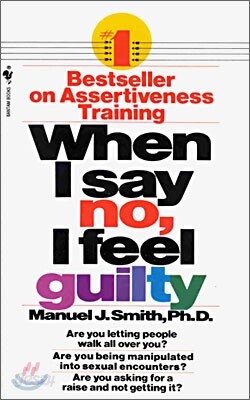
When I Say No, I Feel Guilty: How to Cope--Using the Skills of Systematic Assertive Therapy
How to Cope - Using the Skills of Systematic Assertive Therapy
Mass Market Paperback
- 번역서
- 죄책감 없이 거절하는 용기
이미 소장하고 있다면 판매해 보세요.
- 국내배송만 가능
- 문화비소득공제 가능
책소개
목차
|
1. Our inherited survival responses; coping with other people by fight, flight, or verbal assertiveness 1
Problems other people give us: is conflict inevitable? Our primitive survival behaviors: how we become so aggressive or tend to avoid other people Our verbal problem-solving ability: the unique difference between us and other animal species How learning to feel anxious, ignorant, and guilty as children can make us passive, manipulable, and nonassertive as adults. Can parents control their children's behavior without making them feel anxious, ignorant, or guilty? 2. Our prime assertive human right--how other people violate it 24 How we are manipulated into doing what others want Assertive Right I: You have the right to judge your own behavior, thoughts, and emotions, and to take the responsibility for their initiation and consequences upon yourself How we can stop being manipulated by other people The manipulator's basic tool: external structure. Need there be rules to cover every situation? Three ways to simplify how you look at your relationship with anyone else: commercial, authority, and equal interactions Is being assertive immoral or illegal? 3. Our everyday assertive rights--the common ways other people manipulate us 47 Assertive Right II: You have the right to offer no reasons or excuses for justifying your behavior Assertive Right III: You have the right to judge if you are responsible for finding solutions to other people's problems Assertive Right IV: You have the right to change your mind Assertive Right V: You have the right to make mistakes--and be responsible for them Assertive Right VI: You have the right to say, "I don't know." Assertive Right VII: You have the right to be independent of the goodwill of others before coping with them Assertive Right VIII: You have the right to be illogical in making decisions Assertive Right IX: You have the right to say, "I don't understand." Assertive Right X: You have the right to say, "I don't care." 4. The first thing to learn in being assertive: persistence 72 Assertive rights and assertive behavior: Both are important in living assertively Substituting verbal persistence for silent passivity The systematic skill of Broken Record Habit: How people talk you into doing what they want Practical goals in being assertive: Workable Compromise, keeping your self-respect, and the limits of being assertive 5. Assertive social conversation and communication 88 Why are we often tongue-tied? The conversational skills of following up Free Information and Self-Disclosure Disclosing your own worries to other people: One way to stop manipulation Eye-to-eye contact: An important part of assertive behavior 6. Assertively coping with the great manipulator: criticism 100 Nonassertive critics: How they manipulate you into doing what they want The systematic skill of Fogging Agreeing with critical truths and still doing what you want Agreeing in principle with logical criticism and still doing what you want Agreeing with the odds that you will fail and still doing what you want The systematic skill of Negative Assertion Asserting your negative points: What you can do when you are 100 per cent in error Coping with compliments or criticism: They are no different when you are assertive 7. Prompting people you care about to be more assertive and less manipulative toward you 120 Assertively inquiring about yourself and what you do: How this eliminates right and wrong statements used to control your behavior The systematic skill of Negative Inquiry Prompting criticism: How it can reduce manipulation Prompting criticism about your work performance: How this can lead to a promotion Prompting criticism about yourself: How this can lead to a closer relationship with people you care for 8. Everyday commercial situations--assertively coping where money is involved 133 Putting the systematic skills together to cope with typical commercial conflicts: Door-to-door salesmen. Returning defective merchandise. Angry customers. Getting defective merchandise fixed. Dealing with the public. Getting repairs or refunds from auto dealers. Problems in getting and giving professional medical treatment 9. Everyday authority situations--assertively coping with supervision or expertise 173 Using systematic skills to assert yourself in authority interactions: Between employee and supervisor. In a job or graduate school interview. Choosing between job offers. Speaking to an audience or presenting a report. Between parents and children. Between teachers and students. With teen-agers 10. Everyday equal relationships--working out compromises or just saying "No" 227 Using assertive skills to cope with people who are equal to you, but not as close as some: Lending out your car. Imposing neighbors. Friends who want a business loan. Interfering parents. Dates and lovers who manipulate you 11. Really close equal relationships--sex and assertion 273 Asserting your sexual wants and your other wants: the wants are different, the assertive behavior is the same Fear and Anger: the emotional bases of sexual difficulties The Anxiety Model, the Anger Model, and the Mixed Model: treatment modes for sexual problems Learned sexual problems and how they can be treated with relearning How being nonassertively passive or manipulative can contribute to sexual difficulties How being assertive can help with changing your sexual lifestyle: Hidden anxiety agendas about change. Compromises on different sexual wants. Assertively prompting your partner to learn new ways with you to overcome a routine sex life or a routine lifestyle Anxiety, passivity, and lack of sexual foreplay. Decrease in sexual frequency: a sign of withdrawal of close contact with a mate, in and out of bed In Summary 318 Do you want to assert yourself or do you want to control other people? What happens to society if a lot of us become more assertive and less manipulable? Suggested Technical Readings 321 Glossary of Systematic Assertive Skills 323 |
저자 소개 1
Manuel J. Smith
1934년 뉴욕 브루클린에서 출생, 샌디에이고 주립대학교를 거쳐 UCLA에서 박사학위를 받았다. UCLA에서 심리학 부임상교수를 지내면서 사회심리학, 사회공포증, 정신생리학 등에서 많은 연구업적을 남긴 저명한 임상심리학자이다. 인간관계와 커뮤니케이션의 권위자인 그는 환자의 임상치료 및 강연활동을 통해 수많은 사람을 상담하고 치료했다. 미국에서 수백만 명이 그의 책과 강연을 통해 자신의 문제를 해결하는 데 도움을 받았다.
품목정보
- 발행일
- 1975년 02월 01일
- 쪽수, 무게, 크기
- 324쪽 | 170g | 108*176*30mm
- ISBN13
- 9780553263909
사락 별점0
혜택 및 유의사항밑줄0
혜택 및 유의사항상품정보안내
직수입외서의 경우, 해외거래처에서 제공하는 정보가 부족하여 제목, 표지, 가격, 유통상태 등의 정보가 미비하거나 변경되는 경우가 있습니다. 정확한 확인을 원하시는 경우, 일대일 상담으로 문의하여 주시면 답변 드리겠습니다.
(판형과 판수 등이 다양한 도서는 찾으시는 도서의 ISBN을 알려 주시면 보다 빠르고 정확한 안내가 가능합니다.)
해외거래처에서 품절인 경우, 2차 거래선을 통해 유럽과 미국 출판사로 직접 수입이 진행될 수 있습니다.
수입 진행 시점으로 부터 2~3주가 추가로 소요되며, 해외에서도 유통이 원활하지 않은 도서는 품절 안내가 지연될 수 있습니다.
해당 경우, 문자와 메일로 별도 안내를 드리고 있사오니 마이페이지에서 휴대전화번호와 메일주소를 다시 한번 확인해주시기 바랍니다.
(판형과 판수 등이 다양한 도서는 찾으시는 도서의 ISBN을 알려 주시면 보다 빠르고 정확한 안내가 가능합니다.)
해외거래처에서 품절인 경우, 2차 거래선을 통해 유럽과 미국 출판사로 직접 수입이 진행될 수 있습니다.
수입 진행 시점으로 부터 2~3주가 추가로 소요되며, 해외에서도 유통이 원활하지 않은 도서는 품절 안내가 지연될 수 있습니다.
해당 경우, 문자와 메일로 별도 안내를 드리고 있사오니 마이페이지에서 휴대전화번호와 메일주소를 다시 한번 확인해주시기 바랍니다.