
이미 소장하고 있다면 판매해 보세요.
- 국내배송만 가능
- 해외 거래처 사정에 의하여 품절/지연 가능
- 도서 정보 중 미표기 사항 안내?
- 문화비소득공제 가능
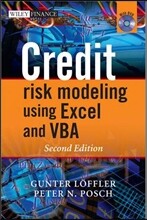
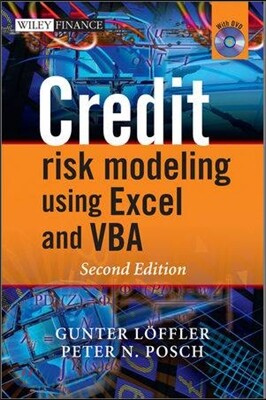
책소개
목차
|
Preface to the 2nd edition xi Preface to the 1st edition xiii Some Hints for Troubleshooting xv 1 Estimating Credit Scores with Logit 1 Linking scores, default probabilities and observed default behavior 1 Estimating logit coefficients in Excel 4 Computing statistics after model estimation 8 Interpreting regression statistics 10 Prediction and scenario analysis 12 Treating outliers in input variables 16 Choosing the functional relationship between the score and explanatory variables 20 Concluding remarks 25 Appendix 25 Logit and probit 25 Marginal effects 25 Notes and literature 26 2 The Structural Approach to Default Prediction and Valuation 27 Default and valuation in a structural model 27 Implementing the Merton model with a one-year horizon 30 The iterative approach 30 A solution using equity values and equity volatilities 35 Implementing the Merton model with a T -year horizon 39 Credit spreads 43 CreditGrades 44 Appendix 50 Notes and literature 52 Assumptions 52 Literature 53 3 Transition Matrices 55 Cohort approach 56 Multi-period transitions 61 Hazard rate approach 63 Obtaining a generator matrix from a given transition matrix 69 Confidence intervals with the binomial distribution 71 Bootstrapped confidence intervals for the hazard approach 74 Notes and literature 78 Appendix 78 Matrix functions 78 4 Prediction of Default and Transition Rates 83 Candidate variables for prediction 83 Predicting investment-grade default rates with linear regression 85 Predicting investment-grade default rates with Poisson regression 88 Backtesting the prediction models 94 Predicting transition matrices 99 Adjusting transition matrices 100 Representing transition matrices with a single parameter 101 Shifting the transition matrix 103 Backtesting the transition forecasts 108 Scope of application 108 Notes and literature 110 Appendix 110 5 Prediction of Loss Given Default 115 Candidate variables for prediction 115 Instrument-related variables 116 Firm-specific variables 117 Macroeconomic variables 118 Industry variables 118 Creating a data set 119 Regression analysis of LGD 120 Backtesting predictions 123 Notes and literature 126 Appendix 126 6 Modeling and Estimating Default Correlations with the Asset Value Approach 131 Default correlation, joint default probabilities and the asset value approach 131 Calibrating the asset value approach to default experience: the method of moments 133 Estimating asset correlation with maximum likelihood 136 Exploring the reliability of estimators with a Monte Carlo study 144 Concluding remarks 147 Notes and literature 147 7 Measuring Credit Portfolio Risk with the Asset Value Approach 149 A default-mode model implemented in the spreadsheet 149 VBA implementation of a default-mode model 152 Importance sampling 156 Quasi Monte Carlo 160 Assessing Simulation Error 162 Exploiting portfolio structure in the VBA program 165 Dealing with parameter uncertainty 168 Extensions 170 First extension: Multi-factor model 170 Second extension: t-distributed asset values 171 Third extension: Random LGDs 173 Fourth extension: Other risk measures 175 Fifth extension: Multi-state modeling 177 Notes and literature 179 8 Validation of Rating Systems 181 Cumulative accuracy profile and accuracy ratios 182 Receiver operating characteristic (ROC) 185 Bootstrapping confidence intervals for the accuracy ratio 187 Interpreting caps and ROCs 190 Brier score 191 Testing the calibration of rating-specific default probabilities 192 Validation strategies 195 Testing for missing information 198 Notes and literature 201 9 Validation of Credit Portfolio Models 203 Testing distributions with the Berkowitz test 203 Example implementation of the Berkowitz test 206 Representing the loss distribution 207 Simulating the critical chi-square value 209 Testing modeling details: Berkowitz on subportfolios 211 Assessing power 214 Scope and limits of the test 216 Notes and literature 217 10 Credit Default Swaps and Risk-Neutral Default Probabilities 219 Describing the term structure of default: PDs cumulative, marginal and seen from today 220 From bond prices to risk-neutral default probabilities 221 Concepts and formulae 221 Implementation 225 Pricing a CDS 232 Refining the PD estimation 234 Market values for a CDS 237 Example 239 Estimating upfront CDS and the ‘Big Bang’ protocol 240 Pricing of a pro-rata basket 241 Forward CDS spreads 242 Example 243 Pricing of swaptions 243 Notes and literature 247 Appendix 247 Deriving the hazard rate for a CDS 247 11 Risk Analysis and Pricing of Structured Credit: CDOs and First-to-Default Swaps 249 Estimating CDO risk with Monte Carlo simulation 249 The large homogeneous portfolio (LHP) approximation 253 Systemic risk of CDO tranches 256 Default times for first-to-default swaps 259 CDO pricing in the LHP framework 263 Simulation-based CDO pricing 272 Notes and literature 281 Appendix 282 Closed-form solution for the LHP model 282 Cholesky decomposition 283 Estimating PD structure from a CDS 284 12 Basel II and Internal Ratings 285 Calculating capital requirements in the Internal Ratings-Based (IRB) approach 285 Assessing a given grading structure 288 Towards an optimal grading structure 294 Notes and literature 297 Appendix A1 Visual Basics for Applications (VBA) 299 Appendix A2 Solver 307 Appendix A3 Maximum Likelihood Estimation and Newton’s Method 313 Appendix A4 Testing and Goodness of Fit 319 Appendix A5 User-defined Functions 325 Index 333 |
저자 소개
About the authors
GUNTER LOFFLER is Professor of Finance at the University of Ulm in Germany. His current research interests are on credit risk and empirical finance. Previously, Gunter was Assistant Professor at Goethe University Frankfurt, and served as an internal consultant in the asset management division of Commerzbank. His Ph.D. in finance is from the University of Mannheim. Gunter has studied at Heidelberg and Cambridge Universities.
PETER N. POSCH is Assistant Professor of Finance at the University of Ulm in Germany. Previously, Peter was co-head of credit treasury at a large bank, where he also traded credit derivatives and other fixed income products for the bank's proprietary books. His Ph.D. in finance on the dynamics of credit risk is from the University of Ulm. Peter has studied economics, philosophy and law at the University of Bonn.
품목정보
- 발행일
- 2011년 01월 31일
- 쪽수, 무게, 크기
- 368쪽 | 165*249*23mm
- ISBN13
- 9780470660928
리뷰/한줄평0
상품정보안내
(판형과 판수 등이 다양한 도서는 찾으시는 도서의 ISBN을 알려 주시면 보다 빠르고 정확한 안내가 가능합니다.)
해외거래처에서 품절인 경우, 2차 거래선을 통해 유럽과 미국 출판사로 직접 수입이 진행될 수 있습니다.
수입 진행 시점으로 부터 2~3주가 추가로 소요되며, 해외에서도 유통이 원활하지 않은 도서는 품절 안내가 지연될 수 있습니다.
해당 경우, 문자와 메일로 별도 안내를 드리고 있사오니 마이페이지에서 휴대전화번호와 메일주소를 다시 한번 확인해주시기 바랍니다.