

소득공제
외서
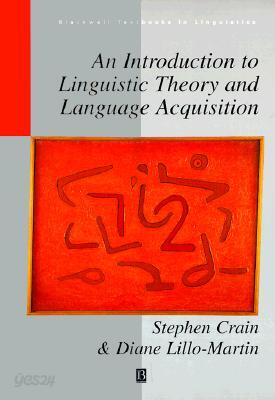
An Introduction to Linguistic Theory and Language Acquisition
Paperback
Stephen Crain, Diane Lillo-Martin
Blackwell
2003.02.01.
이미 소장하고 있다면 판매해 보세요.
- 국내배송만 가능
- 문화비소득공제 가능
Blackwell Textbooks in Linguistics
-
 Indo-European Language and Culture: An Introduction 이동Indo-European Language and Culture: An Introduction58,500원
-
An Introduction to Linguistic Theory and Language Acquisition 이동An Introduction to Linguistic Theory and Language Acquisition30,000원
-
Modern Phrase Structure Grammar: Out of Our Ancient Society 이동Modern Phrase Structure Grammar: Out of Our Ancient Society25,000원
책소개
목차
|
Preface
Acknowledgments Pt. I Linguistic Knowledge 1 Introduction to Language Acquisition 2 Knowledge in the Absence of Experience 3 Stages of Language Acquisition 4 Why Language Does Not Have to be Taught 5 Dispelling a Common-Sense Account 6 Universal Grammar and the Logical Problem of Language Acquisition 7 The Modularity Hypothesis Pt. II Constituent Structure 8 Phrase Structure 9 Phrase Structure Rules and X'-Theory 10 Setting the X'-Parameters 11 Phrasal Categories 12 Ambiguity and Productivity 13 Children's Knowledge of Phrase Structure 14 Constraints on Reference 15 Children's Knowledge of Constraints: Backwards Anaphora Pt. III Transformational Syntax 16 A Transformation Generating Yes/No Questions 17 Children's Adherence to Structure Dependence 18 WH-Movement 19 Cross-Linguistic Aspects of WH-Questions 20 The Acquisition of WH-Questions 21 Successive Cyclic Movement 22 Successful Cyclic Movement 23 A Constraint on Contraction 24 Acquisition of Wanna Contraction 25 Principle C in WH-Questions 26 Children's Knowledge of Strong Crossover Pt. IV Universal Grammar in the Visual Modality 27 The Structure of American Sign Language 28 The Acquisition of American Sign Language 29 The Structure and Acquisition of WH-Questions in American Sign Language 30 Parameter Setting 31 Modularity and Modality Pt. V Semantics and Philosophy of Language 32 Theories of Meaning 33 Truth-Conditional Semantics 34 Compositionality I 35 Compositionality II 36 Intensional Semantics 37 Learnability of Syntax and Semantics 38 Acquisition of NPs with Modifiers 39 Relative Clauses 40 Universal Quantification References Index |
품목정보
- 발행일
- 2003년 02월 01일
- 쪽수, 무게, 크기
- 424쪽 | 776g | 170*240*30mm
- ISBN13
- 9780631195368
사락 별점0
혜택 및 유의사항밑줄0
혜택 및 유의사항상품정보안내
직수입외서의 경우, 해외거래처에서 제공하는 정보가 부족하여 제목, 표지, 가격, 유통상태 등의 정보가 미비하거나 변경되는 경우가 있습니다. 정확한 확인을 원하시는 경우, 일대일 상담으로 문의하여 주시면 답변 드리겠습니다.
(판형과 판수 등이 다양한 도서는 찾으시는 도서의 ISBN을 알려 주시면 보다 빠르고 정확한 안내가 가능합니다.)
해외거래처에서 품절인 경우, 2차 거래선을 통해 유럽과 미국 출판사로 직접 수입이 진행될 수 있습니다.
수입 진행 시점으로 부터 2~3주가 추가로 소요되며, 해외에서도 유통이 원활하지 않은 도서는 품절 안내가 지연될 수 있습니다.
해당 경우, 문자와 메일로 별도 안내를 드리고 있사오니 마이페이지에서 휴대전화번호와 메일주소를 다시 한번 확인해주시기 바랍니다.
(판형과 판수 등이 다양한 도서는 찾으시는 도서의 ISBN을 알려 주시면 보다 빠르고 정확한 안내가 가능합니다.)
해외거래처에서 품절인 경우, 2차 거래선을 통해 유럽과 미국 출판사로 직접 수입이 진행될 수 있습니다.
수입 진행 시점으로 부터 2~3주가 추가로 소요되며, 해외에서도 유통이 원활하지 않은 도서는 품절 안내가 지연될 수 있습니다.
해당 경우, 문자와 메일로 별도 안내를 드리고 있사오니 마이페이지에서 휴대전화번호와 메일주소를 다시 한번 확인해주시기 바랍니다.
