
소득공제
크레마클럽
PDF
eBook
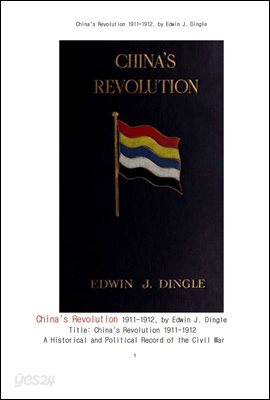
1911-1912년도 중국의 신해혁명 辛亥革命 . China's Revolution 1911-1912, by Edwin J. Dingle
PDF
뉴가출판사
2020.10.12.
- PDF 안내
-
이 상품은 구매 후 지원 기기에서 예스24 eBook앱 설치 후 바로 이용 가능한 상품입니다.
이 상품의 태그






소개
목차
|
1911-1912년도 중국의 신해혁명 辛亥革命 . China's Revolution 1911-1912, by Edwin J. Dingle
CONTENTS CHAPTER I. THE REVOLUTION II. THE AFTERMATH III. GENERAL EXPECTATIONS IV. GENERAL LI YUAN HUNG'S AMBITIONS FOR THE NEW CHINA V. A PREMATURE OPENING VI. THE EARLY HOSTILITIES VII. THE BATTLE OF KILOMETRE TEN VIII. THE BURNING OF HANKOW IX. THE STRONGHOLD OF WUCHANG X. LI YUAN HUNG SEEKS PEACE XI. THE FALL OF HANYANG XII. THE REPUBLIC SEEKS RECOGNITION XIII. THE PEACE CONFERENCE―A MONARCHY OR A REPUBLIC? XIV. THE COMING OF SUN YAT-SEN XV. YUAN SHIH K'AI'S RETIREMENT XVI. RECALLED TO SAVE THE MONARCHY XVII. THE SZECHUEN REVOLT XVIII. SOME REVOLUTION FACTORS XIX. THE ABDICATION EDICT XX. THE OUTLOOK FOR REFORM |
저자 소개
1911-1912년도 중국의 신해혁명 辛亥革命 . China's Revolution 1911-1912, by Edwin J. Dingle
영미저술가
CHINA'S REVOLUTION
1911-1912
A HISTORICAL AND POLITICAL
RECORD OF THE CIVIL WAR
BY
EDWIN J. DINGLE
WITH 2 MAPS AND 36 ILLUSTRATIONS
NEW YORK
McBRIDE, NAST & COMPANY
1912
영미저술가
CHINA'S REVOLUTION
1911-1912
A HISTORICAL AND POLITICAL
RECORD OF THE CIVIL WAR
BY
EDWIN J. DINGLE
WITH 2 MAPS AND 36 ILLUSTRATIONS
NEW YORK
McBRIDE, NAST & COMPANY
1912
품목정보
- 발행일
- 2020년 10월 12일
- 지원기기
- 크레마, PC(윈도우 - 4K 모니터 미지원), 아이폰, 아이패드, 안드로이드폰, 안드로이드패드, 전자책단말기(저사양 기기 사용 불가), PC(Mac)
- 파일/용량
- PDF(DRM) | 2.44MB ?
- 글자 수/ 페이지 수
- 약 208쪽 ?
- ISBN13
- 9791191064445
출판사 리뷰
|
1911-1912년도 중국의 신해혁명 辛亥革命 . China's Revolution 1911-1912, by Edwin J. Dingle
AUTHOR'S NOTE This volume is a popular history of the Revolution in China that broke out at Wuchang, Hankow, and Hanyang in October of 1911. The narrative contains a good deal of new information touching upon revolutionism in China, and the events leading up to the present climax. The magnitude of this Revolution cannot possibly be understood yet; but this volume is written in the hope that it will enable the student otherwise untutored to understand much that one absorbs in Chinese life. When the Revolution broke out, I was residing in Hankow. Throughout the war I remained in Hankow, leaving this centre for Shanghai during the days when the Peace Conference was held in that city. I am a personal friend of the leader of the Revolution, General Li Yuan Hung, and, by virtue of having all the time been in possession of much exclusive information from behind the political curtain, am probably equipped to write of the main doings of the Revolution in that area where its effects were most marked. On the very eve of the Revolution, a book written by myself was published simultaneously in England and America, which contains some strangely prophetic utterances, and will give the reader who has not made Chinese politics a study a general idea of the condition of the country when the Revolution made the scales drop from the eyes of her teeming millions.[1] {8} I wish gratefully to acknowledge the kind offices of Mr. Thos. F. Millard, editor of the China Press, for allowing me free use of the columns of that journal. Much of my information has been culled from the C.P., although many of the articles were written by myself for that newspaper, whilst the war was in progress; but I am largely indebted to that paper also for many of my general later facts. Especially also do I wish to thank the Rev. Bernard Upward, of Hankow, for the assistance he has rendered me whilst this volume was being prepared. The chapter entitled "Some Revolution Factors" is from Mr. Upward's pen, as is also that headed "Yuan Shih K'ai"; many of the illustrations shown in the volume also are reproductions from Mr. Upward's splendid collection. My warm thanks are also due to Mr. Stanley V. Boxer, B.Sc., for the drawings from which the two maps embodied in this volume were prepared, and for the explanatory note accompanying the sketch map of the battlefields. It should, perhaps, in fairness to myself, be mentioned that, owing to absence from England, I have not had an opportunity of reading the proof-sheets before this volume was printed. EDWIN J. DINGLE. HANKOW, HUPEH, CHINA. April 1, 1912. |
