

소득공제
외서
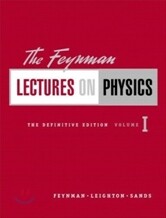
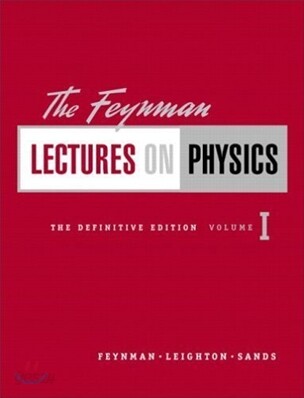
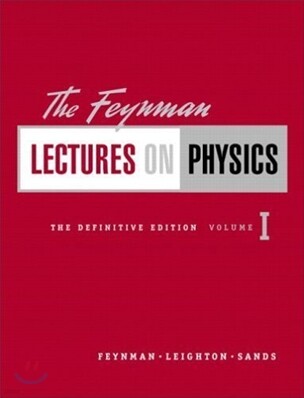
The Feynman Lectures on Physics Volume 1 : The Definitive Edition
Feynman Lectures on Physics
Hardcover, 2nd Edition
Addison Wesley Publishing Company
2005.09.15.
이미 소장하고 있다면 판매해 보세요.
- 국내배송만 가능
- 문화비소득공제 가능
이 상품의 시리즈 3
이 상품의 시리즈 알림신청-
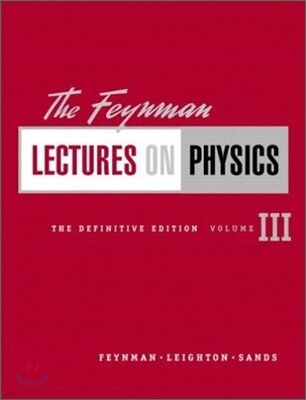
The Feynman Lectures on Physics Volume 3 : The Definitive Edition 이동The Feynman Lectures on Physics Volume 3 : The Definitive Edition품절
-
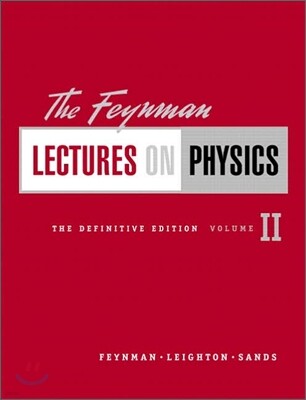
The Feynman Lectures on Physics Volume 2 : The Definitive Edition 이동The Feynman Lectures on Physics Volume 2 : The Definitive Edition품절
-
The Feynman Lectures on Physics Volume 1 : The Definitive Edition 이동The Feynman Lectures on Physics Volume 1 : The Definitive Edition일시품절
책소개
목차
|
Atoms in Motion
Introduction Matter is made of atoms Atomic processes Chemical reactions Basic Physics Introduction Physics before 1920 Quantum physics Nuclei and particles The Relation of Physics to Other Sciences Introduction Chemistry Biology Astronomy Geology Psychology How did it get that way? Conservation of Energy What is energy? Gravitational potential energy Kinetic energy Other forms of energy Time and Distance Motion Time Short times Long times Units and standards of time Large distances Short distances Probability Chance and likelihood Fluctuations The random walk A probability distribution The uncertainty principle The Theory of Gravitation Planetary motions Kepler's laws Development of dynamics Newton's law of gravitation Universal gravitation Cavendish's experiment What is gravity? Gravity and relativity Motion Description of motion Speed Speed as a derivative Distance as an integral Acceleration Newton's Laws of Dynamics Momentum and force Speed and velocity Components of velocity, acceleration, and force What is the force? Meaning of the dynamical equations Numerical solution of the equations Planetary motions Conservation of Momentum Newton's Third Law Conservation of momentum Momentum is conserved! Momentum and energy Relativistic momentum Vectors Symmetry in physics Translations Rotations Vectors Vector algebra Newton's laws in vector notation Scalar product of vectors Characteristics of Force What is a force? Friction Molecular forces Fundamental forces. Fields Pseudo forces Nuclear forces Work and Potential Energy (A) Energy of a falling body Work done by gravity Summation of energy Gravitational field of large objects Work and Potential Energy (conclusion) Work Constrained motion Conservative forces Nonconservative forces Potentials and fields The Special Theory of Relativity The principle of relativity The Lorentz transformation The Michelson-Morley experiment Transformation of time The Lorentz contraction Simultaneity Four-vectors Relativistic dynamics Equivalence of mass and energy Relativistic Energy and Momentum Relativity and the philosophers The twin paradox Transformation of velocities Relativistic mass Relativistic energy Space-Time The geometry of space-time Space-time intervals Past, present, and future More about four-vectors Four-vector algebra Rotation in Two Dimensions The center of mass Rotation of a rigid body Angular momentum Conservation of angular momentum Center of Mass; Moment of Inertia Properties of the center of mass Locating the center of mass Finding the moment of inertia Rotational kinetic energy Rotation in Space Torques in three dimensions The rotation equations using cross products The gyroscope Angular momentum of a solid body The Harmonic Oscillator Linear differential equations The harmonic oscillator Harmonic motion and circular motion Initial conditions Forced oscillations Algebra Addition and multiplication The inverse operations Abstraction and generalization Approximating irrational numbers Complex numbers Imaginary exponents Resonance Complex numbers and harmonic motion The forced oscillator with damping Electrical resonance Resonance in nature Transients The energy of an oscillator Damped oscillations Electrical transients Linear Systems and Review Linear differential equations Superposition of solutions Oscillations in linear systems Analogs in physics Series and parallel impedances Optics: The Principle of Least Time Light Reflection and refraction Fermat's principle of least time Applications of Fermat's principle A more precise statement of Fermat's principle How it works Geometrical Optics Introduction The focal length of a spherical surface The focal length of a lens Magnification Compound lenses Aberrations Resolving power Electromagnetic Radiation Electromagnetism Radiation The dipole radiator Interference Interference Electromagnetic waves Energy of radiation Sinusoidal waves Two dipole radiators The mathematics of interference i Diffraction The resultant amplitude due to n equal oscillators The diffraction grating Resolving power of a grating The parabolic antenna Colored films; crystals Diffraction by opaque screens The field of a plane of oscillating charges The Origin of the Refractive Index The index of refraction The field due to the material Dispersion Absorption The energy carried by an electric wave Diffraction of light by a screen Radiation Damping. Light Scattering Radiation resistance The rate of radiation of energy Radiation damping Independent sources Scattering of light Polarization The electric vector of light Polarization of scattered light Birefringence Polarizers Optical activity The intensity of reflected light Anomalous refraction Relativistic Effects in Radiation Moving sources Finding the ``apparent'' motion Synchrotron radiation Cosmic synchrotron radiation Bremsstrahlung The Doppler effect The w, k four-vector Aberration The momentum of light Color Vision The human eye Color depends on intensity Measuring the color sensation The chromaticity diagram The mechanism of color vision Physiochemistry of color vision Mechanisms of Seeing The sensation of color The physiology of the eye The rod cells The compound (insect) eye Other eyes Neurology of vision Quantum Behavior Atomic mechanics An experiment with bullets An experiment with waves An experiment with electrons The interference of electron waves Watching the electrons First principles of quantum mechanics The uncertainty principle The Relation of Wave and Particle Viewpoints Probability wave amplitudes Measurement of position and momentum Crystal diffraction The size of an atom Energy levels Philosophical implications The Kinetic Theory of Gases Properties of matter The pressure of a gas Compressibility of radiation Temperature and kinetic energy The ideal gas law The Principles of Statistical Mechanics The exponential atmosphere The Boltzmann law Evaporation of a liquid The distribution of molecular speeds The specific heats of gases The failure of classical physics The Brownian Movement Equipartition of energy Thermal equilibrium of radiation Equipartition and the quantum oscillator The random walk Applications of Kinetic Theory Evaporation Thermionic emission Thermal ionization Chemical kinetics Einstein's laws of radiation Diffusion Collisions between molecules The mean free path The drift speed Ionic conductivity Molecular diffusion Thermal conductivity The Laws of Thermodynamics Heat engines; the first law The second law Reversible engines The efficiency of an ideal engine The thermodynamic temperature Entropy Illustrations of Thermodynamics Internal energy Applications The Clausius-Clapeyron equation Ratchet and Pawl How a ratchet works The ratchet as an engine Reversibility in mechanics Irreversibility Order and entropy Sound. The Wave Equation Waves The propagation of sound The wave equation Solutions of the wave equation The speed of sound Beats Adding two waves Beat notes and modulation Side bands Localized wave trains Probability amplitudes for particles Waves in three dimensions Normal modes Modes The reflection of waves Confined waves, with natural frequencies Modes in two dimensions Coupled pendulums Linear systems Harmonics Musical tones The Fourier series Quality and consonance The Fourier coefficients The energy theorem Nonlinear responses Waves Bow waves Shock waves Waves in solids Surface waves Symmetry in Physical Laws Symmetry operations Symmetry in space and time Symmetry and conservation laws Mirror reflections Polar and axial vectors Which hand is right? Parity is not conserved! Antimatter Broken symmetries Index |
품목정보
- 발행일
- 2005년 09월 15일
- 쪽수, 무게, 크기
- 544쪽 | 크기확인중
- ISBN13
- 9780805390469
사락 별점0
혜택 및 유의사항밑줄0
혜택 및 유의사항상품정보안내
직수입외서의 경우, 해외거래처에서 제공하는 정보가 부족하여 제목, 표지, 가격, 유통상태 등의 정보가 미비하거나 변경되는 경우가 있습니다. 정확한 확인을 원하시는 경우, 일대일 상담으로 문의하여 주시면 답변 드리겠습니다.
(판형과 판수 등이 다양한 도서는 찾으시는 도서의 ISBN을 알려 주시면 보다 빠르고 정확한 안내가 가능합니다.)
해외거래처에서 품절인 경우, 2차 거래선을 통해 유럽과 미국 출판사로 직접 수입이 진행될 수 있습니다.
수입 진행 시점으로 부터 2~3주가 추가로 소요되며, 해외에서도 유통이 원활하지 않은 도서는 품절 안내가 지연될 수 있습니다.
해당 경우, 문자와 메일로 별도 안내를 드리고 있사오니 마이페이지에서 휴대전화번호와 메일주소를 다시 한번 확인해주시기 바랍니다.
(판형과 판수 등이 다양한 도서는 찾으시는 도서의 ISBN을 알려 주시면 보다 빠르고 정확한 안내가 가능합니다.)
해외거래처에서 품절인 경우, 2차 거래선을 통해 유럽과 미국 출판사로 직접 수입이 진행될 수 있습니다.
수입 진행 시점으로 부터 2~3주가 추가로 소요되며, 해외에서도 유통이 원활하지 않은 도서는 품절 안내가 지연될 수 있습니다.
해당 경우, 문자와 메일로 별도 안내를 드리고 있사오니 마이페이지에서 휴대전화번호와 메일주소를 다시 한번 확인해주시기 바랍니다.