
소득공제
외서
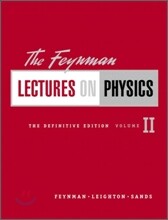
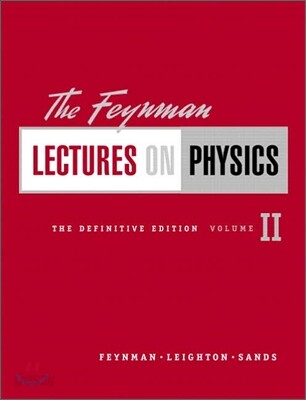
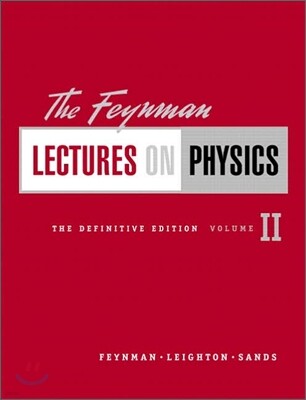
The Feynman Lectures on Physics Volume 2 : The Definitive Edition
Feynman Lectures on Physics
Hardcover, 2nd Edition
Addison Wesley Publishing Company
2005.09.15.
이미 소장하고 있다면 판매해 보세요.
- 국내배송만 가능
- 문화비소득공제 가능
이 상품의 시리즈 3
이 상품의 시리즈 알림신청-
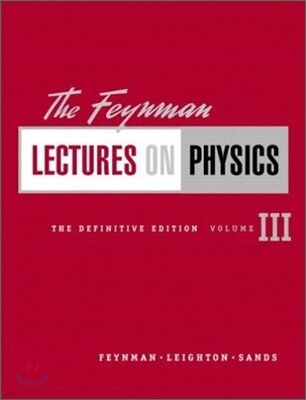
The Feynman Lectures on Physics Volume 3 : The Definitive Edition 이동The Feynman Lectures on Physics Volume 3 : The Definitive Edition품절
-
The Feynman Lectures on Physics Volume 2 : The Definitive Edition 이동The Feynman Lectures on Physics Volume 2 : The Definitive Edition품절
-
The Feynman Lectures on Physics Volume 1 : The Definitive Edition 이동The Feynman Lectures on Physics Volume 1 : The Definitive Edition일시품절
책소개
목차
|
Electromagnetism
Electrical forces Electric and magnetic fields Characteristics of vector fields The laws of electromagnetism What are the fields? Electromagnetism in science and technology Differential Calculus of Vector Fields Understanding physics Scalar and vector fields---T and h Derivatives of fields---the gradient The operator Operations with The differential equation of heat flow Second derivatives of vector fields Pitfalls Vector Integral Calculus Vector integrals; the line integral of ψ The flux of a vector field The flux from a cube; Gauss' theorem Heat conduction; the diffusion equation The circulation of a vector field The circulation around a square; Stokes' theorem Curl-free and divergence-free fields Summary Electrostatics Statics Coulomb's law; superposition Electric potential E = φ The flux of E Gauss' law; divergence of E Field of a sphere of charge Field lines; equipotential surfaces Application of Gauss' Law Electrostatics is Gauss's law plus Equilibrium in an electrostatic field Equilibrium with conductors Stability of atoms The field of a line charge A sheet of charge; two sheets A sphere of charge; a spherical shell Is the field of a point charge exactly 1/r2? The fields of a conductor The field in a cavity of a conductor The Electric Field in Various Circumstances Equations of the electrostatic potential The electric dipole Remarks on vector equations The dipole potential as a gradient The dipole approximation for an arbitrary distribution The fields of charged conductors The method of images A point charge near a conducting plane A point charge near a conducting sphere Condensers; parallel plates High-voltage breakdown The field-emission microscope The Electric Field in Various Circumstances (Continued) Methods for finding the electrostatic field Two-dimensional fields; functions of the complex variable Plasma oscillations Colloidal particles in an electrolyte The electrostatic field of a grid Electrostatic Energy The electrostatic energy of charges. A uniform sphere The energy of a condenser. Forces on charged conductors The electrostatic energy of an ionic crystal Electrostatic energy in nuclei Energy in the electrostatic field The energy of a point charge Electricity in the Atmosphere The electric potential gradient of the atmosphere Electric currents in the atmosphere Origin of the atmospheric currents Thunderstorms The mechanism of charge separation Lightning Dielectrics The dielectric constant The polarization vector P Polarization charges The electrostatic equations with dielectrics Fields and forces with dielectrics Inside Dielectrics Molecular dipoles Electronic polarization Polar molecules; orientation polarization Electric fields in cavities of a dielectric The dielectric constant of liquids; the Clausius-Mossotti equation Solid dielectrics Ferroelectricity; BaTiO3 Electrostatic Analogs The same equations have the same solutions The flow of heat; a point source near an infinite plane boundary The stretched membrane The diffusion of neutrons; a uniform spherical source in a homogeneous medium Irrotational fluid flow; the flow past a sphere Illumination; the uniform lighting of a plane The ``underlying unity'' of nature Magnetostatics The magnetic field Electric current; the conservation of charge The magnetic force on a current The magnetic field of steady currents; Ampere's law The magnetic field of a straight wire and of a solenoid; atomic currents The relativity of magnetic and electric fields The transformation of currents and charges Superposition; the right-hand rule The Magnetic field in Various Situations The vector potential The vector potential of known currents A straight wire A long solenoid The field of a small loop; the magnetic dipole The vector potential of a circuit The law of Biot and Savart The Vector Potential The forces on a current loop; energy of a dipole Mechanical and electrical energies The energy of steady currents B versus A The vector potential and quantum mechanics What is true for statics is false for dynamics Induced Currents Motors and generators Transformers and inductances Forces on induced currents Electrical technology The Laws of Induction The physics of induction Exceptions to the ``flux rule'' Particle acceleration by an induced electric field; the betatron A paradox Alternating-current generator Mutual inductance Self-inductance Inductance and magnetic energy The Maxwell Equations Maxwell's equations How the new term works All of classical physics A travelling field The speed of light Solving Maxwell's equations; the potentials and the wave equation The Principle of Least Action A special lecture---almost verbatim A note added after the lecture Solutions of Maxwell's Equations in Free Space Waves in free space; plane waves Three-dimensional waves Scientific imagination Spherical waves Solutions of Maxwell's Equations with Currents and Charges Light and electromagnetic waves Spherical waves from a point source The general solution of Maxwell's equations The fields of an oscillating dipole The potentials of a moving charge; the general solution of Lienard and Wiechert The potentials for a charge moving with constant velocity; the Lorentz formula AC Circuits Impedances Generators Networks of ideal elements; Kirchhoff's rules Equivalent circuits Energy A ladder network Filters Other circuit elements Cavity Resonators Real circuit elements A capacitor at high frequencies A resonant cavity Cavity modes Cavities and resonant circuits Waveguides The transmission line The rectangular waveguide The cutoff frequency The speed of the guided waves Observing guided waves Waveguide plumbing Waveguide modes Another way of looking at the guided waves Electrodynamics in Relativistic Notation Four-vectors The scalar product The four-dimensional gradient Electrodynamics in four-dimensional notation The four-potential of a moving charge The invariance of the equations of electrodynamics Lorentz Transformations of the Fields The four-potential of a moving charge The fields of a point charge with a constant velocity Relativistic transformation of the fields The equations of motion in relativistic notation Field Energy and Field Momentum Local conservation Energy conservation and electromagnetism Energy density and energy flow in the electromagnetic field The ambiguity of the field energy Examples of energy flow Field momentum Electromagnetic Mass The field energy of a point charge The field momentum of a moving charge Electromagnetic mass The force of an electron on itself Attempts to modify the Maxwell theory The nuclear force field The Motion of Charges in Electric and Magnetic Fields Motion in a uniform electric or magnetic field Momentum analysis An electrostatic lens A magnetic lens The electron microscope Accelerator guide fields Alternating-gradient focusing Motion in crossed electric and magnetic fields The Internal Geometry of Crystals The internal geometry of crystals Chemical bonds in crystals The growth of crystals Crystal lattices Symmetries in two dimensions Symmetries in three dimensions The strength of metals Dislocations and crystal growth The Bragg-Nye crystal model Tensors The tensor of polarizability Transforming the tensor components The energy ellipsoid Other tensors; the tensor of inertia The cross product The tensor of stress Tensors of higher rank The four-tensor of electromagnetic momentum Refractive Index of Dense Materials Polarization of matter Maxwell's equations in a dielectric Waves in a dielectric The complex index of refraction The index of a mixture Waves in metals Low-frequency and high-frequency approximations; the skin depth and the plasma frequency Reflection from Surfaces Reflection and refraction of light Waves in dense materials The boundary conditions The reflected and transmitted waves Reflection from metals Total internal reflection The Magnetism of Matter Diamagnetism and paramagnetism Magnetic moments and angular momentum The precession of atomic magnets Diamagnetism Larmor's theorem Classical physics gives neither diamagnetism nor paramagnetism Angular momentum in quantum mechanics The magnetic energy of atoms Paramagnetism and Magnetic Resonance Quantized magnetic states The Stern-Gerlach experiment The Rabi molecular-beam method The paramagnetism of bulk materials Cooling by adiabatic demagnetization Nuclear magnetic resonance Ferromagnetism Magnetization currents The field H The magnetization curve Iron-core inductances Electromagnets Spontaneous magnetization Magnetic Materials Understanding ferromagnetism Thermodynamic properties The hysteresis curve Ferromagnetic materials Extraordinary magnetic materials Elasticity Hooke's law Uniform strains The torsion bar; shear waves The bent beam Buckling Elastic Materials The tensor of strain The tensor of elasticity The motions in an elastic body Nonelastic behavior Calculating the elastic constants The Flow of Dry Water Hydrostatics The equations of motion Steady flow---Bernoulli's theorem Circulation Vortex lines The Flow of Wet Water Viscosity Viscous flow The Reynolds number Flow past a circular cylinder The limit of zero viscosity Couette flow Curved Space Curved spaces with two dimensions Curvature in three-dimensional space Our space is curved Geometry in space-time Gravity and the principle of equivalence The speed of clocks in a gravitational field The curvature of space-time Motion in curved space-time Einstein's theory of gravitation Index |
품목정보
- 발행일
- 2005년 09월 15일
- 쪽수, 무게, 크기
- 512쪽 | 크기확인중
- ISBN13
- 9780805390476
사락 별점0
혜택 및 유의사항밑줄0
혜택 및 유의사항상품정보안내
직수입외서의 경우, 해외거래처에서 제공하는 정보가 부족하여 제목, 표지, 가격, 유통상태 등의 정보가 미비하거나 변경되는 경우가 있습니다. 정확한 확인을 원하시는 경우, 일대일 상담으로 문의하여 주시면 답변 드리겠습니다.
(판형과 판수 등이 다양한 도서는 찾으시는 도서의 ISBN을 알려 주시면 보다 빠르고 정확한 안내가 가능합니다.)
해외거래처에서 품절인 경우, 2차 거래선을 통해 유럽과 미국 출판사로 직접 수입이 진행될 수 있습니다.
수입 진행 시점으로 부터 2~3주가 추가로 소요되며, 해외에서도 유통이 원활하지 않은 도서는 품절 안내가 지연될 수 있습니다.
해당 경우, 문자와 메일로 별도 안내를 드리고 있사오니 마이페이지에서 휴대전화번호와 메일주소를 다시 한번 확인해주시기 바랍니다.
(판형과 판수 등이 다양한 도서는 찾으시는 도서의 ISBN을 알려 주시면 보다 빠르고 정확한 안내가 가능합니다.)
해외거래처에서 품절인 경우, 2차 거래선을 통해 유럽과 미국 출판사로 직접 수입이 진행될 수 있습니다.
수입 진행 시점으로 부터 2~3주가 추가로 소요되며, 해외에서도 유통이 원활하지 않은 도서는 품절 안내가 지연될 수 있습니다.
해당 경우, 문자와 메일로 별도 안내를 드리고 있사오니 마이페이지에서 휴대전화번호와 메일주소를 다시 한번 확인해주시기 바랍니다.
