


소득공제
외서
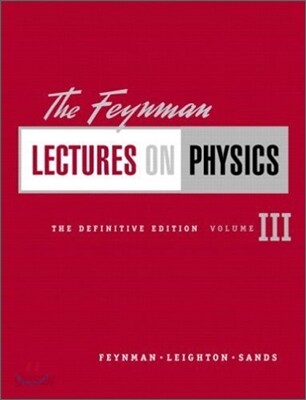
The Feynman Lectures on Physics Volume 3 : The Definitive Edition
Feynman Lectures on Physics
Hardcover, 2nd Ed.
Addison Wesley Publishing Company
2005.09.15.
이미 소장하고 있다면 판매해 보세요.
- 국내배송만 가능
- 문화비소득공제 가능
이 상품의 시리즈 3
이 상품의 시리즈 알림신청-
The Feynman Lectures on Physics Volume 3 : The Definitive Edition 이동The Feynman Lectures on Physics Volume 3 : The Definitive Edition품절
-
The Feynman Lectures on Physics Volume 2 : The Definitive Edition 이동The Feynman Lectures on Physics Volume 2 : The Definitive Edition품절
-
The Feynman Lectures on Physics Volume 1 : The Definitive Edition 이동The Feynman Lectures on Physics Volume 1 : The Definitive Edition일시품절

책소개
목차
|
Quantum Behavior
Atomic mechanics An experiment with bullets An experiment with waves An experiment with electrons The interference of electron waves Watching the electrons First principles of quantum mechanics The uncertainty principle The Relation of Wave and Particle Viewpoints Probability wave amplitudes Measurement of position and momentum Crystal diffraction The size of an atom Energy levels Philosophical implications Probability Amplitudes The laws of combining amplitudes The two-slit interference pattern Scattering from a crystal Identical particles Identical Particles Bose particles and Fermi particles States with two Bose particles States with n Bose particles Emission and absorption of photons The blackbody spectrum Liquid helium The exclusion principle Spin One Filtering atoms with a Stern-Gerlach apparatus Experiments with filtered atoms Stern-Gerlach filters in series Base states Interfering amplitudes The machinery of quantum mechanics Transforming to a different base Other situations Spin One-Half Transforming amplitudes Transforming to a rotated coordinate system Rotations about the z-axis Rotations of 180° and 90° about y Rotations about x Arbitrary rotations The Dependence of Amplitudes on Time Atoms at rest; stationary states Uniform motion Potential energy; energy conservation Forces; the classical limit The ``precession'' of a spin one-half particle The Hamiltonian Matrix Amplitudes and vectors Resolving state vectors What are the base states of the world? How states change with time The Hamiltonian matrix The ammonia molecule The Ammonia Maser The states of an ammonia molecule The molecule in a static electric field Transitions in a time-dependent field Transitions at resonance Transitions off resonance The absorption of light Other Two-State Systems The hydrogen molecular ion Nuclear forces The hydrogen molecule The benzene molecule Dyes The Hamiltonian of a spin one-half particle in a magnetic field The spinning electrons in a magnetic field More Two-State Systems The Pauli spin matrices The spin matrices as operators The solution of the two-state equations The polarization states of the photon The neutral K-meson Generalization to N-state systems The Hyperfine Splitting in Hydrogen Base states for a system with two spin one-half particles The Hamiltonian for the ground state of hydrogen The energy levels The Zeeman splitting The states in a magnetic field The projection matrix for spin one Propagation in a Crystal Lattice States for an electron in a one-dimensional lattice States of definite energy Time-dependent states An electron in a three-dimensional lattice Other states in a lattice Scattering by imperfections in the lattice Trapping by a lattice imperfection Scattering amplitudes and bound states Semiconductors Electrons and holes in semiconductors Impure semiconductors The Hall effect Semiconductor junctions Rectification at a semiconductor junction The transistor The Independent Particle Approximation Spin waves Two spin waves Independent particles The benzene molecule More organic chemistry Other uses of the approximation The Dependence of Amplitudes on Position Amplitudes on a line The wave function States of definite momentum Normalization of the states in x The Schrodinger equation Quantized energy levels Symmetry and Conservation Laws Symmetry Symmetry and conservation The conservation laws Polarized light The distintegration of the λ Summary of the rotation matrices Angular Momentum Electric dipole radiation Light scattering The annihilation of positronium Rotation matrix for any spin Measuring a nuclear spin Composition of angular momentum Added Note 1: Derivation of the rotation matrix Added Note 2: Conservation of parity in photon emission The Hydrogen Atom and The Periodic Table Schrodinger's equation for the hydrogen atom Spherically symmetric solutions States with an angular dependence The general solution for hydrogen The hydrogen wave functions The periodic table Operators Operations and operators Average energies The average energy of an atom The position operator The momentum operator Angular momentum The change of averages with time The Schrodinger Equation in a Classical Context: A Seminar on Superconductivity Schrodinger's equation in a magnetic field The equation of continuity for probabilities Two kinds of momentum The meaning of the wave function Superconductivity The Meissner effect Flux quantization The dynamics of superconductivity The Josephson junction Feynman's Epilogue Appendix Index |
품목정보
- 발행일
- 2005년 09월 15일
- 쪽수, 무게, 크기
- 384쪽 | 크기확인중
- ISBN13
- 9780805390490
사락 별점0
혜택 및 유의사항밑줄0
혜택 및 유의사항상품정보안내
직수입외서의 경우, 해외거래처에서 제공하는 정보가 부족하여 제목, 표지, 가격, 유통상태 등의 정보가 미비하거나 변경되는 경우가 있습니다. 정확한 확인을 원하시는 경우, 일대일 상담으로 문의하여 주시면 답변 드리겠습니다.
(판형과 판수 등이 다양한 도서는 찾으시는 도서의 ISBN을 알려 주시면 보다 빠르고 정확한 안내가 가능합니다.)
해외거래처에서 품절인 경우, 2차 거래선을 통해 유럽과 미국 출판사로 직접 수입이 진행될 수 있습니다.
수입 진행 시점으로 부터 2~3주가 추가로 소요되며, 해외에서도 유통이 원활하지 않은 도서는 품절 안내가 지연될 수 있습니다.
해당 경우, 문자와 메일로 별도 안내를 드리고 있사오니 마이페이지에서 휴대전화번호와 메일주소를 다시 한번 확인해주시기 바랍니다.
(판형과 판수 등이 다양한 도서는 찾으시는 도서의 ISBN을 알려 주시면 보다 빠르고 정확한 안내가 가능합니다.)
해외거래처에서 품절인 경우, 2차 거래선을 통해 유럽과 미국 출판사로 직접 수입이 진행될 수 있습니다.
수입 진행 시점으로 부터 2~3주가 추가로 소요되며, 해외에서도 유통이 원활하지 않은 도서는 품절 안내가 지연될 수 있습니다.
해당 경우, 문자와 메일로 별도 안내를 드리고 있사오니 마이페이지에서 휴대전화번호와 메일주소를 다시 한번 확인해주시기 바랍니다.
