
소득공제
수입
직수입양서
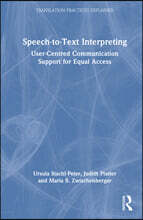
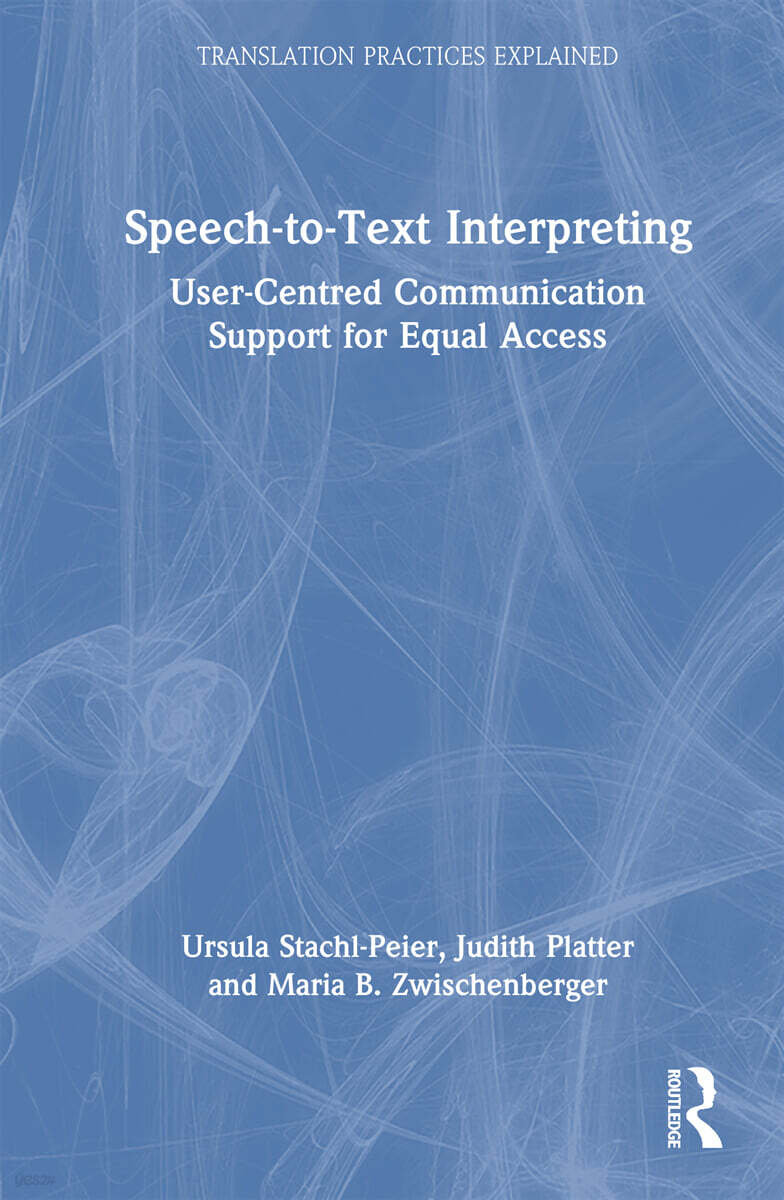
Speech-to-Text Interpreting
User-Centred Communication Support for Equal Access
Hardback, 1st Edition
Ursula Stachl-Peier, Judith Platter Platter, Maria Bernadette Zwischenberger
Routledge
2026.09.21.
- 국내배송만 가능
- 예약도서와 함께 주문 시 도서 출간일에 함께 배송됩니다. (출판사의 사정으로 출간 지연 가능)
- 해외 거래처 사정에 의하여 품절/지연 가능
- 도서 정보 중 미표기 사항 안내?
- 문화비소득공제 가능
Translation Practices Explained
-
 Introducing ASL-English Educational Interpreting 이동Introducing ASL-English Educational Interpreting20% 90,210원
 -
Introducing ASL-English Educational Interpreting 이동Introducing ASL-English Educational Interpreting20% 323,330원
-
Patient-Centred Translation and Communication 이동Patient-Centred Translation and Communication10% 86,680원
-
Patient-Centred Translation and Communication 이동Patient-Centred Translation and Communication10% 363,750원
-
Translating for Museums, Galleries and Heritage Sites 이동Translating for Museums, Galleries and Heritage Sites10% 363,750원
-
Translating for Museums, Galleries and Heritage Sites 이동Translating for Museums, Galleries and Heritage Sites10% 90,910원
-
Legal Interpreting and Questioning Techniques Explained 이동Legal Interpreting and Questioning Techniques Explained10% 363,750원
-
Legal Interpreting and Questioning Techniques Explained 이동Legal Interpreting and Questioning Techniques Explained10% 90,910원
-
Diplomatic and Political Interpreting Explained 이동Diplomatic and Political Interpreting Explained10% 88,800원
-
Diplomatic and Political Interpreting Explained 이동Diplomatic and Political Interpreting Explained10% 363,750원
-
Translating Promotional and Advertising Texts 이동Translating Promotional and Advertising Texts10% 90,910원
-
Translating Promotional and Advertising Texts 이동Translating Promotional and Advertising Texts10% 363,750원
-
Project-Based Approach to Translation Technology 이동Project-Based Approach to Translation Technology10% 363,750원
-
Project-Based Approach to Translation Technology 이동Project-Based Approach to Translation Technology10% 93,030원
책소개
목차
|
List of illustrations List of abbreviations About the book Overview of chapters PART I 1.1 Fundamentals 1.1.1 Speech-to-text interpreting for deaf and hard-of-hearing people: What’s in a name? 1.1.2 The history of STTI 1.1.2.1 The origins of speech-to-text: Written notes and print literacy 1.1.2.2 STTI after 1900 1.1.2.3 The emergence of a profession 1.2 Translation & Interpreting Studies and intralingual speech-to-text conversion: From the margins to the centre – with help from accessibility legislation 1.2.1 STT and the impact of accessibility legislation 1.2.2 TIS and accessibility studies: Recent trends 1.2.3 Speech-to-text interpreting: Still a marginal field in TIS 1.2.4 Opening the TIS door to STTI research 1.2.5 Further pertinent research PART II 2.1 STTI methods and equipment 2.1.1 ‘Basic kit’ 2.1.2 Conventional keyboards 2.1.3 Stenotype and CART 2.1.4 Palantype 2.1.5 Velotype 2.1.6. Repeaking 2.1.7 Automatic speech-recognition (ASR) 2.1.8 Live interpreted text and transcript 2.2 Configuring the physical and virtual STTI meeting space 2.2.1. Display devices and audio sources 2.2.2 Room configurations and seating setups 2.2.3 Preparing for the assignment 2.2.4 Remote speech-to-text interpreting (R-STTI) 2.2.4.1 Research into R-STTI 2.2.5 Practising R-STTI 2.2.5.1 Possible configurations for R-STTI 2.2.5.2 Technical preparation for R-STTI 2.2.5.3 Technical management at location of participants 2.2.5.4 Recommendations for meeting organisers 2.3 International and national standards pertinent to STTI service provision 2.3.1 Standards developed by the International Organization for Standardization (ISO) 2.3.2 Standards developed by the International Telecommunication Union (ITU) 2.3.3 National standards 2.4 The STT interpreters’ working language(s) 2.4.1 Classifications of levels of language proficiency 2.4.2 Language skills for STTI: Listening, writing, reading, speaking 2.4.3 Enhancing your linguistic competence PART III 3.1 Accessibility, disability and universal design 3.1.1 The evolution of disability rights and accessibility legislation 3.1.2 Accessibility, accessible design and universal design 3.1.3 Legislative ideals and DHH people’s daily reality 3.1.4 Resurgence of the ‘medical model’? 3.1.5 Proactive and user-led as new approaches in communication access 3.2 Accessibility and user-centred STTI 3.2.1 From audience design to user-centred translation 3.2.2 User-centredness and accessibility in speech-to-text practises 3.2.2.1 Readability 3.2.2.2 Legibility and the reception of subtitles 3.2.3 Verbatim versus edited – and user-centred STTI PART IV 4.1 Assessing STT quality 4.1.1 Defining quality and quality assessment 4.1.2 Models of live-subtitling quality assessment 4.1.2.1 WER method 4.1.2.2 NER model 4.1.2.3 Concept-based rendition assessment 4.1.2.4 WIRA model 4.1.2.5 QIT model 4.1.3 Summary and appraisal 4.2 Practising user-centred STTI 4.2.1 Conduits versus active participants with their own agency 4.2.2 STTI as a discourse process within a socio-cultural context 4.2.2.1 Communicative transaction within a socio-cultural context 4.2.2.2 Interpreting as interaction 4.2.2.3 Interpreting as a discourse process 4.2.2.4 The multimodal nature of interpreter-mediated interaction 4.2.3 Analysing and assessing STTI-mediated events 4.2.4 Pedagogical approach and format of activities 4.3 STTI as single-speaker events 4.3.1 Introduction 4.3.2 Learning units 4.4 STTI for conversational encounters 4.4.1 Introduction 4.4.2 Learning units 4.5 STTI at multi-party events 4.5.1 Introduction 4.5.2 Learning units 4.6 STTI in educational settings 4.6.1 Introduction 4.6.2 Learning units 4.7 User-centred STTI: A possible model of assessment 4.7.1 Assessing STTI 4.7.2 Appraisal of the interpretations as a product and communicative process 4.7.3 User-centredness? 4.7.4 Appraisal of the interpretations as a service 4.7.5 Protocols and instruments for ensuring user satisfaction PART VI 5.1 Codes of ethics and STTI as a professional practice 5.1.1 Fundamentals 5.1.1.1 Codes of ethics and professional associations 5.1.1.2 Codes of ethics: Help or hindrance? 5.1.1.3 Deontological, teleological and virtue-based codes 5.1.1.4 Contents of codes of ethics 5.1.1.5 Arguments against a wider conception of the interpreter’s role 5.1.2 Codes of professional ethics for STT Interpreters and the Demand Control Schema 5.1.2.1 Four codes of professional ethics for STT interpreters 5.1.2.2 Resolving ethical dilemmas using DCS 5.1.3 Ethics and the concept of Role Space 5.1.4 Codes of ethics and professional practice revisited 5.2 Cognitive processing and interpreting strategies 5.2.1 Cognitive research into interpreting 5.2.1.1 Daniel Gile’s effort model 5.2.1.2 Sylvia Kalina’s cognitive and pragmatic discourse model of interpreting 5.2.2 Research into cognitive processing in STT 5.2.2.1 Cognitive models of respeaking 5.2.3 How can the models support STT interpreters? 5.2.3.1 Pre-task preparation and cognitive load: Some examples 5.2.4 Team collaboration analysed from a 4E(A) perspective 5.2.5 Investigating team collaboration 5.2.5.1 Explorative study of team collaboration 5.2.5.2 A wider conception of collaboration 5.3 Interlingual live subtitling and transpeaking (on the PORTAL) PART VI 6.1 Knowledge skills and competences: From novice to professional expert 6.1.1 TI competence research: An overview 6.1.2 TI competence models 6.1.3 Modelling STTI competence: the LiveTextAccess project 6.1.4 Learning outcomes for STTI 6.2 Initial STTI education and professional development planning 6.2.1 Principles of interpreter education 6.2.1.1 Learning environments and instructional formats 6.2.2 Curricula design, implementation and attainment 6.2.2.1 Assessment practices 6.2.3 Certification and accreditation 6.3 Practice and self-care 6.3.1 Practice makes perfect 6.3.2 Deliberate practice 6.3.3 Professional development planning 6.3.3.1 Skills audit and interpreter profile 6.3.4 Self-care 7 The future of STTI References |
관련 분류
- 카테고리 분류
품목정보
- 발행일
- 2026년 09월 21일
- 쪽수, 무게, 크기
- 256쪽 | 160*230mm
- ISBN13
- 9781032603858
리뷰/한줄평0
상품정보안내
직수입외서의 경우, 해외거래처에서 제공하는 정보가 부족하여 제목, 표지, 가격, 유통상태 등의 정보가 미비하거나 변경되는 경우가 있습니다. 정확한 확인을 원하시는 경우, 일대일 상담으로 문의하여 주시면 답변 드리겠습니다.
(판형과 판수 등이 다양한 도서는 찾으시는 도서의 ISBN을 알려 주시면 보다 빠르고 정확한 안내가 가능합니다.)
해외거래처에서 품절인 경우, 2차 거래선을 통해 유럽과 미국 출판사로 직접 수입이 진행될 수 있습니다.
수입 진행 시점으로 부터 2~3주가 추가로 소요되며, 해외에서도 유통이 원활하지 않은 도서는 품절 안내가 지연될 수 있습니다.
해당 경우, 문자와 메일로 별도 안내를 드리고 있사오니 마이페이지에서 휴대전화번호와 메일주소를 다시 한번 확인해주시기 바랍니다.
(판형과 판수 등이 다양한 도서는 찾으시는 도서의 ISBN을 알려 주시면 보다 빠르고 정확한 안내가 가능합니다.)
해외거래처에서 품절인 경우, 2차 거래선을 통해 유럽과 미국 출판사로 직접 수입이 진행될 수 있습니다.
수입 진행 시점으로 부터 2~3주가 추가로 소요되며, 해외에서도 유통이 원활하지 않은 도서는 품절 안내가 지연될 수 있습니다.
해당 경우, 문자와 메일로 별도 안내를 드리고 있사오니 마이페이지에서 휴대전화번호와 메일주소를 다시 한번 확인해주시기 바랍니다.
363,750원
총 1개
363,750원