
소득공제
수입
직수입양서
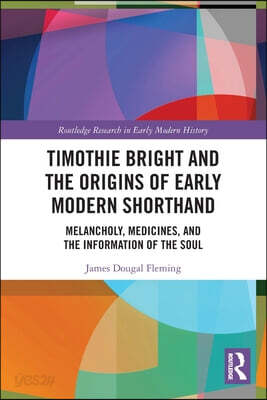
Timothie Bright and the Origins of Early Modern Shorthand
Melancholy, Medicines, and the Information of the Soul
Paperback, 1st Edition
Fleming, James Dougal
Routledge
2026.05.22.
이미 소장하고 있다면 판매해 보세요.
- 국내배송만 가능
- 해외 거래처 사정에 의하여 품절/지연 가능
- 도서 정보 중 미표기 사항 안내?
- 문화비소득공제 가능
Routledge Research in Early Modern History
-
 Cross-Cultural Politics and the Suspension of the Portuguese Inquisition 1674–81 이동Cross-Cultural Politics and the Suspension of the Portuguese Inquisition 1674–8110% 356,010원
 -
Post-Tridentine Apostolic Nunciatures (1562–1605) 이동Post-Tridentine Apostolic Nunciatures (1562–1605)10% 356,010원
-
Children and Young People in Eighteenth-Century Malta, ca. 1740 to 1798 이동Children and Young People in Eighteenth-Century Malta, ca. 1740 to 179810% 356,010원
-
Diplomacy and the Resilience of the Spanish Monarchy 이동Diplomacy and the Resilience of the Spanish Monarchy10% 356,010원
-
Parliamentarism in Northern and East-Central Europe in the Long Eighteenth Century 이동Parliamentarism in Northern and East-Central Europe in the Long Eighteenth Century10% 99,330원
-
Products, Users, and Popular Luxury in Early Modern Greece 이동Products, Users, and Popular Luxury in Early Modern Greece10% 99,330원
-
Timothie Bright and the Origins of Early Modern Shorthand 이동Timothie Bright and the Origins of Early Modern Shorthand10% 99,330원
-
Exploring Sixteenth-Century Italy Through the Poems of Giulio Cesare Croce 이동Exploring Sixteenth-Century Italy Through the Poems of Giulio Cesare Croce10% 356,010원
-
Bible Interpreted by Women in Early Modern Italy: Promoting Dignity and Agency 이동Bible Interpreted by Women in Early Modern Italy: Promoting Dignity and Agency10% 356,010원
-
Colonel Philip Jones, Oliver Cromwell and the British Revolutions in South Wales 이동Colonel Philip Jones, Oliver Cromwell and the British Revolutions in South Wales10% 356,010원
-
British and German Worlds in an Age of Divergence (1600–1850) 이동British and German Worlds in an Age of Divergence (1600–1850)10% 99,330원
-
Figure of Ganymede in Early Modern Spanish Comedias 이동Figure of Ganymede in Early Modern Spanish Comedias10% 356,010원
-
Early Jesuits and the Rhetorical Tradition 이동Early Jesuits and the Rhetorical Tradition10% 99,330원
-
Academic Households in Early Modern Northern Europe 이동Academic Households in Early Modern Northern Europe10% 356,010원
-
Hospitality and the Enlightenment (Encountering China) 이동Hospitality and the Enlightenment (Encountering China)10% 356,010원
-
Paper Heritage in Italy, France, Spain and Beyond (16th to 19th Centuries) 이동Paper Heritage in Italy, France, Spain and Beyond (16th to 19th Centuries)10% 99,330원
-
Parliamentarism in Northern and East-Central Europe in the Long Eighteenth Century 이동Parliamentarism in Northern and East-Central Europe in the Long Eighteenth Century10% 356,010원
책소개
목차
|
Introduction The Double physician Informatio medici Messages and meanings From hand to soul Part One: Technology 1. The Seventeenth-Century Shorthand Movement: In Four Corners A Protean art Yet shorter Groovy images Another way to the word 2. “My Invention”: What Was Characterie? Verbatim notation Informational exchange Hybrid publishing Innovation Source 3. “Indifferently Affected”: The Characterie Terms Wanting an alphabet De arte combinatoria A Book of lists Writing sermons Orality and control Mere information Part Two: Theory 4. Against Navigation: English Medicines The Medical background, ca. 1580 An English Galenism, 1574 The Paracelsian difference, 1585 TEM (i) Aut externi orbis (ii) Here be (no) serpents 5. “Never Able to Abide”: The Melancholy Conscience The Medical Tradition: Natural, genial, adust The Literary Valence: Euphues his face Treatment: Going on a data TMel (i) “Saving that” (ii) “No medicine, no purgation, no cordial” (iii) “Spectacles are to be shunned” (iv) “In written words revealed” 6. “The Mechenist”: Not Being There TMel (v) The Natural chemist (vi) Invisible seeds (vii) Bright’s spirit (viii) Faculty and instruments (ix) In machina (x) Serenity of the spotless psyche (xi) Information overload Conclusion Appendices 1. Sixteenth-Century English shorthands before Bright’s? The absence of evidence. 2. Lists of the Characterie terms. 3. Bright on “soul” and “mind.” Bibliography |
관련 분류
품목정보
- 발행일
- 2026년 05월 22일
- 쪽수, 무게, 크기
- 228쪽 | 460g | 160*230mm
- ISBN13
- 9781032757506
리뷰/한줄평0
상품정보안내
직수입외서의 경우, 해외거래처에서 제공하는 정보가 부족하여 제목, 표지, 가격, 유통상태 등의 정보가 미비하거나 변경되는 경우가 있습니다. 정확한 확인을 원하시는 경우, 일대일 상담으로 문의하여 주시면 답변 드리겠습니다.
(판형과 판수 등이 다양한 도서는 찾으시는 도서의 ISBN을 알려 주시면 보다 빠르고 정확한 안내가 가능합니다.)
해외거래처에서 품절인 경우, 2차 거래선을 통해 유럽과 미국 출판사로 직접 수입이 진행될 수 있습니다.
수입 진행 시점으로 부터 2~3주가 추가로 소요되며, 해외에서도 유통이 원활하지 않은 도서는 품절 안내가 지연될 수 있습니다.
해당 경우, 문자와 메일로 별도 안내를 드리고 있사오니 마이페이지에서 휴대전화번호와 메일주소를 다시 한번 확인해주시기 바랍니다.
(판형과 판수 등이 다양한 도서는 찾으시는 도서의 ISBN을 알려 주시면 보다 빠르고 정확한 안내가 가능합니다.)
해외거래처에서 품절인 경우, 2차 거래선을 통해 유럽과 미국 출판사로 직접 수입이 진행될 수 있습니다.
수입 진행 시점으로 부터 2~3주가 추가로 소요되며, 해외에서도 유통이 원활하지 않은 도서는 품절 안내가 지연될 수 있습니다.
해당 경우, 문자와 메일로 별도 안내를 드리고 있사오니 마이페이지에서 휴대전화번호와 메일주소를 다시 한번 확인해주시기 바랍니다.
99,330원
총 1개
99,330원