

이미 소장하고 있다면 판매해 보세요.
- 국내배송만 가능
- 문화비소득공제 가능
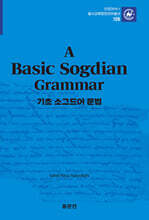
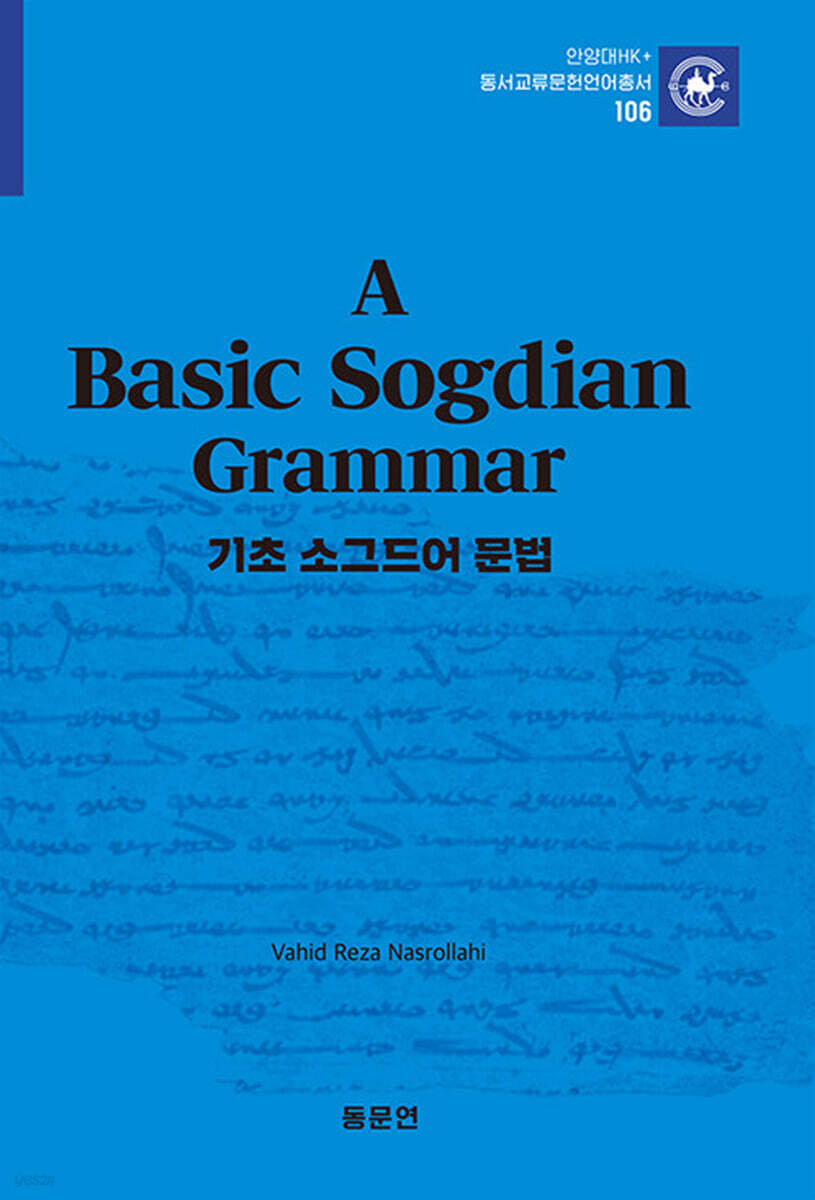
안양대학교HK+ 동서교류문헌언어총서

이 상품의 태그
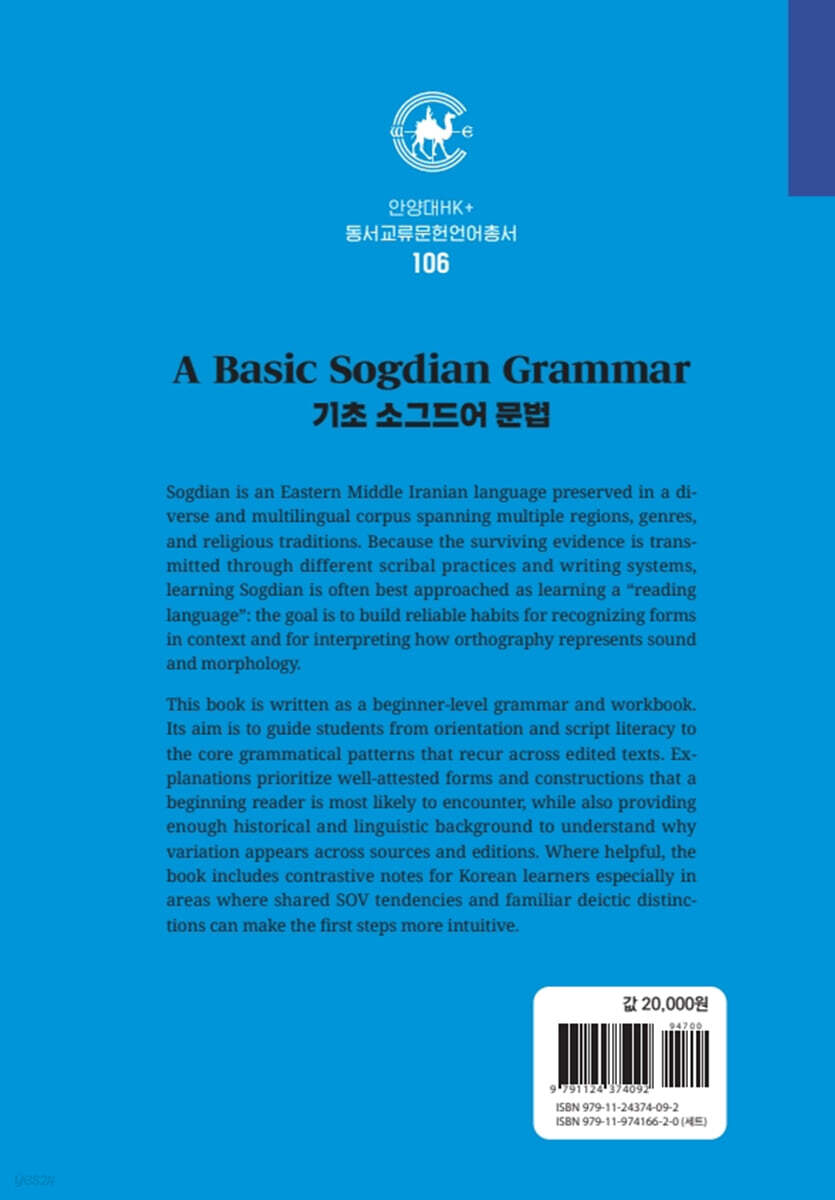
책소개
목차
|
발간에 즈음하여
Preface Part I. Background Chapter 1. Sogdian and the Sogdian World Chapter 2. Writing Systems and Orthographic Conventions Chapter 3. Phonology and pronunciation Part II. Basic Grammar Chapter 4. Number and case of nouns · Chapter 5. Pronouns Chapter 6. Adjectives and ordinals in the noun phrase Chapter 7. Comparison of Adjectives Chapter 8. Adverbs Chapter 9. Postpositions and Conjunctions Chapter 10. Numerals ·· Chapter 11. Verb Stems and Person Marking Chapter 12. TAM, Negation, and Copular Predication Chapter 13. Non-Finite Forms and Subordination Chapter 14. Basic Syntax and Sentence Patterns Appendices: answer keys |
저자 소개 1
데이빗 레자
He earned his M.A. and Ph.D. in Korean Language Education from Seoul National University’s Department of Education and College of Education. His master’s thesis was “A Study on the Pronunciation Instruction of Korean Diphthongs for Iranian Learners.” At the same time, his doctoral dissertation was “A Study on the Learning Pro
He earned his M.A. and Ph.D. in Korean Language Education from Seoul National University’s Department of Education and College of Education. His master’s thesis was “A Study on the Pronunciation Instruction of Korean Diphthongs for Iranian Learners.” At the same time, his doctoral dissertation was “A Study on the Learning Pro\-cess of Academic Korean Writing by Iranian Learners: A Grounded Theory Approach.” He is an HK+ Research Professor at Anyang University’s HK+ Project Group, having started in July 2025.
Since 2020, he has lectured at Anyang University’s HK+ Project Group for M.A. and Ph.D. students on topics such as Persian Grammar and Conversation, Reading of Medieval Persian Fables, and Judeo-Persian Grammar. He has also given public lectures to mass audiences. He has also served as an exceptional instructor in world-culture education programs at Seoul National University, offering lectures to elementary, middle, and high school students.
His research focuses on both Persian classical literary traditions and Korean language instruction. He co-wrote the article “Representation of Besil? Land in Kush-N?me.” He has published internationally on topics including the growth of academic Korean writing among Iranian students, TOPIK-based writing patterns, cultural comparisons (Nowruz and Seollal), and argumentative writing. He is the author of Comprehensive English Grammar in Easy Language and Common English Idioms in TOEFL.
서울대학교 사범대학 교육학과 한국어교육전공에서 석사 및 박사학위를 받았다. 석사학위 논문은 “이란인 학습자를 위한 한국어 이중모음 발음 교육 연구”이며, 박사학위 논문은 “이란인 학습자의 학문 목적 한국어 글쓰기 학습 과정에 대한 연구: 근거 이론적 접근”이다. 2025년 7월부터 안양대학교 HK+사업단 연구교수로 재직 중이다. 2020년부터 안양대학교 HK+사업단에서 페르시아어 문법·회화, 중세 페르시아어 우화 강독, 유대-페르시아 문법 등을 석·박사 과정 학생을 대상으로 강의해 왔으며, 시민 대상 공개강의도 진행했다. 또한 서울대학교에서 진행하는 세계문화 관련 강의(초·중·고)를 꾸준히 우수 강사로 수행해 왔다. 주요 저술로는 페르시아 고전 서사 전통에 관한 연구인 “Representation of Besil? Land in Kush-N?me”(공저), Comprehensive English Grammar in Easy Language, Common English Idioms in TOEFL 등이 있다.
Since 2020, he has lectured at Anyang University’s HK+ Project Group for M.A. and Ph.D. students on topics such as Persian Grammar and Conversation, Reading of Medieval Persian Fables, and Judeo-Persian Grammar. He has also given public lectures to mass audiences. He has also served as an exceptional instructor in world-culture education programs at Seoul National University, offering lectures to elementary, middle, and high school students.
His research focuses on both Persian classical literary traditions and Korean language instruction. He co-wrote the article “Representation of Besil? Land in Kush-N?me.” He has published internationally on topics including the growth of academic Korean writing among Iranian students, TOPIK-based writing patterns, cultural comparisons (Nowruz and Seollal), and argumentative writing. He is the author of Comprehensive English Grammar in Easy Language and Common English Idioms in TOEFL.
서울대학교 사범대학 교육학과 한국어교육전공에서 석사 및 박사학위를 받았다. 석사학위 논문은 “이란인 학습자를 위한 한국어 이중모음 발음 교육 연구”이며, 박사학위 논문은 “이란인 학습자의 학문 목적 한국어 글쓰기 학습 과정에 대한 연구: 근거 이론적 접근”이다. 2025년 7월부터 안양대학교 HK+사업단 연구교수로 재직 중이다. 2020년부터 안양대학교 HK+사업단에서 페르시아어 문법·회화, 중세 페르시아어 우화 강독, 유대-페르시아 문법 등을 석·박사 과정 학생을 대상으로 강의해 왔으며, 시민 대상 공개강의도 진행했다. 또한 서울대학교에서 진행하는 세계문화 관련 강의(초·중·고)를 꾸준히 우수 강사로 수행해 왔다. 주요 저술로는 페르시아 고전 서사 전통에 관한 연구인 “Representation of Besil? Land in Kush-N?me”(공저), Comprehensive English Grammar in Easy Language, Common English Idioms in TOEFL 등이 있다.
품목정보
- 발행일
- 2026년 03월 02일
- 쪽수, 무게, 크기
- 231쪽 | 155*230*20mm
- ISBN13
- 9791124374092
책 속으로
|
Sogdian is an Eastern Middle Iranian language, related to Bactrian, Khwarezmian, and the Saka languages (Khotanese, Tumshuqese). Within Indo-European, it belongs to the Iranian branch and is thus more distantly related to Avestan, Old Persian, and modern languages such as Persian, Kurdish, and Pashto. Its closest modern relative is Yaghnobi, often treated as a direct or near-direct descendant, though it has followed its own path of change. (Yoshida, 2018).
--- p.21 Sogdian nouns do not show grammatical gender. Instead, their inflectional system focuses on number (singular vs. plural) and case (Direct vs. Oblique). The plural is formed regularly by the suffix -t, with Oblique plural forms typically appearing as -t-i/-t-y, especially before postpositions (Sims-Williams, 1979; Yoshida, 2016). --- p.77 Sogdian finite verbs are composed of (i) a lexical stem and (ii) grammatical material that indicates person and number—either as suffixal endings (primarily in many non-past formations) or as copular/auxiliary elements (especially in common past formations). Descriptive grammars commonly present paradigms in a “stem + marker” format, because this segmentation is the most reliable way to recognize forms across manuscripts, scripts, and editorial normalizations (Gershevitch, 1954; Gharib, 1965; Yoshida, 2009, 2016; Zarshenas, 2011). --- p.144 Sogdian clause structure is built not only around finite verbs (with person/number agreement), but also around a productive system of non-finite verb forms and a set of subordination strategies that package embedded predication as complements, modifiers, or backgrounded clauses. --- p.167 |
사락 별점0
혜택 및 유의사항밑줄0
혜택 및 유의사항
19,000원
총 1개
19,000원