
소득공제
크레마클럽
EPUB
eBook
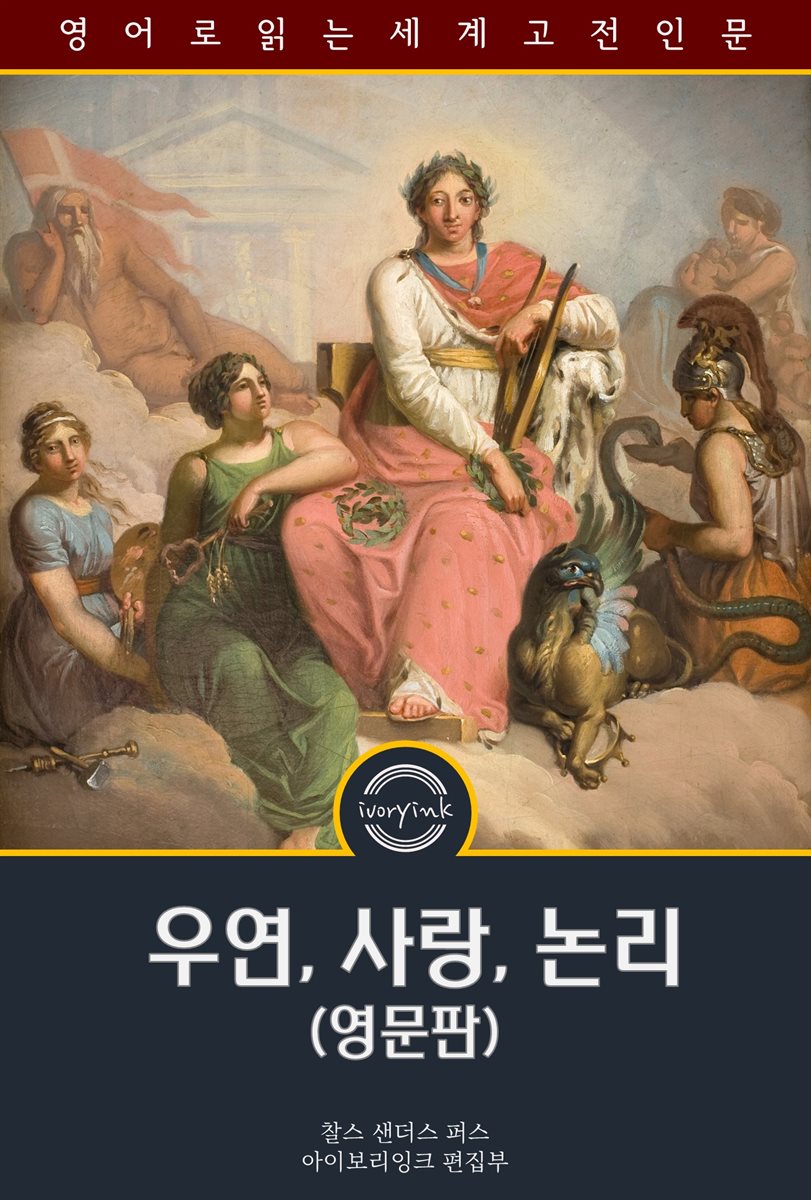
우연, 사랑, 논리 / Chance, Love, and Logic (영문판)
EPUB
이 상품의 태그

















소개
목차
|
표지
목차 INTRODUCTION PROEM THE RULES OF PHILOSOPHY PART I CHANCE AND LOGIC (ILLUSTRATIONS OF THE LOGIC OF SCIENCE) CHANCE AND LOGIC FIRST PAPER THE FIXATION OF BELIEF SECOND PAPER HOW TO MAKE OUR IDEAS CLEAR THIRD PAPER THE DOCTRINE OF CHANCES FOURTH PAPER THE PROBABILITY OF INDUCTION FIFTH PAPER THE ORDER OF NATURE SIXTH PAPER DEDUCTION, INDUCTION, AND HYPOTHESIS PART II LOVE AND CHANCE I. THE ARCHITECTURE OF THEORIES II. THE DOCTRINE OF NECESSITY EXAMINED III. THE LAW OF MIND WHAT THE LAW IS INDIVIDUALITY OF IDEAS CONTINUITY OF IDEAS INFINITY AND CONTINUITY, IN GENERAL ANALYSIS OF TIME THAT FEELINGS HAVE INTENSIVE CONTINUITY THAT FEELINGS HAVE SPATIAL EXTENSION AFFECTIONS OF IDEAS IDEAS CANNOT BE CONNECTED EXCEPT BY CONTINUITY MENTAL LAW FOLLOWS THE FORMS OF LOGIC UNCERTAINTY OF MENTAL ACTION RESTATEMENT OF THE LAW PERSONALITY COMMUNICATION CONCLUSION IV. MAN’S GLASSY ESSENCE V. EVOLUTIONARY LOVE AT FIRST BLUSH. COUNTER-GOSPELS copyrights (참고) 분량: 약 55 만자 |
저자 소개
찰스 샌더스 퍼스(Charles Sanders Peirce, 1839?1914)는 미국의 철학자이자 논리학자·수학자·과학자입니다. 그는 '프래그머티즘(pragmatism)'의 개념을 발전시키고 현대 기호학의 기초를 다진 인물로 평가받습니다. 퍼스는 특히 귀추(abduction)라는 추론 형식을 강조하며, 지식은 본질적으로 불완전하고 수정 가능한 것이라는 '판정불가능성(fallibilism)'을 주장했습니다. 그의 사상은 논리, 과학철학, 언어이론 등 여러 분야에 깊은 영향을 미쳤고, 텍스트는 때로 난해하지만 세심한 독해를 통해 풍부한 사유적 보상을 제공합니다.
품목정보
- 발행일
- 2026년 07월 21일
- 지원기기
- 크레마,PC(윈도우 - 4K 모니터 미지원),아이폰,아이패드,안드로이드폰,안드로이드패드,전자책단말기(저사양 기기 사용 불가),PC(Mac)
- 파일/용량
- EPUB(DRM) | 1.24MB ?
- ISBN13
- 9791139835700
출판사 리뷰
|
<미리 보기>
Many and diverse are the minds that form the philosophic community. There are, first and foremost, the great masters, the system builders who rear their stately palaces towering to the moon. These architectonic minds are served by a varied host of followers and auxiliaries. Some provide the furnishings to make these mystic mansions of the mind more commodious, while others are engaged in making their facades more imposing. Some are busy strengthening weak places or building much-needed additions, while many more are engaged in defending these structures against the impetuous army of critics who are ever eager and ready to pounce down upon and destroy all that is new or bears the mortal mark of human imperfection. There are also the philologists, those who are in a more narrow sense scholars, who dig not only for facts or roots, but also for the stones which may serve either for building or as weapons of destruction. Remote from all these, however, are the intellectual rovers who, in their search for new fields, venture into the thick jungle that surrounds the little patch of cultivated science. They are not gregarious creatures, these lonely pioneers; and in their wanderings they often completely lose touch with those who tread the beaten paths. Those that return to the community often speak strangely of strange things; and it is not always that they arouse sufficient faith for others to follow them and change their trails into high roads. Few nowadays question the great value of these pioneer minds; and it is often claimed that universities are established to facilitate their work, and to prevent it from being lost. But universities, like other well-managed institutions, can find place only for those who work well in harness. The restless, impatient minds, like the socially or conventionally unacceptable, are thus kept out, no matter how fruitful their originality. Charles S. Peirce was certainly one of these restless pioneer souls with the fatal gift of genuine originality. In his early papers, in the Journal of Speculative Philosophy, and later, in the Monist papers reprinted as Part II of this volume, we get glimpses of a vast philosophic system on which he was working with an unusual wealth of material and apparatus. To a rich imagination and extraordinary learning he added one of the most essential gifts of successful system builders, the power to coin an apt and striking terminology. But the admitted incompleteness of these preliminary sketches of his philosophic system is not altogether due to the inherent difficulty of the task and to external causes such as neglect and poverty. A certain inner instability or lack of self-mastery is reflected in the outer moral or conventional waywardness which, except for a few years at Johns Hopkins, caused him to be excluded from a university career, and thus deprived him of much needed stimulus to ordinary consistency and intelligibility. As the years advanced, bringing little general interest in, or recognition of, the brilliant logical studies of his early years, Peirce became more and more fragmentary, cryptic, and involved; so that James, the intellectual companion of his youth, later found his lectures on pragmatism, "flashes of brilliant light relieved against Cimmerian darkness"?a statement not to be entirely discounted by the fact that James had no interest in or aptitude for formal logical or mathematical considerations. Despite these limitations, however, Peirce stands out as one of the great founders of modern scientific logic; and in the realm of general philosophy the development of some of his pregnant ideas has led to the pragmatism and radical empiricism of James, as well as to the mathematical idealism of Royce, and to the anti-nominalism which characterizes the philosophic movement known as Neo-Realism. At any rate, the work of James, Royce, and Russell, as well as that of logicians like Schroeder, brings us of the present generation into a better position to appreciate the significance of Peirce’s work, than were his contemporaries. |