


이미 소장하고 있다면 판매해 보세요.
- 국내배송만 가능
- 문화비소득공제 가능
책소개
목차
|
Part One. Motivation
Chapter 1. The Need for Risk Management Chapter 2. Lessons form Financial Disasters Chapter 3. Regulatory Capital Standards with VAR Part Two. Building Blocks Chapter 4. Measuring Financial Risk Chapter 5. Computing Value at Risk Chapter 6. Backtesting VAR Models Chapter 7. Portfolio Risk : Analytical Methods Chapter 8. Forecasting Risks and Correlations Part Three. Value-at-Risk Systems Chapter 9. VAR Methods Chapter 10. Stress Testing Chapter 11. Implementing Delta-Normal VAR Chapter 12. Simulation Methods Chapter 13. Credit Risk Chapter 14. Liquidity Risk Part Four. Applications of Risk-Management Systems Chapter 15. Using VAR to Measure and Control Risk Chapter 16. Using VAR for Active Risk Management Chapter 17. VAR in Investment Management Chapter 18. The Technology of Risk Chapter 19. Operational Risk Management Chapter 20. Integrated Risk Management Part Five. The Risk-Management Profession Chapter 21. Risk Management : Guidelines and Pitfalls Chapter 22. Conclusions |
품목정보
- 발행일
- 2000년 08월 01일
- 쪽수, 무게, 크기
- 544쪽 | 1130g | 크기확인중
- ISBN13
- 9780071355025
책 속으로
|
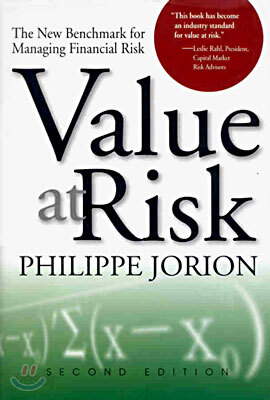
Waht is VaR? VaR is a method of assessing risk that uses standard statistical techiniqes routinely used in other techinical fiedls. Formally, VaR measures the worst expected loss over a given horizno under normal market conditions at a given confidence level. Based on firm scientific foundations, VaR provides users with a summary measure of market risk. ...
In contrast with traditional risk measures, VaR provides an aggressive view of a portfolio's risk that accounts for leverage, correlations and current positions. As a result, it is truly a forward-looking risk measure. VaR, however, applies not only to derivatives but to all financial instruments Furthermore, the methodology can also be broadened from market risk to other types of financial risks. --- Preface |
추천평
사락 별점0
혜택 및 유의사항밑줄0
혜택 및 유의사항상품정보안내
직수입외서의 경우, 해외거래처에서 제공하는 정보가 부족하여 제목, 표지, 가격, 유통상태 등의 정보가 미비하거나 변경되는 경우가 있습니다. 정확한 확인을 원하시는 경우, 일대일 상담으로 문의하여 주시면 답변 드리겠습니다.
(판형과 판수 등이 다양한 도서는 찾으시는 도서의 ISBN을 알려 주시면 보다 빠르고 정확한 안내가 가능합니다.)
해외거래처에서 품절인 경우, 2차 거래선을 통해 유럽과 미국 출판사로 직접 수입이 진행될 수 있습니다.
수입 진행 시점으로 부터 2~3주가 추가로 소요되며, 해외에서도 유통이 원활하지 않은 도서는 품절 안내가 지연될 수 있습니다.
해당 경우, 문자와 메일로 별도 안내를 드리고 있사오니 마이페이지에서 휴대전화번호와 메일주소를 다시 한번 확인해주시기 바랍니다.
(판형과 판수 등이 다양한 도서는 찾으시는 도서의 ISBN을 알려 주시면 보다 빠르고 정확한 안내가 가능합니다.)
해외거래처에서 품절인 경우, 2차 거래선을 통해 유럽과 미국 출판사로 직접 수입이 진행될 수 있습니다.
수입 진행 시점으로 부터 2~3주가 추가로 소요되며, 해외에서도 유통이 원활하지 않은 도서는 품절 안내가 지연될 수 있습니다.
해당 경우, 문자와 메일로 별도 안내를 드리고 있사오니 마이페이지에서 휴대전화번호와 메일주소를 다시 한번 확인해주시기 바랍니다.