
이미 소장하고 있다면 판매해 보세요.
- 국내배송만 가능
- 문화비소득공제 가능
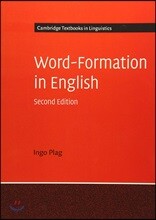
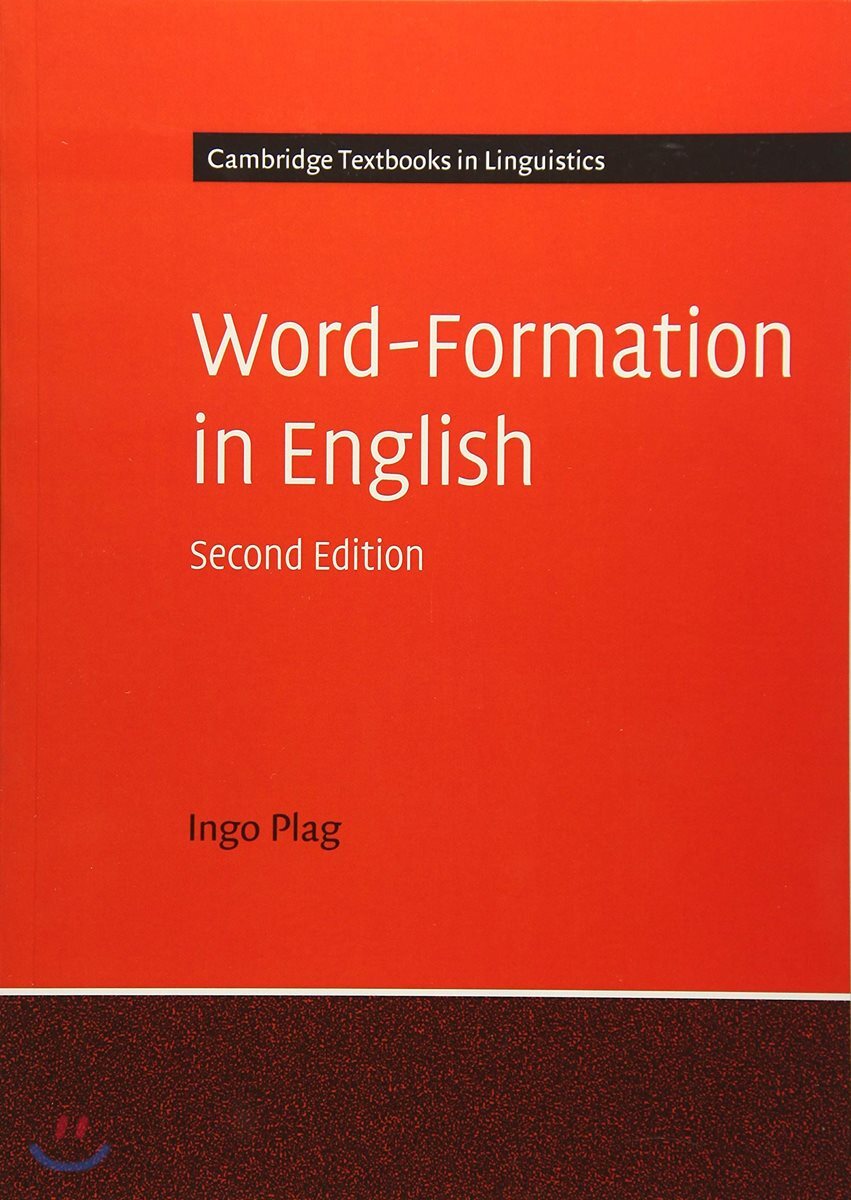
Cambridge Textbooks in Linguistics
-
 Minimalist Syntax: Exploring the Structure of English 이동Minimalist Syntax: Exploring the Structure of English323,530원
 -
Body Movement and Speech in Medical Interaction 이동Body Movement and Speech in Medical Interaction273,480원
-
Handbook of Categorical Algebra: Volume 1, Basic Category Theory 이동Handbook of Categorical Algebra: Volume 1, Basic Category Theory429,000원
책소개
목차
|
Preface to the first edition
Preface to the second edition Abbreviations and notational conventions Introduction: what this book is about and how it can be used 1. Basic concepts 1.1. What is a word? 1.2. Studying word-formation 1.3. Inflection and derivation 1.4. Summary Further reading Exercises 2. Studying complex words 2.1. Identifying morphemes 2.1.1. The morpheme as the minimal linguistic sign 2.1.2. Problems with the morpheme: the mapping of form and meaning 2.2. Allomorphy 2.3. Establishing word-formation rules 2.4. Multiple affixation and compounding 2.5. Summary Further reading Exercises 3. Productivity and the mental lexicon 3.1. Introduction: what is productivity? 3.2. Possible and actual words 3.3. Complex words in the lexicon 3.4. Measuring productivity 3.5. Constraining productivity 3.5.1. Pragmatic restrictions 3.5.2. Structural restrictions 3.5.3. Blocking 3.6. Summary Further reading Exercises 4. Affixation 4.1. What is an affix? 4.2. How to investigate affixes: more on methodology 4.3. General properties of English affixation 4.3.1. Phonological properties 4.3.2. Morphological properties 4.3.3. Semantic properties 4.3.4. Classifying affixes 4.4. Suffixes 4.4.1. Nominal suffixes 4.4.2. Verbal suffixes 4.4.3. Adjectival suffixes 4.4.4. Adverbial suffixes 4.5. Prefixes 4.6. Infixation 4.7. Summary Further reading Exercises 5. Derivation without affixation 5.1. Conversion 5.1.1. The directionality of conversion 5.1.2. Conversion or zero-affixation? 5.1.3. Conversion: syntactic or morphological? 5.2. Prosodic morphology 5.2.1. Truncations: truncated names, -y diminutives, and clippings 5.2.2. Blends 5.3. Abbreviations and acronyms 5.4. Summary Further reading Exercises 6. Compounding 6.1. Recognising compounds 6.1.1. What are compounds made of? 6.1.2. More on the structure of compounds: the notion of head 6.1.3. Canonical and non-canonical compounds 6.1.4. Summary 6.2. An inventory of compounding patterns 6.3. Nominal compounds 6.3.1. Headedness 6.3.2. Interpreting nominal compounds 6.3.3. Stress assignment 6.4. Adjectival compounds 6.5. Verbal compounds 6.6 Neoclassical compounds 6.7. Compounding: syntax or morphology? 6.8. Summary Further reading Exercises 7. Theoretical issues: modelling word-formation 7.1. Introduction: why theory? 7.2. Phonology-morphology interaction 7.3. Affix ordering 7.4. The nature of word-formation rules 7.4.1. Morpheme-based morphology 7.4.2. Word-based morphology 7.4.3. Analogy 7.4.4. Naive Discriminative Learning 7.4.5. Summary Further reading Exercises Answer key to exercises Chapter 1 Chapter 2 Chapter 3 Chapter 4 Chapter 5 Chapter 6 Chapter 7 References Index. |
관련 분류
품목정보
- 발행일
- 2018년 08월 23일
- 쪽수, 무게, 크기
- 258쪽 | 530g | 176*245*12mm
- ISBN13
- 9781316623299
리뷰/한줄평0
상품정보안내
직수입외서의 경우, 해외거래처에서 제공하는 정보가 부족하여 제목, 표지, 가격, 유통상태 등의 정보가 미비하거나 변경되는 경우가 있습니다. 정확한 확인을 원하시는 경우, 일대일 상담으로 문의하여 주시면 답변 드리겠습니다.
(판형과 판수 등이 다양한 도서는 찾으시는 도서의 ISBN을 알려 주시면 보다 빠르고 정확한 안내가 가능합니다.)
해외거래처에서 품절인 경우, 2차 거래선을 통해 유럽과 미국 출판사로 직접 수입이 진행될 수 있습니다.
수입 진행 시점으로 부터 2~3주가 추가로 소요되며, 해외에서도 유통이 원활하지 않은 도서는 품절 안내가 지연될 수 있습니다.
해당 경우, 문자와 메일로 별도 안내를 드리고 있사오니 마이페이지에서 휴대전화번호와 메일주소를 다시 한번 확인해주시기 바랍니다.
(판형과 판수 등이 다양한 도서는 찾으시는 도서의 ISBN을 알려 주시면 보다 빠르고 정확한 안내가 가능합니다.)
해외거래처에서 품절인 경우, 2차 거래선을 통해 유럽과 미국 출판사로 직접 수입이 진행될 수 있습니다.
수입 진행 시점으로 부터 2~3주가 추가로 소요되며, 해외에서도 유통이 원활하지 않은 도서는 품절 안내가 지연될 수 있습니다.
해당 경우, 문자와 메일로 별도 안내를 드리고 있사오니 마이페이지에서 휴대전화번호와 메일주소를 다시 한번 확인해주시기 바랍니다.
49,000원
총 1개
49,000원