
소득공제
직수입양서
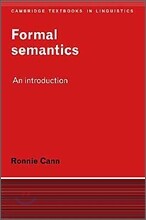
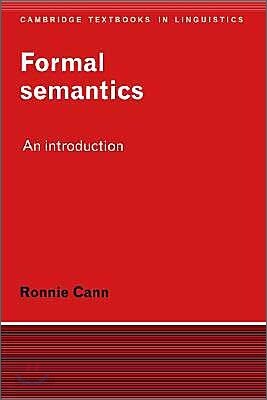
Formal Semantics
An Introduction
Paperback, POD 주문제작도서
Cann, Ronnie (University of Edinburgh)
Cambridge University Press
1993.02.01.
- 주문 제작 (POD) 도서로 제본 및 인쇄 품질이 다소 미흡할 수 있습니다 (해당 사유 반품 불가)
이미 소장하고 있다면 판매해 보세요.
- 국내배송만 가능
- 문화비소득공제 가능
Cambridge Textbooks in Linguistics
-
 Minimalist Syntax: Exploring the Structure of English 이동Minimalist Syntax: Exploring the Structure of English323,530원
 -
Body Movement and Speech in Medical Interaction 이동Body Movement and Speech in Medical Interaction273,480원
-
Handbook of Categorical Algebra: Volume 1, Basic Category Theory 이동Handbook of Categorical Algebra: Volume 1, Basic Category Theory429,000원
책소개
목차
|
1 Introduction 1
1.1 Semantics and semantic theory 1 1.2 Interpretation and representation 13 1.3 Beyond truth-conditions 19 1.4 A note on method 23 1.5 Further reading 25 2 Predicates and Arguments 27 2.1 Translating English into a logical language 27 2.2 Interpreting L[subscript P] 38 2.3 Further reading 53 3 Negation and Co-Ordination 54 3.1 Compound sentences 54 3.2 Complex formulae 55 3.3 Interpretation 60 3.4 Formal interpretation 74 3.5 Further reading 81 4 Type Theory 82 4.1 Verb phrases and other constituents 82 4.2 A typed logical language 83 4.3 More set theory 93 4.4 Interpreting L[subscript type] 98 4.5 Adverbs 107 4.6 Further reading 111 5 The Lambda Operator 112 5.1 The passive 112 5.2 Introducing the lambda operator 115 5.3 Generalising lambda expressions 127 5.4 Reviewing co-ordination 136 5.5 Further reading 149 6 Quantification 150 6.1 The variety of noun phrases 150 6.2 Introducing the logical quantifiers 151 6.3 A compositional approach 159 6.4 Proper names and definite descriptions 172 6.5 Two problems 177 6.6 Generalised quantifiers 187 6.7 Further Reading 195 7 Inference 197 7.1 Making inferences 197 7.2 Logical deduction 200 7.3 Lexical meaning 215 7.4 Non-truth-conditional aspects of the connectives 224 7.5 Further Reading 231 8 Time, Tense and Aspect 233 8.1 Temporal contingency 233 8.2 Time 233 8.3 Tense 241 8.4 Simple aspect 251 8.5 Scope ambiguities 259 8.6 Further reading 262 9 Possible Worlds 263 9.1 Where entailments fail 263 9.2 Intension and extension 267 9.3 Introducing other worlds 269 9.4 Further reading 281 10 Intensional Semantics 282 10.1 Modelling intensions 282 10.2 The intensional language L[subscript IL] 288 10.3 Interpreting opaque contexts 299 10.4 Two problems 315 10.5 Postscript 320 10.6 Further reading |
품목정보
- 발행일
- 1993년 02월 01일
- 쪽수, 무게, 크기
- 362쪽 | 576g | 150*230*20mm
- ISBN13
- 9780521376105
리뷰/한줄평0
상품정보안내
직수입외서의 경우, 해외거래처에서 제공하는 정보가 부족하여 제목, 표지, 가격, 유통상태 등의 정보가 미비하거나 변경되는 경우가 있습니다. 정확한 확인을 원하시는 경우, 일대일 상담으로 문의하여 주시면 답변 드리겠습니다.
(판형과 판수 등이 다양한 도서는 찾으시는 도서의 ISBN을 알려 주시면 보다 빠르고 정확한 안내가 가능합니다.)
해외거래처에서 품절인 경우, 2차 거래선을 통해 유럽과 미국 출판사로 직접 수입이 진행될 수 있습니다.
수입 진행 시점으로 부터 2~3주가 추가로 소요되며, 해외에서도 유통이 원활하지 않은 도서는 품절 안내가 지연될 수 있습니다.
해당 경우, 문자와 메일로 별도 안내를 드리고 있사오니 마이페이지에서 휴대전화번호와 메일주소를 다시 한번 확인해주시기 바랍니다.
(판형과 판수 등이 다양한 도서는 찾으시는 도서의 ISBN을 알려 주시면 보다 빠르고 정확한 안내가 가능합니다.)
해외거래처에서 품절인 경우, 2차 거래선을 통해 유럽과 미국 출판사로 직접 수입이 진행될 수 있습니다.
수입 진행 시점으로 부터 2~3주가 추가로 소요되며, 해외에서도 유통이 원활하지 않은 도서는 품절 안내가 지연될 수 있습니다.
해당 경우, 문자와 메일로 별도 안내를 드리고 있사오니 마이페이지에서 휴대전화번호와 메일주소를 다시 한번 확인해주시기 바랍니다.
144,780원
총 1개
144,780원
