

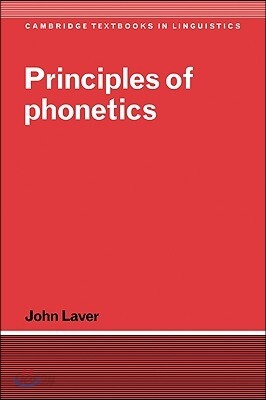
- 주문 제작 (POD) 도서로 제본 및 인쇄 품질이 다소 미흡할 수 있습니다 (해당 사유 반품 불가)
이미 소장하고 있다면 판매해 보세요.
- 국내배송만 가능
- 문화비소득공제 가능
Cambridge Textbooks in Linguistics
-
 Minimalist Syntax: Exploring the Structure of English 이동Minimalist Syntax: Exploring the Structure of English323,530원
 -
Body Movement and Speech in Medical Interaction 이동Body Movement and Speech in Medical Interaction273,480원
-
Handbook of Categorical Algebra: Volume 1, Basic Category Theory 이동Handbook of Categorical Algebra: Volume 1, Basic Category Theory429,000원
책소개
목차
|
Pt. I General concepts
1 The semiotic framework 13 2 The relationship between phonetics and phonology 26 3 Accent, dialect and language 55 Pt. II The analytic framework 4 The phonetic analysis of speech 95 5 The architecture of phonetic classification 119 Pt. III Initiation and phonation 6 Airstream mechanisms 161 7 Phonation 184 Pt. IV Linear segmental analysis 8 Stop articulations 205 9 Fricative articulations 244 10 Resonant articulations 269 11 Multiple articulations 314 Pt. V Articulatory co-ordination and phonetic settings 12 Intersegmental co-ordination 339 13 Phonetic similarity and multisegmental settings 391 Pt. VI Temporal, prosodic and metrical analysis 14 The temporal organization of speech: segmental duration 431 15 The prosodic organization of speech: pitch and loudness 450 16 The metrical organization of speech: stress, syllable weight, prominence and rhythm 511 17 The temporal organization of speech: continuity and rate 534 Pt. VII Principles of transcription 18 Types of transcription 549 Pt. VIII Conclusion 19 Evaluating general phonetic theory 565 Envoi 592 Appendix I: The phonetic alphabet of the International Phonetic Association 593 Appendix II: Index of languages 596 References 622 Index of names 685 Subject index |
품목정보
- 발행일
- 1994년 05월 01일
- 쪽수, 무게, 크기
- 735쪽 | 1007g | 150*230*40mm
- ISBN13
- 9780521456555
리뷰/한줄평0
상품정보안내
직수입외서의 경우, 해외거래처에서 제공하는 정보가 부족하여 제목, 표지, 가격, 유통상태 등의 정보가 미비하거나 변경되는 경우가 있습니다. 정확한 확인을 원하시는 경우, 일대일 상담으로 문의하여 주시면 답변 드리겠습니다.
(판형과 판수 등이 다양한 도서는 찾으시는 도서의 ISBN을 알려 주시면 보다 빠르고 정확한 안내가 가능합니다.)
해외거래처에서 품절인 경우, 2차 거래선을 통해 유럽과 미국 출판사로 직접 수입이 진행될 수 있습니다.
수입 진행 시점으로 부터 2~3주가 추가로 소요되며, 해외에서도 유통이 원활하지 않은 도서는 품절 안내가 지연될 수 있습니다.
해당 경우, 문자와 메일로 별도 안내를 드리고 있사오니 마이페이지에서 휴대전화번호와 메일주소를 다시 한번 확인해주시기 바랍니다.
(판형과 판수 등이 다양한 도서는 찾으시는 도서의 ISBN을 알려 주시면 보다 빠르고 정확한 안내가 가능합니다.)
해외거래처에서 품절인 경우, 2차 거래선을 통해 유럽과 미국 출판사로 직접 수입이 진행될 수 있습니다.
수입 진행 시점으로 부터 2~3주가 추가로 소요되며, 해외에서도 유통이 원활하지 않은 도서는 품절 안내가 지연될 수 있습니다.
해당 경우, 문자와 메일로 별도 안내를 드리고 있사오니 마이페이지에서 휴대전화번호와 메일주소를 다시 한번 확인해주시기 바랍니다.
219,860원
총 1개
219,860원