
소득공제
크레마클럽
PDF
eBook
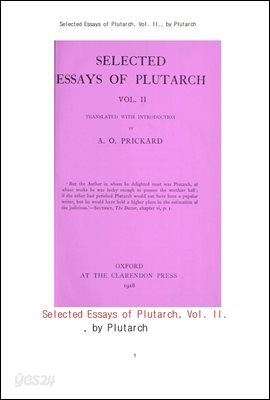
플루타르크의 선별된 에세이 제2집.Selected Essays of Plutarch, Vol. II., by Plutarch
PDF
- PDF 안내
-
이 상품은 구매 후 지원 기기에서 예스24 eBook앱 설치 후 바로 이용 가능한 상품입니다.
이 상품의 태그














소개
목차
|
플루타르크의 선별된 에세이 제1집. Selected Essays of Plutarch, Vol. I., by Plutarch
CONTENTS On the Genius of Socrates 1 Three Pythian Dialogues 52 I. On the ‘E’ at Delphi 57 II. Why the Pythia does not now give Oracles in Verse 79 III. On the Cessation of the Oracles 112 On the Instances of Delay in Divine Punishment 171 From the Dialogue ‘On the Soul’ 214 On Superstition 219 Appendix: A Short Discourse of Superstition. By John Smith 236 On the Face which appears on the Orb of the Moon 246 Notes 309 Note on the Myths in Plutarch 313 Note on the Plurality of Worlds and the Five Regular Solids 318 Index 321 |
저자 소개
플루타르크의 선별된 에세이 제1집. Selected Essays of Plutarch, Vol. I., by Plutarch
플루타르크 46?-120? 그리스의 철학자로 영웅전 작가
품목정보
- 발행일
- 2020년 08월 09일
- 지원기기
- 크레마, PC(윈도우 - 4K 모니터 미지원), 아이폰, 아이패드, 안드로이드폰, 안드로이드패드, 전자책단말기(저사양 기기 사용 불가), PC(Mac)
- 파일/용량
- PDF(DRM) | 2.44MB ?
- ISBN13
- 9791190842891
- KC인증
-
출판사 리뷰
|
플루타르크의 선별된 에세이 제2집. Selected Essays of Plutarch, Vol. I., by Plutarch
PREFACE This volume covers about one- eighth part of the miscellaneous works of Plutarch known as the Moralia, much the same quantity as is contained in Professor Tucker’s volume of this series which appeared in 1913. All the pieces now offered are in the form of dialogue, except the short treatise On Superstition, which seemed to justify its inclusion by a certain affinity of thought. The text followed is that of Wyttenbach, issued by the Clarendon Press in 1795- 1800, or rather a text compounded of the Greek text there printed, his own critical notes and revision of the old Latin version, his commentary, where one exists, and his posthumous Index of Greek words used by Plutarch (1830). A few corrections by C. F. Hermann, Emperius, Madvig, and other scholars, have been introduced, for many of which I am indebted, in the first place, as I have acknowledged more particularly, to M. G. N. Bernardakis, the accomplished editor of the Moralia in the Teubner series (1888- 96). A very few fresh corrections, mostly on obvious points, have been admitted. The notes at the foot of the page are intended to show all deviations from Wyttenbach’s text, so constituted, or to give references to the authors of passages quoted by Plutarch; there may be a few exceptions, where an illustrative reference or an obvious explanation is given. For the plays and fragments of the Tragic Poets reference is made to Dindorf’s Poetae Scenici; for Pindar and other lyric poets, to Bergk’s Poetae Lyrici Graeci (ed. 1900); for the fragments of Heraclitus, to Bywater’s Heracliti Ephesii reliquiae (Oxford, 1877); iv those of other early philosophers will be found in their places in Diels’ Vorsokratiker (1903) or other collections. |
