

이미 소장하고 있다면 판매해 보세요.
- 국내배송만 가능
- 문화비소득공제 가능
이 상품의 태그















책소개
목차
|
1. 서론
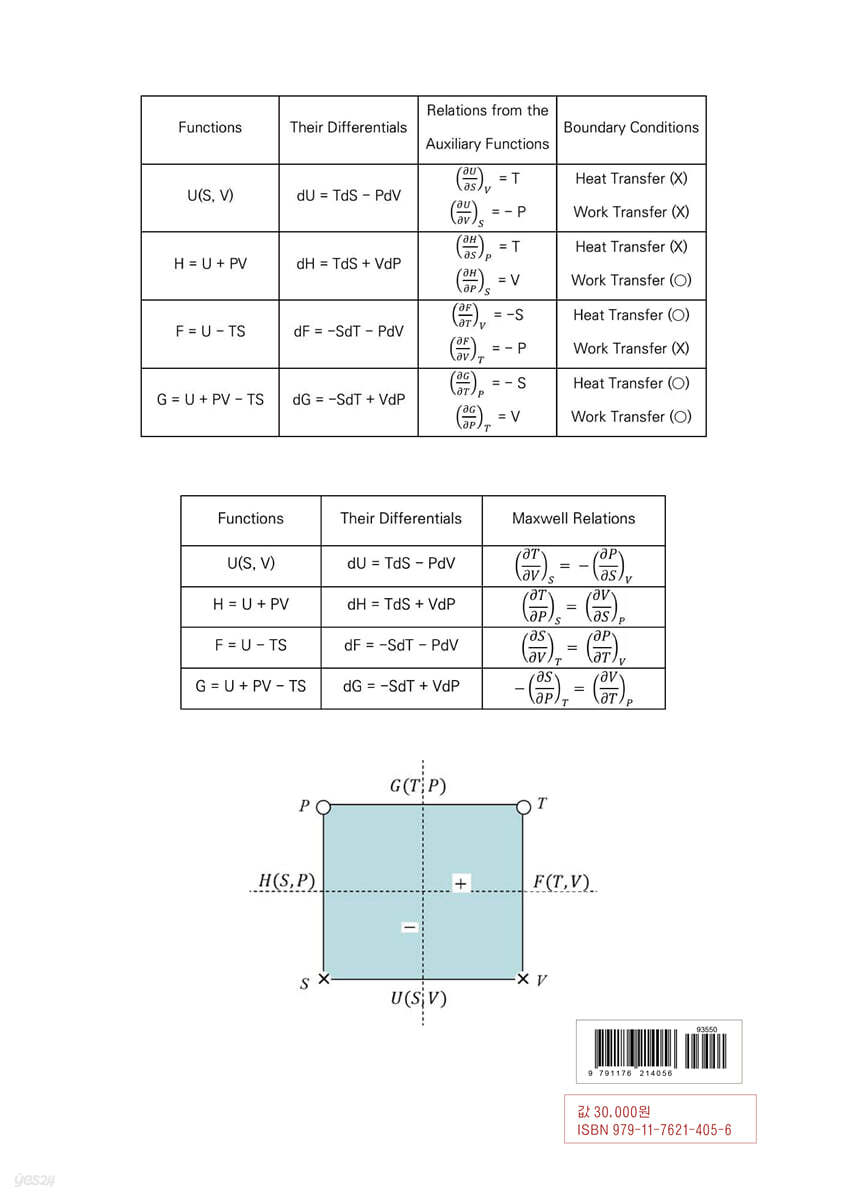
[연습문제] 1. 열역학 제1, 2, 3 법칙 [연습문제] Ⅲ. 상태, 상태변수 그리고 프로세스 [연습문제] IV. 이상기체의 거동 IV-1 Boyle-Charles Gas Law IV-2 Van der Waals Equation IV-3 Internal Energies of Ideal Gas and Real Gas [연습문제] V. 상태 변화 과정과 열 용량 V-1 Processes of Ideal Gas (1) 등체적과정 (Constant Volume Process) (2) 등압과정 (Constant Pressure Process) (3) 단열과정 (Adiabatic Process) (4) 등온과정 (Isothermal Process) V-2 Heat Capacity V-3 Enthalpy, H V-4 Temperature Change during an Adiabatic Process [연습문제] VI. 엔트로피의 통계역학적 해석 VI-1 Definition of Entropy S VI-2 Statistical Interpretation of Entropy VI-3 Thermal Entropy and Configurational Entropy VI-4 Boltzmann Distribution Function VI-5 Proof of InΩ being proportional to Clausius Entropy S [연습문제] VII. 가역과정과 비가역과정 VII-1 Irreversible Process VII-2 Entropy of Irreversible Processes [연습문제] VIII. 보조함수 VIII-1 Geometric Relations VIII-2 Auxiliary Functions (1) Enthalpy (2) Helmholtz Free Energy (3) Gibbs Free Energy VIII-3 Differentials of Auxiliary Functions VIII-4 Maxwell Relations VIII-5 Applications of Maxwell Relation using Experimentally determined Parameters [연습문제] IX. 엔탈피와 엔트로피 함수 그리고 Gibbs 자유에너지 IX-1 Enthalpy as a function of Temperature under a constant Pressure IX-2 Entropy as a function of Temperature under a constant Pressure IX-3 Gibbs Free Energy as a function of Temperature under a constant Pressure. IX-4 Phase Diagram determined from Gibbs Free Energy Change with Temperature and Pressure IX-5 Clapeyron Equation IX-6 Clausius-Clapeyron Equation [연습문제] X. 실제기체의 거동 X-1 Temperature Variation by Heat Transfer under constant Pressure X-2 Pressure Variation by Work Transfer under constant Temperature X-3 Van der Waals Gas Model describing Real Gas Behavior [연습문제] XI. 혼합 기체의 거동 XI-1 Gibbs Free Energy Variation with Pressure under constant Temperature XI-2 Mixture of Ideal Gases XI-3 Partial Molar Quantities and their Physical Meanings XI-4 Chemical Potential as a Partial Molar Quantities XI-5 Equilibrium Vapor Pressure of a Component in Condensed Solutions XI-6 Activity and Activity Coefficient XI-7 Raoult's Law and Henry's Law XI-8 Chemical Potential and Activity [연습문제] XII. 화학반응 평형 XII-1 Reactions involving Gases XII-2 Effect of Temperature on Chemical Reaction Equilibrium XII-3 Reference Pressure and Effect of Total Pressure on Chemical Reactions XII-4 Reactions involving Pure Condensed Phases and a Gaseous Phase (1) CO/CO2 비율 조절을 이용한 산소분압 조절 (2) H2/H2O 비율 조절을 이용한 산소분압 조절 XII-5 Reactions involving Condensed Solution Phases and a Gaseous Phase [연습문제] XIII. 상태도 XIII-1 Free Energy Change as a Solute dissolving into a Matrix XIII-2 Gibbs Free Energy of a Binary System XIII-3 Ideal Solution XIII-4 Development of Phase Diagrams XIII-5 Development of Eutectic Phase Diagrams XIII-6 Development of Other Phase Diagrams [연습문제] XIV. 용액모델 XIV-1 Non-ideal Mixing XIV-2 Regular Solution Model [연습문제] XV. 전기화학 [중급] XV-1 lonization Energy of an Element XV-2 Equilibrium in Two Phase Systems involving an Electrolyte XV-3 Equilibrium in an Electrochemical Cell XV-4 Standard Hydrogen Electrode XV-5 Pourbaix Diagram (1) The Stability of Water (2) Pourbaix Diagram for Copper [연습문제] XVI. 우세 영역도 [중급] (Predominance Area Diagram) XVI-1 Reactions of a Metal with a Single Gas Component XVI-2 Reactions of a Metal with Two Gas Components [연습문제] XVII. 계면 열역학 [중급] XVII-1 Geometry of Surfaces XVII-2 Conditions for Equilibrium in Systems with Curved Interfaces XVII-3 Equilibrium Conditions in Unary Systems with Curved Boundaries XVII-4 Chemical Potential of Atoms on Curved Surfaces [연습문제] XVIII. 결정결함 (Defects in Crystals) [중급] XVIII-1 Point Defects in Elemental Crystals XVIII-2 Conditions for Equilibrium in a Crystal with Vacancies XVIII-3 Equilibrium Concentration of Vacancies in a Crystal XVIII-4 Point Defects in Stoichiometric Compound Crystals (1) Frenkel Defects (2) Schottky Defects. (3) Defect Association (4) Extrinsic Point Defects in Stoichiometric Compound Crystals XVIII-5 Point Defects in Non-stoichiometric Compound Crystals (1) 산소결핍형 산화물 (2) 산소과잉형 산화물 (3) Brouwer Diagram (4) Extrinsic Point Defects in Non-stoichiometric Compound Crystals [연습문제] XIX. 자유에너지의 의미 [중급] XIX-1 Euler Equation XIX-2 Legendre Transformation XIX-3 Free Energy Functions XIX-4 Equilibrium Condition [연습문제] XX. 희박용액 (Dilute Solution) [중급] XX-1 Activities in Dilute Solutions XX-2 Transformation of Standard States XX-3 Measurements of Activity [연습문제] XXI. 용액의 기준상태 [중급] XXI-1 Standard State of Components in Solutions [연습문제] [주요 용어 정리] 부록 A. 주관식 문제. B. 연습문제 [정량적 문제] 풀이 찾아보기 (Index) |
저자 소개 1
서울대학교 무기재료공학과 학/석/박사.
영남대학교 신소재공학부 교수.
전공분야 : 세라믹 (습식) 분말 공정, 산화물/비산화물 세라믹 소결, 방열소재/열계면소재, 이산요소분석법(Discrete Element Analysis).
품목정보
- 발행일
- 2026년 08월 01일
- 쪽수, 무게, 크기
- 344쪽 | 182*257*30mm
- ISBN13
- 9791176214056
출판사 리뷰
|
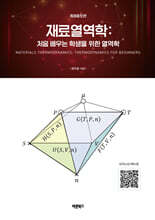
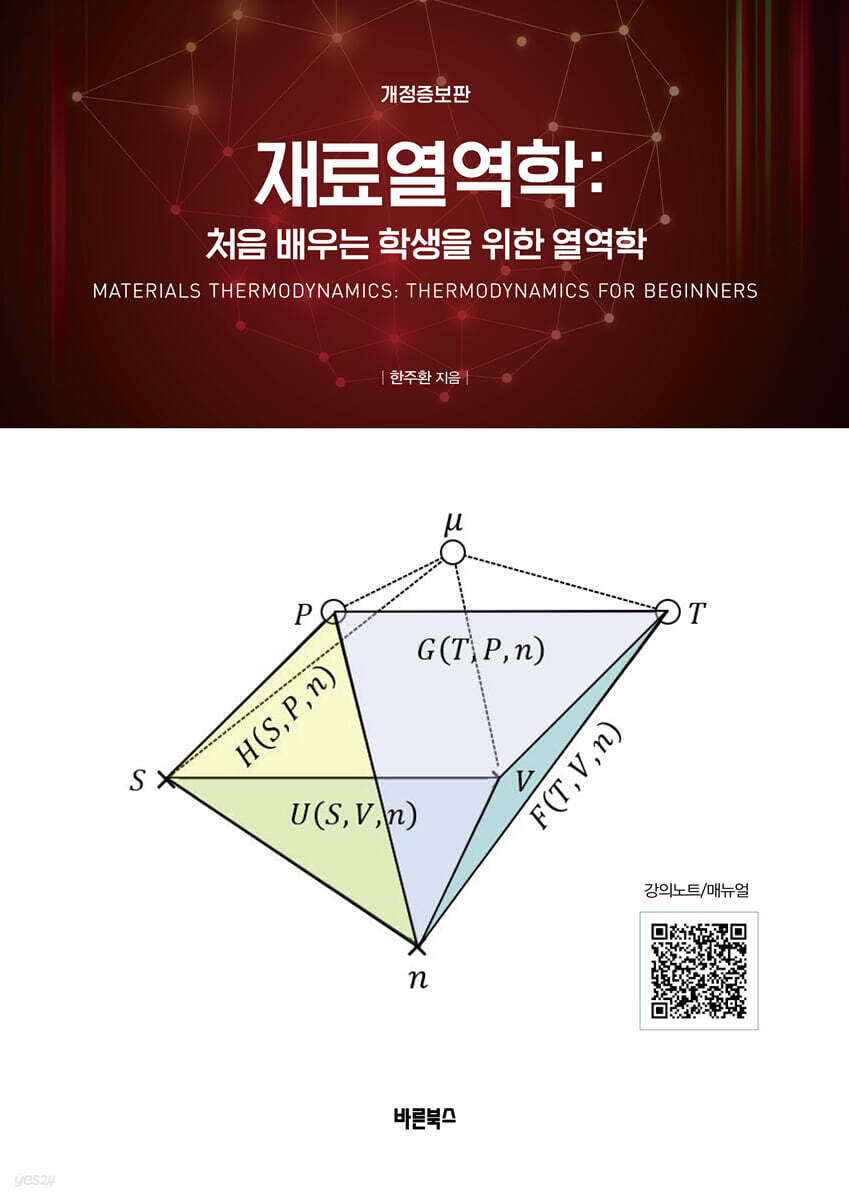
이 책은 열역학을 처음 접하는 학생을 위해서 집필되었습니다. 열역학은 공학 전반의 기초 학문으로, 기계공학과 화학공학을 포함한 다양한 공학 분야에서 필수적인 기초 학문입니다. 그중에서도 이 책은 재료와 관련된 열역학에 초점을 맞추어, 열과 일의 출입에 따른 재료 내부에서 일어나는 다양한 현상과 그 발생 원리를 이해하는 데 목적을 두고 있습니다.
[교재의 핵심 내용 및 구성] * 열역학의 근본 원리 체계적 설명: 본 교재는 자연현상에서 관찰되는 3가지 근본 섭리 (즉, 에너지 보존 [제1 법칙], 자발적 과정에서 나타나는 엔트로피의 증가 [제2 법칙], 그리고 엔트로피 시작점의 존재 [제3 법칙])를 바탕으로 열과 일이 출입함에 따라 재료 내부에서 나타나는 상태의 변화, 평형, 상전이, 화학반응 등을 지배하는 원리를 이해하는 것을 목적으로 합니다. * Gibbs 자유에너지 중심의 예측: 특히 자발적 변화의 방향과 평형을 가늠하는 핵심 상태함수인 Gibbs 자유에너지 G를 통해 기체의 거동, 용액의 형성, 상변태, 화학 반응 등 다양한 재료 현상을 정량적으로 해석하고 예측할 수 있게 합니다. * 응용 분야 및 모델 소개: 이상기체/실제기체 모델, 이상용액/정규용액 모델 등 이론적 도구를 소개하고, 이를 화학반응 평형 (Ellingham 도표), 상평형 (상태도), 전기화학적 평형 (Nernst 방정식, Pourbaix 도표)과 같은 실제 문제에 적용하는 방법을 설명합니다. * 학습 편의를 위한 구조: 독자의 학습을 돕기 위해 각 장은 개념 설명과 물리적 해석을 우선하며, 필요한 수식은 맥락과 목적을 분명히 한 뒤 도입했습니다. 또한, 핵심 정리, 예제, 요약, 그리고 개념 점검 문제를 통해 스스로 학습 내용을 점검할 수 있도록 구성되어 있습니다. * 추가 학습 자료 제공: 강의 노트와 문제 풀이집은 ‘https://ceramic.yu.ac.kr’에서 제공됩니다. 특히 열역학 계산을 경험해 볼 수 있는 프로그램도 제공하고 있습니다. 본 교재는 열역학이 단순한 이론을 넘어 재료 설계, 개발, 공정 제어의 확고한 과학적 기반임을 분명히 하며, 재료의 안정성, 상변화, 화학반응을 지배하는 근본 원리를 중심으로 깊이 있는 이해를 돕습니다. |
사락 별점0
혜택 및 유의사항밑줄0
혜택 및 유의사항
27,000원
총 1개
27,000원
