
소득공제
외서
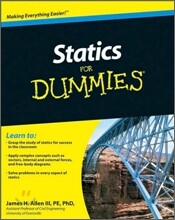
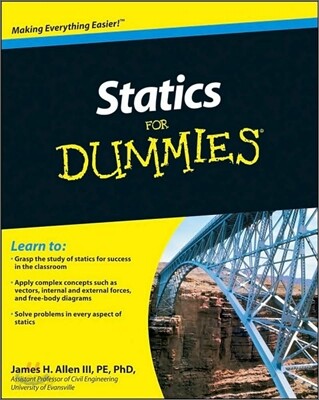
Statics for Dummies
A Leader's Guide for Building Inner Excellence
Paperback
Allen, James H.
For Dummies
2010.08.20.
이미 소장하고 있다면 판매해 보세요.
- 국내배송만 가능
- 문화비소득공제 가능
For Dummies
-
 Microsoft 365 Office All-in-One For Dummies 이동Microsoft 365 Office All-in-One For Dummies18% 56,970원
 -
Microsoft 365 Excel VBA Programming For Dummies 이동Microsoft 365 Excel VBA Programming For Dummies18% 49,840원
책소개
목차
|
Introduction 1 Part I: Setting the Stage for Statics 7 Chapter 1: Using Statics to Describe the World around You 9 Chapter 2: A Quick Mathematics Refresher 17 Chapter 3: Working with Unit Systems and Constants 31 Part II: Your Statics Foundation: Vector Basics 39 Chapter 4: Viewing the World through Vectors 41 Chapter 5: Using Vectors to Better Defi ne Direction 51 Chapter 6: Vector Mathematics and Identities 69 Chapter 7: Turning Multiple Vectors into a Single Vector Resultant 79 Chapter 8: Breaking Down a Vector into Components 95 Part III: Forces and Moments as Vectors 107 Chapter 9: Applying Concentrated Forces and External Point Loads 109 Chapter 10: Spreading It Out: Understanding Distributed Loads 123 Chapter 11: Finding the Centers of Objects and Regions 135 Chapter 12: Special Occasions in the Life of a Force Vector: Moments and Couples 149 Part IV: A Picture Is Worth a Thousand Words (Or At Least a Few Equations): Free-Body Diagrams 167 Chapter 13: Anatomy of a Free-Body Diagram 169 Chapter 14: The F.B.D.: Knowing What to Draw and How to Draw It 185 Chapter 15: Simplifying a Free-Body Diagram 199 Part V: A Question of Balance: Equilibrium 207 Chapter 16: Mr. Newton Has Entered the Building: The Basics of Equilibrium 209 Chapter 17: Taking a Closer Look at Two-Dimensional Equilibrium: Scalar Methods 219 Chapter 18: Getting Better Acquainted with Three-Dimensional Equilibrium: Vector Methods 229 Part VI: Statics in Action 241 Chapter 19: Working with Trusses 243 Chapter 20: Analyzing Beams and Bending Members 259 Chapter 21: Working with Frames and Machines 279 Chapter 22: A Different Kind of Axial System: Cable Systems 293 Chapter 23: Those Darn Dam Problems: Submerged Surfaces 309 Chapter 24: Incorporating Friction into Your Applications 321 Part VII: The Part of Tens 339 Chapter 25: Ten Steps to Solving Any Statics Problem 341 Chapter 26: Ten Tips for Surviving a Statics Exam 347 Index 353 |
저자 소개
James H. Allen III, PE, PhD, is a registered professional engineer who teaches courses in the areas of statics, mechanics, structural engineering, and steel design.
관련 분류
품목정보
- 발행일
- 2010년 08월 20일
- 쪽수, 무게, 크기
- 384쪽 | 크기확인중
- ISBN13
- 9780470598948
리뷰/한줄평0
상품정보안내
직수입외서의 경우, 해외거래처에서 제공하는 정보가 부족하여 제목, 표지, 가격, 유통상태 등의 정보가 미비하거나 변경되는 경우가 있습니다. 정확한 확인을 원하시는 경우, 일대일 상담으로 문의하여 주시면 답변 드리겠습니다.
(판형과 판수 등이 다양한 도서는 찾으시는 도서의 ISBN을 알려 주시면 보다 빠르고 정확한 안내가 가능합니다.)
해외거래처에서 품절인 경우, 2차 거래선을 통해 유럽과 미국 출판사로 직접 수입이 진행될 수 있습니다.
수입 진행 시점으로 부터 2~3주가 추가로 소요되며, 해외에서도 유통이 원활하지 않은 도서는 품절 안내가 지연될 수 있습니다.
해당 경우, 문자와 메일로 별도 안내를 드리고 있사오니 마이페이지에서 휴대전화번호와 메일주소를 다시 한번 확인해주시기 바랍니다.
(판형과 판수 등이 다양한 도서는 찾으시는 도서의 ISBN을 알려 주시면 보다 빠르고 정확한 안내가 가능합니다.)
해외거래처에서 품절인 경우, 2차 거래선을 통해 유럽과 미국 출판사로 직접 수입이 진행될 수 있습니다.
수입 진행 시점으로 부터 2~3주가 추가로 소요되며, 해외에서도 유통이 원활하지 않은 도서는 품절 안내가 지연될 수 있습니다.
해당 경우, 문자와 메일로 별도 안내를 드리고 있사오니 마이페이지에서 휴대전화번호와 메일주소를 다시 한번 확인해주시기 바랍니다.
23,000원
총 1개
23,000원