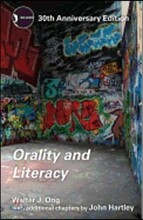

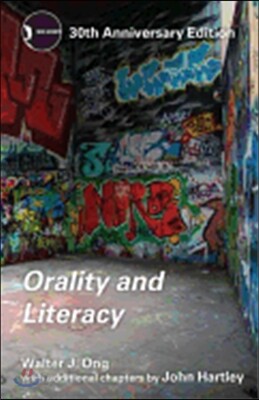
John Hartley: Before Ongism: "To become what we want to be, we have to decide what we were" Orality & Literacy: The Technologization Of The Word Introduction Part1: The orality of language 1. The literate mind and the oral past 2. Did you say ‘oral literature’? Part2: The modern discovery of primary oral cultures 1. Early awareness of oral tradition 2. The Homeric question 3. Milman Parry’s discovery 4. Consequent and related work Part3: Some psychodynamics of orality 1. Sounded word as power and action 2. You know what you can recall: mnemonics and formulas 3. Further characteristics of orally based thought and expression 4. Additive rather than subordinative 5. Aggregative rather than analytic 6. Redundant or ‘copious’ 7. Conservative or traditionalist 8. Close to the human lifeworld 9. Agonistically toned 10. Empathetic and participatory rather than objectively distanced 11. Homeostatic 12. Situational rather than abstract 13. Oral memorization 14. Verbomotor lifestyle 15. The noetic role of heroic ‘heavy’ ?gures and of the bizarre 16. The interiority of sound 17. Orality, community and the sacral 18. Words are not signs Part4: Writing restructures consciousness 1. The new world of autonomous discourse 2. Plato, writing and computers 3. Writing is a technology 4. What is ‘writing’ or ‘script’? 5. Many scripts but only one alphabet 6. The onset of literacy 7. From memory to written records 8. Some dynamics of textuality 9. Distance, precision, grapholects and magnavocabularies 10. Interactions: rhetoric and the places 11. Interactions: learned languages 12. Tenaciousness of orality Part5: Print, space and closure 1. Hearing-dominance yields to sight-dominance 2. Space and meaning 3. Indexes 4. Books, contents and labels 5. Meaningful surface 6. Typographic space 7. More diffuse effects 8. Print and closure: intertextuality 9. Post-typography: electronics Part6: Oral memory, the story line and characterization 1. The primacy of the story line 2. Narrative and oral cultures 3. Oral memory and the story line 4. Closure of plot: travelogue to detective story 5. The ‘round’ character, writing and print Part7: Some theorems 1. Literary history 2. New Criticism and Formalism 3. Structuralism 4. Textualists and deconstructionists 5. Speech-act and reader-response theory 6. Social sciences, philosophy, biblical studies 7. Orality, writing and being human 8. ‘Media’ versus human communication 9. The inward turn: consciousness and the text John Hartley: After Ongism: The Evolution of Networked Intelligence
직수입외서의 경우, 해외거래처에서 제공하는 정보가 부족하여 제목, 표지, 가격, 유통상태 등의 정보가 미비하거나 변경되는 경우가 있습니다. 정확한 확인을 원하시는 경우, 일대일 상담으로 문의하여 주시면 답변 드리겠습니다. (판형과 판수 등이 다양한 도서는 찾으시는 도서의 ISBN을 알려 주시면 보다 빠르고 정확한 안내가 가능합니다.)
해외거래처에서 품절인 경우, 2차 거래선을 통해 유럽과 미국 출판사로 직접 수입이 진행될 수 있습니다. 수입 진행 시점으로 부터 2~3주가 추가로 소요되며, 해외에서도 유통이 원활하지 않은 도서는 품절 안내가 지연될 수 있습니다. 해당 경우, 문자와 메일로 별도 안내를 드리고 있사오니 마이페이지에서 휴대전화번호와 메일주소를 다시 한번 확인해주시기 바랍니다.