
이미 소장하고 있다면 판매해 보세요.
- 국내배송만 가능
- 해외 거래처 사정에 의하여 품절/지연 가능
- 도서 정보 중 미표기 사항 안내?
- 문화비소득공제 가능
For Dummies
-
 Microsoft 365 Office All-in-One For Dummies 이동Microsoft 365 Office All-in-One For Dummies18% 58,610원
 -
Microsoft 365 Excel VBA Programming For Dummies 이동Microsoft 365 Excel VBA Programming For Dummies18% 51,280원
책소개
목차
|
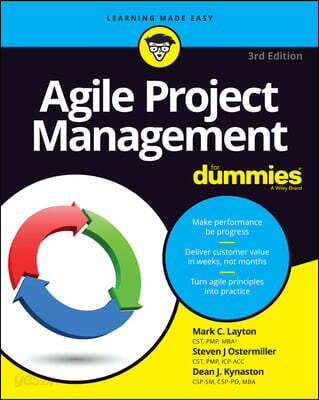
Introduction 1 Part1: Understanding Agility 5 Chapter 1: Modernizing Project Management 7 Chapter 2: Applying the Agile Manifesto and Principles 21 Chapter 3: Why Being Agile Works Better 49 Chapter 4: Agility Is about Being Customer Focused 69 Part2: Being Agile 89 Chapter 5: Agile Approaches 91 Chapter 6: Agile Environments in Action 109 Chapter 7: Agile Behaviors in Action 123 Chapter 8: The Permanent Team 149 Part3: Agile Planning and Execution 159 Chapter 9: Defining the Product Vision and Product Roadmap 161 Chapter 10: Planning Releases and Sprints 183 Chapter 11: Working throughout the Day 215 Chapter 12: Showcasing Work, Inspecting, and Adapting 239 Part4: Agility Management 251 Chapter 13: Managing a Portfolio: Pursuing Value over Requirements 253 Chapter 14: Managing Scope and Procurement 269 Chapter 15: Managing Time and Cost 287 Chapter 16: Managing Team Dynamics and Communication 307 Chapter 17: Managing Quality and Risk 331 Part5: Ensuring Success 355 Chapter 18: Building a Foundation 357 Chapter 19: De-Scaling across Teams 373 Chapter 20: Being a Change Agent 395 Part6: The Part of Tens 421 Chapter 21: Ten Key Benefits of Agile Product Development 423 Chapter 22: Ten Key Factors for Agile Product Development Success 431 Chapter 23: Ten Signs That You’re Not Agile 437 Chapter 24: Ten Valuable Resources for Agile Professionals 449 Index 455 |
저자 소개
Mark C. Layton is an entrepreneur and certification instructor with 25 years of experience in organizational design.
Steven J Ostermiller is a community builder, agile trainer and coach helping organizations and people become more agile.
Dean J. Kynaston is a coach, Certified Scrum Professional, and organizational agile transformation leader.
품목정보
- 발행일
- 2020년 09월 29일
- 쪽수, 무게, 크기
- 496쪽 | 635g | 188*234*33mm
- ISBN13
- 9781119676997
리뷰/한줄평0
상품정보안내
직수입외서의 경우, 해외거래처에서 제공하는 정보가 부족하여 제목, 표지, 가격, 유통상태 등의 정보가 미비하거나 변경되는 경우가 있습니다. 정확한 확인을 원하시는 경우, 일대일 상담으로 문의하여 주시면 답변 드리겠습니다.
(판형과 판수 등이 다양한 도서는 찾으시는 도서의 ISBN을 알려 주시면 보다 빠르고 정확한 안내가 가능합니다.)
해외거래처에서 품절인 경우, 2차 거래선을 통해 유럽과 미국 출판사로 직접 수입이 진행될 수 있습니다.
수입 진행 시점으로 부터 2~3주가 추가로 소요되며, 해외에서도 유통이 원활하지 않은 도서는 품절 안내가 지연될 수 있습니다.
해당 경우, 문자와 메일로 별도 안내를 드리고 있사오니 마이페이지에서 휴대전화번호와 메일주소를 다시 한번 확인해주시기 바랍니다.
(판형과 판수 등이 다양한 도서는 찾으시는 도서의 ISBN을 알려 주시면 보다 빠르고 정확한 안내가 가능합니다.)
해외거래처에서 품절인 경우, 2차 거래선을 통해 유럽과 미국 출판사로 직접 수입이 진행될 수 있습니다.
수입 진행 시점으로 부터 2~3주가 추가로 소요되며, 해외에서도 유통이 원활하지 않은 도서는 품절 안내가 지연될 수 있습니다.
해당 경우, 문자와 메일로 별도 안내를 드리고 있사오니 마이페이지에서 휴대전화번호와 메일주소를 다시 한번 확인해주시기 바랍니다.