
이미 소장하고 있다면 판매해 보세요.
- 해외배송 가능?
- 문화비소득공제 가능
관련 상품
이 상품의 태그


책소개
목차
|
Preface
Chapter One. Biotechnological Crops 1-1. Conventional Crossbreeding and the Green Revolution 1-2. Emergence of Biotechnology 1-3. Nomenclature of Biotech Crops 1-4. Benefits and Safety of Biotech Crops Chapter Two. History and Status Quo of Biotech Crops 2-1. History of Biotech Crops 2-2. The Status Quo of GMO Crop Yield Chapter Three. Processes of Biotech Crops Development 3-1. Extracting Genes of Desirable Traits 3-2. DNA Recombination 3-3. Methods to Transform Recombinant Genes 3-4. Regeneration and the Event Selection of Biotech Crops 3-5. Marker Free Technology 3-6. Plastid Transformation Chapter Four. Biotech Crops in the Field 4-1. Examples and Breeding Principles of Biotech Crops a. Herbicide Tolerant Crops b. Insect-Resistant Crops c. Virus Disease Resistant Crops d. Oil Crops with Improved Fatty Acid Composition e. Plant with Improved Starch Contents and Structures f. Delayed-Ripening Tomato and Biotech Vaccines g. Biotech Crops Tolerant to Environmental Stresses h. Plants Resistant to Bacterial and Fungal Diseases i. Ultra Productive Rice with Immensely Increased Yield Productivity j. Coffee without Caffeine k. Blue Roses and Carnations l. Landmine Detecting Plants m. Duplicate Gene Transplant and Gene Stacked Event 4-2. Current State and Prospect of Biotech Rice Research 4-3. The Status of Korea 4-4. Effects of Bioengineered Crops Chapter Five. Risk Assessment and Regulation of Biotech Crops and Foods 5-1. Risk Assessment of Biotech Foods 5-2. Food Safety Assessment Principle and Method 5-3. Example of Food Safety Test of Biotech Crop in Korea a. Judgment on Substantial Equivalence b. Purpose of Development and Its Usage c. Details about Host d. Details about Vector e. Details about Transgene and Its Product f. Details on Transformant 5-4. Evaluation of the Biotech Crops on Environmental Safety 5-5. The Rules and Methods of Environmental Risk Evaluation 5-6. Approved Biotech Crops in Korea Chapter Six. Safety Management Status of Biotech Crops 6-1. South Korea 6-2. United States of America 6-3. Japan 6-4. Canada 6-5. EU 6-6. OECD Chapter Seven. Biotech Crops and the Consumer’s Option 7-1. Labeling of Genetically Modified Organism in South Korea 7-2. Labeling of Genetically Modified Organisms in Other Countries 7-3. Authorized Analysis Methods a. Enzyme Linked ImmunoSorbent Assay Method b. Polymerase Chain Reaction (PCR) Methods Chapter Eight. Disputes over and the Scientific Facts of Biotechnological Crops 8-1. The Safety of the Human Body and Related Scientific Facts a. Doctor Pusetie’s Research b. The StarLink Corn Case c. Weevil in Australia d. Irina Ermakova e. The Mass Death of Sheep in India 8-2. Safety within the Environment and Related Scientific Facts a. Emergence of Super Weeds b. The Killing of Monarch Butterflies Caterpillar 8-3. Conclusion Chapter Nine. The Possibility and the Future of Genetically Crops Translator’s Note |
저자 소개
저 자 소 개
Agricultural Biotechnology Studying Group(농업생명공학기술바로알기협의회)
Lead Author
Choi, Yang Do(최양도)
1976 Seoul National University BSc in Agricultural Chemistry
1978 Korea Advanced Institute of Science (KAIS) Master’s degree in Bioengineering
1985 Northwestern University Doctor’s degree in Cell & Molecular Biology
1986~Now, Professor of Agriculture and Life Sciences in Seoul National University
2001~Now, Head of Crop Functional Genomic Center-Funded by 21st Century Frontier of South Korea Ministry of Education, Science and Technology
Lead Author
Choi, Yang Do(최양도)
1976 Seoul National University BSc in Agricultural Chemistry
1978 Korea Advanced Institute of Science (KAIS) Master’s degree in Bioengineering
1985 Northwestern University Doctor’s degree in Cell & Molecular Biology
1986~Now, Professor of Agriculture and Life Sciences in Seoul National University
2001~Now, Head of Crop Functional Genomic Center-Funded by 21st Century Frontier of South Korea Ministry of Education, Science and Technology
역자 : Transbio
Transbio는 용인 외대부속고등학교(HAFS, Hankuk Academy of Foreign Studies)에 재학 중이던 아홉 명의 학생들로 이루어진 생물학 도서 번역동아리이다. 서울대학교 응용생물학부 최양도 교수의 “식탁 위의 생명공학” 강의에 깊은 감명을 받고 이 책을 번역하였다. 아홉 명의 학생들은 외대부고를 졸업한 후 대학에 진학하여 관련 학과에서 공부하고 있다.
Kim, Nawoo(김나우)/ Choi, Joo Hee(최주희)/ Han, Hae In(한해인)/ Han, JiYun(한지윤)/ Kim, Gaon(김가온)/ Kim, Min Sik(김민식)/ Lee, Chae Eun(이채은)/ Park, Jieun(박지은)/ Suh, Juhyung(서주형)/ Woo, Sunyoung(우선영)
Transbio is a book translation club managed by nine former students of HAFS (Hankuk Academy of Foreign Studies) who have common interest in the study of biotechnology. Nawoo Kim, one of the students and the head of Transbio, founded the club in order to let as many people as possible to become accessible to useful knowledge. After listening to the lecture “Biotechnology on a Table”(based on the contents of the book with the same title) by Professor Choi Yang Do of Seoul National University, she not only became to know the importance of biotechnology as a field of study but also as a medium to make people’s lives better in various aspects. She, furthermore, thought that scholars and scientists are not the only ones to learn such knowledge but the ordinary people also owe the responsibility to do so as components of today’s world. The members of Transbio agreed and decided to translate the book into English so that more people will become accessible. With their efforts and tremendous help from Professor Choi, the book has been successfully translated. The nine students graduated from HAFS and now had entered university to further explore their interests in biotechnology.
Kim, Nawoo(김나우)/ Choi, Joo Hee(최주희)/ Han, Hae In(한해인)/ Han, JiYun(한지윤)/ Kim, Gaon(김가온)/ Kim, Min Sik(김민식)/ Lee, Chae Eun(이채은)/ Park, Jieun(박지은)/ Suh, Juhyung(서주형)/ Woo, Sunyoung(우선영)
Transbio is a book translation club managed by nine former students of HAFS (Hankuk Academy of Foreign Studies) who have common interest in the study of biotechnology. Nawoo Kim, one of the students and the head of Transbio, founded the club in order to let as many people as possible to become accessible to useful knowledge. After listening to the lecture “Biotechnology on a Table”(based on the contents of the book with the same title) by Professor Choi Yang Do of Seoul National University, she not only became to know the importance of biotechnology as a field of study but also as a medium to make people’s lives better in various aspects. She, furthermore, thought that scholars and scientists are not the only ones to learn such knowledge but the ordinary people also owe the responsibility to do so as components of today’s world. The members of Transbio agreed and decided to translate the book into English so that more people will become accessible. With their efforts and tremendous help from Professor Choi, the book has been successfully translated. The nine students graduated from HAFS and now had entered university to further explore their interests in biotechnology.
품목정보
- 발행일
- 2017년 01월 23일
- 쪽수, 무게, 크기
- 188쪽 | 344g | 153*224*10mm
- ISBN13
- 9788962913798
출판사 리뷰
|
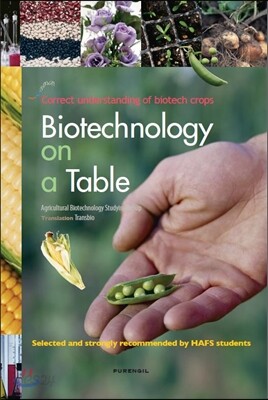
Correct understanding of biotech crops
By providing scientific knowledge and principles on GMO technology, this book would like to contribute to understand the process of the development, safety and possible risk of its output. Authors of experts working in various fields of development and regulation, tried to provide up-to-dated information about genetically modified agricultural products on the basis of science. Scientific technologies are double-edged: they contribute to convenient lives of human beings, but at the same time they may carry a chance of risks. It is just like as we cannot give up the convenience of the automobile provide to us just because it pollutes the air and damages people by traffic accident. In fact, technology itself is neither good nor bad. It depends on how we use the technology. - in the “Preface” 식탁 위의 생명공학 영문판이 나오기까지 중학교 재학 시절, 진정한 적성을 찾기 위해 고민하던 중 서울대학교 응용생물학부 최양도 교수님의 강의, “식탁 위의 생명공학”을 들을 기회가 있었습니다. 강의 내용은 같은 제목의 책을 기반으로 했는데, 강의를 들은 후 처음으로 한 학문 분야에 매료되었습니다. 강의를 통해 유전자재조합기술의 개념과 실제 응용 사례 등에 대해 배울 수 있었는데, DNA 같은 생명의 가장 기본적인 구성단위에 미세한 변화를 주는 것이 한 생물체의 형질에 결정적인 영향을 미치는 것이 흥미로웠습니다. 또한 유전자재조합기술을 통해 생물체에 유용한 형질을 발현시킨 응용사례에 대해 배우면서 현대의 생명공학은 단순한 학문을 넘어 기아, 질병 등 세계 문제를 해결하기 위한 첫걸음으로 보였습니다. 그와 동시에 보다 많은 사람들과 이런 지식을 공유하면 좋겠다고 생각했습니다. 생명공학기술은 관련 학자들만의 전유물이 아니라 현대 사회의 모든 구성원들과 직접적으로 연관이 있으며, 함께 살아가는 세계의 여러 문제를 해결하기 위해 모두가 관심을 가져야 한다는 생각으로 『식탁 위의 생명공학』을 영어로 번역하게 되었습니다. 현대 사회에서 생명공학이 어떤 의미를 가지는지 많은 사람들이 알게 되길 바라며 같은 관심사를 가진 고등학교 친구들과 작업을 거쳤고 출판을 하게 되었습니다. - 번역후기 중(김나우: Transbio 부장, 홍콩과기대 생명공학 전공) |
사락 별점0
혜택 및 유의사항밑줄0
혜택 및 유의사항
13,500원
총 1개
13,500원