
소득공제
수입
직수입양서
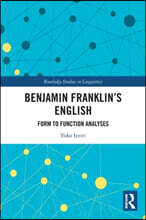
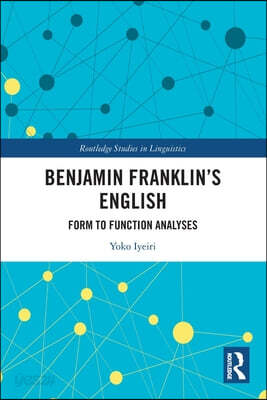
Benjamin Franklin's English
Form to Function Analyses
Paperback, 1st Edition
Iyeiri, Yoko (Kyoto University, Japan)
Routledge
2026.05.21.
이미 소장하고 있다면 판매해 보세요.
- 국내배송만 가능
- 해외 거래처 사정에 의하여 품절/지연 가능
- 도서 정보 중 미표기 사항 안내?
- 문화비소득공제 가능
Routledge Studies in Linguistics
-
 Form and Function Mapping in English Syntax 이동Form and Function Mapping in English Syntax10% 363,750원
 -
Independent Wh-Exclamative Constructions in the History of English 이동Independent Wh-Exclamative Constructions in the History of English10% 101,490원
-
Data Analytics for Discourse Analysis with Python 이동Data Analytics for Discourse Analysis with Python10% 101,490원
-
Coordination and the Strong Minimalist Thesis 이동Coordination and the Strong Minimalist Thesis10% 101,490원
-
Theorizing and Applying Systemic Functional Linguistics 이동Theorizing and Applying Systemic Functional Linguistics10% 101,490원
-
Present in Linguistic Expressions of Temporality 이동Present in Linguistic Expressions of Temporality10% 101,490원
-
Discourse Particles in Asian Languages Volume II 이동Discourse Particles in Asian Languages Volume II10% 93,030원
-
Discourse Particles in Asian Languages Volume I 이동Discourse Particles in Asian Languages Volume I10% 93,030원
-
Independent Wh-Exclamative Constructions in the History of English 이동Independent Wh-Exclamative Constructions in the History of English10% 363,750원
-
Data Analytics for Discourse Analysis with Python 이동Data Analytics for Discourse Analysis with Python10% 363,750원
-
Coordination and the Strong Minimalist Thesis 이동Coordination and the Strong Minimalist Thesis10% 363,750원
-
Theorizing and Applying Systemic Functional Linguistics 이동Theorizing and Applying Systemic Functional Linguistics10% 363,750원
-
Present in Linguistic Expressions of Temporality 이동Present in Linguistic Expressions of Temporality10% 363,750원
Taylor & Francis 신학기 할인 이벤트 ~9.25
-
Challenging Psychiatry’s Reliance on the Disease Model 이동Challenging Psychiatry’s Reliance on the Disease Model20% 88,330원
-
English-Medium Instruction in Vietnamese Higher Education 이동English-Medium Instruction in Vietnamese Higher Education20% 323,330원
-
Exploring Communities of Practice in Higher Education 이동Exploring Communities of Practice in Higher Education20% 323,330원
-
Phenomenology of the Self in Gestalt Therapy 이동Phenomenology of the Self in Gestalt Therapy20% 69,530원
-
Phenomenology of the Self in Gestalt Therapy 이동Phenomenology of the Self in Gestalt Therapy20% 323,330원
-
Globalism, Psychoanalysis, and the Integration of Eight Global Ideologies 이동Globalism, Psychoanalysis, and the Integration of Eight Global Ideologies20% 274,450원
-
Globalism, Psychoanalysis, and the Integration of Eight Global Ideologies 이동Globalism, Psychoanalysis, and the Integration of Eight Global Ideologies20% 82,690원
-
Reading Freud’s Beyond the Pleasure Principle 이동Reading Freud’s Beyond the Pleasure Principle20% 69,530원
-
Reading Freud’s Beyond the Pleasure Principle 이동Reading Freud’s Beyond the Pleasure Principle20% 274,450원
-
Making Professional Development Work in the Classroom 이동Making Professional Development Work in the Classroom20% 323,330원
-
Making Professional Development Work in the Classroom 이동Making Professional Development Work in the Classroom20% 39,450원
-
Play and Mathematics in Early Childhood Education 이동Play and Mathematics in Early Childhood Education20% 82,690원
-
Play and Mathematics in Early Childhood Education 이동Play and Mathematics in Early Childhood Education20% 323,330원
-
Personal Knowledge Management as and for Postqualitative Inquiry 이동Personal Knowledge Management as and for Postqualitative Inquiry20% 127,810원
-
Innovation and Knowledge Management in Manufacturing Industry 이동Innovation and Knowledge Management in Manufacturing Industry20% 157,890원
-
Championing Queer and Trans Inclusion Beyond the Campus Resource Center 이동Championing Queer and Trans Inclusion Beyond the Campus Resource Center20% 323,330원
-
Championing Queer and Trans Inclusion Beyond the Campus Resource Center 이동Championing Queer and Trans Inclusion Beyond the Campus Resource Center20% 63,890원
-
Charting a Career Path as a First-Generation Higher Education Professional 이동Charting a Career Path as a First-Generation Higher Education Professional20% 63,890원
책소개
목차
|
Preface and Acknowledgements 1. Introduction 1.1. The aim of this study 1.2. Why a single person’s English? 1.3. Form-to-function approach and corpus linguistics 1.4. Benjamin Franklin Corpus and some additional comments 2. Form-to-Function Approach 1: Historical Sociolinguistic Perspectives 2.1. Introductory remarks 2.1.1. General 2.1.2. Negation in the BF Corpus: A case study 2.2. Become 2.2.1. The frequency of become 2.2.2. The perfect of become 2.2.3. Become in the pseudo passive construction 2.3. Behalf 2.3.1. In behalf of vs. on behalf of 2.4. Choose 2.4.1 The conditional use of choose 2.4.2. Some other aspects of choose 2.5. Come 2.5.1. Come and its progressive forms 2.5.2. The perfect of come 2.5.3. Come and its collocation 2.6. Fall 2.6.1. The frequency of the verb fall and its usage 2.6.2. The perfect of fall 2.7. Fear 2.7.1. The frequency of the verb fear and its first-person use 2.7.2. The complementation of the verb fear and its parenthetical use 2.7.3. The noun fear 2.8. Forget 2.8.1. The past participle forms of forget 2.8.2. If I forget not 2.8.3. Forget and its subject 2.8.4. Forget and its complementation 2.9. Go 2.9.1. Go and its progressive forms 2.9.2. The perfect of go 2.9.3. Go and its collocation 2.10. Like 2.10.1. The verb like 2.10.2. Like as a hedge 2.10.3. Like vs. likely 2.11. Methinks 2.11.1. Methinks as a fossilized lexical item 2.12. Please 2.12.1. The pragmatic use of please 2.12.2. Please and its transitivity 2.13. Pray 2.13.1. The pragmatic use of pray 2.13.2. The verb pray followed by that-clauses and to-infinitives 2.14. Remember 2.14.1. Remember and its collocation 2.14.2. Discoursal nature of remember 2.14.3. Remember and its complementation 2.15. Show 2.15.1. Show vs. Shew 2.15.2. Show and the double-object construction 2.16. Think 2.16.1. Think and the first and second persons 2.16.2. The comment clause I think 2.17. Work 2.17.1. The preterite and past participle forms of work 2.18. Write 2.18.1. The preterite and past participle forms of write 2.18.2. I wrote a few lines to you, or the dative object construction 3. Form-to-Function Approach 2: Synchronic and Diachronic Perspectives 3.1. Introductory remarks 3.2. Arrive 3.2.1. The perfect of arrive 3.2.2. Arrive and adverbs 3.3. Avoid 3.3.1. Avoid -ing 3.4. Dare 3.4.1. The status of dare and its use in comment clauses 3.5. Doubt 3.5.1. The verb doubt and its complementation 3.5.2. The noun doubt and its complementation 3.5.3. Doubt and author orientation 3.6. Drink 3.6.1. Drank and drunk 3.6.2. Drink and its objects 3.7. Exceedingly 3.7.1. Exceeding vs. exceedingly 3.8. Forbear 3.8.1. Forbear and its complementation 3.9. Forbid 3.9.1. The past participle forms of forbid 3.9.2. Forbid and its complementation 3.10. Grow 3.10.1. Grow and some syntactic features 3.10.2. Grow with animate and inanimate subjects 3.11. Help 3.11.1. Help and its complementation 3.11.2. Cannot help -ing 3.12. Need 3.12.1. The status of need 3.12.2. Other related expressions 3.13. Return 3.13.1. The perfect of return 3.13.2. The verb return and adverbs 3.14. Scarce 3.14.1. Scarce vs. scarcely 3.14.2. Scarce, scarcely and their collocation 3.15. Speak 3.15.1. The past participle forms of speak 3.15.2. Bespeak, an etymologically related verb 3.16. Street 3.16.1. In the street vs. on the street 3.17. Suffer 3.17.1. Transitive and intransitive uses of suffer 3.17.2. Suffer plus to-infinitive 4. Discussion and Conclusion 4.1. About this chapter 4.2 Discussion from functional perspectives 4.2.1. Morphological and orthographic variation 4.2.2. Auxiliaries vs. lexical verbs 4.2.3. Progressive forms 4.2.4. Be-perfect vs. have-perfect 4.2.5. Passive 4.2.6. The double-object construction 4.2.7. Complementation 4.2.8. Adverbs 4.2.9. Choice of prepositions 4.2.10. Comment clauses and author orientation 4.2.11. Politeness expressions and others 4.3. Concluding remarks 4.3.1. Benjamin Franklin’s English 4.3.2. On the form-to-function approach References Electronic resources Bibliography Appendix List of Letters Index |
품목정보
- 발행일
- 2026년 05월 21일
- 쪽수, 무게, 크기
- 240쪽 | 470g | 160*230mm
- ISBN13
- 9781032277059
리뷰/한줄평0
상품정보안내
직수입외서의 경우, 해외거래처에서 제공하는 정보가 부족하여 제목, 표지, 가격, 유통상태 등의 정보가 미비하거나 변경되는 경우가 있습니다. 정확한 확인을 원하시는 경우, 일대일 상담으로 문의하여 주시면 답변 드리겠습니다.
(판형과 판수 등이 다양한 도서는 찾으시는 도서의 ISBN을 알려 주시면 보다 빠르고 정확한 안내가 가능합니다.)
해외거래처에서 품절인 경우, 2차 거래선을 통해 유럽과 미국 출판사로 직접 수입이 진행될 수 있습니다.
수입 진행 시점으로 부터 2~3주가 추가로 소요되며, 해외에서도 유통이 원활하지 않은 도서는 품절 안내가 지연될 수 있습니다.
해당 경우, 문자와 메일로 별도 안내를 드리고 있사오니 마이페이지에서 휴대전화번호와 메일주소를 다시 한번 확인해주시기 바랍니다.
(판형과 판수 등이 다양한 도서는 찾으시는 도서의 ISBN을 알려 주시면 보다 빠르고 정확한 안내가 가능합니다.)
해외거래처에서 품절인 경우, 2차 거래선을 통해 유럽과 미국 출판사로 직접 수입이 진행될 수 있습니다.
수입 진행 시점으로 부터 2~3주가 추가로 소요되며, 해외에서도 유통이 원활하지 않은 도서는 품절 안내가 지연될 수 있습니다.
해당 경우, 문자와 메일로 별도 안내를 드리고 있사오니 마이페이지에서 휴대전화번호와 메일주소를 다시 한번 확인해주시기 바랍니다.
90,210원
총 1개
90,210원