
이미지 검색을 사용해 보세요
검색창 이전화면 이전화면
최근 검색어
인기 검색어

소득공제 수입
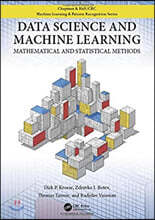
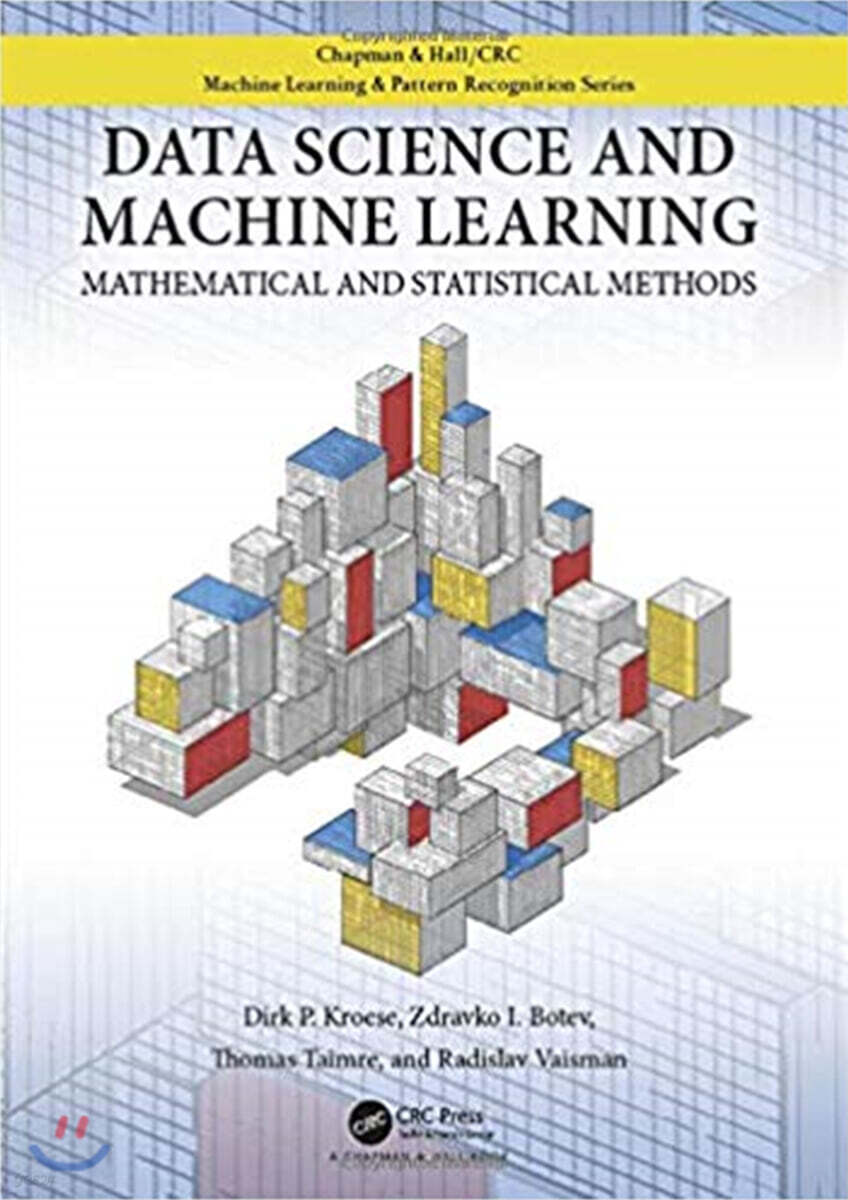
직수입양서 Data Science and Machine Learning
Mathematical and Statistical Methods Hardback, 1st Edition
Te, Alice Y.C. (University of Wales Trinity Saint David, Hong Kong)
Chapman and Hall/CRC 2019.11.22.
가격
219,620
10 197,650
YES포인트?
9,890원 (5%) 마니아추가적립
5만원 이상 구매 시 2천원 추가 적립
결제혜택
최대 1,000원 적립

이미 소장하고 있다면 판매해 보세요.

Chapman & Hall/CRC Machine Learning & Pattern Recognition

책소개

목차

Preface Notation 1. Importing, Summarizing, and Visualizing Data
1.1 Introduction
1.2 Structuring Features According to Type
1.3 Summary Tables
1.4 Summary Statistics
1.5 Visualizing Data
1.5.1 Plotting Qualitative Variables
1.5.2 Plotting Quantitative Variables
1.5.3 Data Visualization in a Bivariate Setting Exercises 2. Statistical Learning
2.1 Introduction
2.2 Supervised and Unsupervised Learning
2.3 Training and Test Loss
2.4 Tradeoffs in Statistical Learning
2.5 Estimating Risk
2.5.1 In-Sample Risk
2.5.2 Cross-Validation
2.6 Modeling Data
2.7 Multivariate Normal Models
2.8 Normal Linear Models
2.9 Bayesian Learning Exercises 3. Monte Carlo Methods
3.1 Introduction
3.2 Monte Carlo Sampling
3.2.1 Generating Random Numbers
3.2.2 Simulating Random Variables
3.2.3 Simulating Random Vectors and Processes
3.2.4 Resampling
3.2.5 Markov Chain Monte Carlo
3.3 Monte Carlo Estimation
3.3.1 Crude Monte Carlo
3.3.2 Bootstrap Method
3.3.3 Variance Reduction
3.4 Monte Carlo for Optimization
3.4.1 Simulated Annealing
3.4.2 Cross-Entropy Method
3.4.3 Splitting for Optimization3.4.4 Noisy Optimization Exercises 4. Unsupervised Learning
4.1 Introduction
4.2 Risk and Loss in Unsupervised Learning
4.3 Expectation?Maximization (EM) Algorithm
4.4 Empirical Distribution and Density Estimation
4.5 Clustering via Mixture Models
4.5.1 Mixture Models
4.5.2 EM Algorithm for Mixture Models
4.6 Clustering via Vector Quantization
4.6.1 K-Means
4.6.2 Clustering via Continuous Multiextremal Optimization
4.7 Hierarchical Clustering
4.8 Principal Component Analysis (PCA)
4.8.1 Motivation: Principal Axes of an Ellipsoid
4.8.2 PCA and Singular Value Decomposition (SVD) Exercises 5. Regression
5.1 Introduction
5.2 Linear Regression
5.3 Analysis via Linear Models
5.3.1 Parameter Estimation
5.3.2 Model Selection and Prediction
5.3.3 Cross-Validation and Predictive Residual Sum of Squares
5.3.4 In-Sample Risk and Akaike Information Criterion
5.3.5 Categorical Features
5.3.6 Nested Models
5.3.7 Coefficient of Determination
5.4 Inference for Normal Linear Models
5.4.1 Comparing Two Normal Linear Models
5.4.2 Confidence and Prediction Intervals
5.5 Nonlinear Regression Models
5.6 Linear Models in Python
5.6.1 Modeling
5.6.2 Analysis
5.6.3 Analysis of Variance (ANOVA)
5.6.4 Confidence and Prediction Intervals
5.6.5 Model Validation
5.6.6 Variable Selection
5.7 Generalized Linear Models Exercises 6. Regularization and Kernel Methods
6.1 Introduction
6.2 Regularization
6.3 Reproducing Kernel Hilbert Spaces
6.4 Construction of Reproducing Kernels
6.4.1 Reproducing Kernels via Feature Mapping
6.4.2 Kernels from Characteristic Functions
6.4.3 Reproducing Kernels Using Orthonormal Features
6.4.4 Kernels from Kernels
6.5 Representer Theorem
6.6 Smoothing Cubic Splines
6.7 Gaussian Process Regression
6.8 Kernel PCA Exercises 7. Classification
7.1 Introduction
7.2 Classification Metrics
7.3 Classification via Bayes’ Rule
7.4 Linear and Quadratic Discriminant Analysis
7.5 Logistic Regression and Softmax Classification
7.6 K-nearest Neighbors Classification
7.7 Support Vector Machine
7.8 Classification with Scikit-Learn Exercises 8. Decision Trees and Ensemble Methods
8.1 Introduction
8.2 Top-Down Construction of Decision Trees
8.2.1 Regional Prediction Functions
8.2.2 Splitting Rules
8.2.3 Termination Criterion
8.2.4 Basic Implementation
8.3 Additional Considerations
8.3.1 Binary Versus Non-Binary Trees
8.3.2 Data Preprocessing
8.3.3 Alternative Splitting Rules
8.3.4 Categorical Variables
8.3.5 Missing Values
8.4 Controlling the Tree Shape
8.4.1 Cost-Complexity Pruning
8.4.2 Advantages and Limitations of Decision Trees
8.5 Bootstrap Aggregation
8.6 Random Forests
8.7 Boosting Exercises 9. Deep Learning
9.1 Introduction
9.2 Feed-Forward Neural Networks
9.3 Back-Propagation
9.4 Methods for Training
9.4.1 Steepest Descent
9.4.2 Levenberg?Marquardt Method
9.4.3 Limited-Memory BFGS Method
9.4.4 Adaptive Gradient Methods
9.5 Examples in Python
9.5.1 Simple Polynomial Regression
9.5.2 Image Classification Exercises A. Linear Algebra and Functional Analysis A.1 Vector Spaces, Bases, and Matrices A.2 Inner Product A.3 Complex Vectors and Matrices A.4 Orthogonal Projections A.5 Eigenvalues and Eigenvectors A.5.1 Left- and Right-Eigenvectors A.6 Matrix Decompositions A.6.1 (P)LU Decomposition A.6.2 Woodbury Identity A.6.3 Cholesky Decomposition A.6.4 QR Decomposition and the Gram?Schmidt Procedure A.6.5 Singular Value Decomposition A.6.6 Solving Structured Matrix Equations A.7 Functional Analysis A.8 Fourier Transforms A.8.1 Discrete Fourier Transform A.8.2 Fast Fourier Transform B. Multivariate Differentiation and Optimization B.1 Multivariate Differentiation B.1.1 Taylor Expansion B.1.2 Chain Rule B.2 Optimization Theory B.2.1 Convexity and Optimization B.2.2 Lagrangian Method B.2.3 Duality B.3 Numerical Root-Finding and Minimization B.3.1 Newton-Like Methods B.3.2 Quasi-Newton Methods B.3.3 Normal Approximation Method B.3.4 Nonlinear Least Squares B.4 Constrained Minimization via Penalty Functions C. Probability and Statistics C.1 Random Experiments and Probability Spaces C.2 Random Variables and Probability Distributions C.3 Expectation C.4 Joint Distributions C.5 Conditioning and Independence C.5.1 Conditional Probability C.5.2 Independence C.5.3 Expectation and Covariance C.5.4 Conditional Density and Conditional Expectation C.6 Functions of Random Variables C.7 Multivariate Normal Distribution C.8 Convergence of Random Variables C.9 Law of Large Numbers and Central Limit Theorem C.10 Markov Chains C.11 Statistics C.12 Estimation C.12.1 Method of Moments C.12.2 Maximum Likelihood Method C.13 Confidence Intervals C.14 Hypothesis Testing D. Python Primer D.1 Getting Started D.2 Python Objects D.3 Types and Operators D.4 Functions and Methods D.5 Modules D.6 Flow Control D.7 Iteration D.8 Classes D.9 Files D.10 NumPy D.10.1 Creating and Shaping Arrays D.10.2 Slicing D.10.3 Array Operations D.10.4 Random Numbers D.11 Matplotlib D.11.1 Creating a Basic Plot D.12 Pandas D.12.1 Series and DataFrame D.12.2 Manipulating Data Frames D.12.3 Extracting Information D.12.4 Plotting D.13 Scikit-learn D.13.1 Partitioning the Data D.13.2 Standardization D.13.3 Fitting and Prediction D.13.4 Testing the Model D.14 System Calls, URL Access, and Speed-Up Bibliography Index

저자 소개

Dirk P. Kroese
Dirk P. Kroese, PhD, is a Professor of Mathematics and Statistics at The University of Queensland. He has published over 120 articles and five books in a wide range of areas in mathematics, statistics, data science, machine learning, and Monte Carlo methods. He is a pioneer of the well-known Cross-Entropy method―an adaptive Monte Carlo technique, which is being used around the world to help solve difficult estimation and optimization problems in science, engineering, and finance.
Zdravko Botev
Zdravko Botev, PhD, is an Australian Mathematical Science Institute Lecturer in Data Science and Machine Learning with an appointment at the University of New South Wales in Sydney, Australia. He is the recipient of the 2018 Christopher Heyde Medal of the Australian Academy of Science for distinguished research in the Mathematical Sciences.
Thomas Taimre
Thomas Taimre, PhD, is a Senior Lecturer of Mathematics and Statistics at The University of Queensland. His research interests range from applied probability and Monte Carlo methods to applied physics and the remarkably universal self-mixing effect in lasers. He has published over 100 articles, holds a patent, and is the coauthor of Handbook of Monte Carlo Methods (Wiley).
Radislav Vaisman
Radislav Vaisman, PhD, is a Lecturer of Mathematics and Statistics at The University of Queensland. His research interests lie at the intersection of applied probability, machine learning, and computer science. He has published over 20 articles and two books.

품목정보

발행일
2019년 11월 22일
쪽수, 무게, 크기
538쪽 | 1617g | 210*280mm
ISBN13
9781138492530

리뷰/한줄평0

리뷰

첫번째 리뷰어가 되어주세요.

한줄평

첫번째 한줄평을 남겨주세요.

상품정보안내

직수입외서의 경우, 해외거래처에서 제공하는 정보가 부족하여 제목, 표지, 가격, 유통상태 등의 정보가 미비하거나 변경되는 경우가 있습니다. 정확한 확인을 원하시는 경우, 일대일 상담으로 문의하여 주시면 답변 드리겠습니다.
(판형과 판수 등이 다양한 도서는 찾으시는 도서의 ISBN을 알려 주시면 보다 빠르고 정확한 안내가 가능합니다.)

해외거래처에서 품절인 경우, 2차 거래선을 통해 유럽과 미국 출판사로 직접 수입이 진행될 수 있습니다.
수입 진행 시점으로 부터 2~3주가 추가로 소요되며, 해외에서도 유통이 원활하지 않은 도서는 품절 안내가 지연될 수 있습니다.
해당 경우, 문자와 메일로 별도 안내를 드리고 있사오니 마이페이지에서 휴대전화번호와 메일주소를 다시 한번 확인해주시기 바랍니다.