
이미 소장하고 있다면 판매해 보세요.
- 해외배송 가능?
- 문화비소득공제 가능
샘문 시선

이 상품의 태그
책소개
목차
|
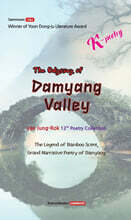
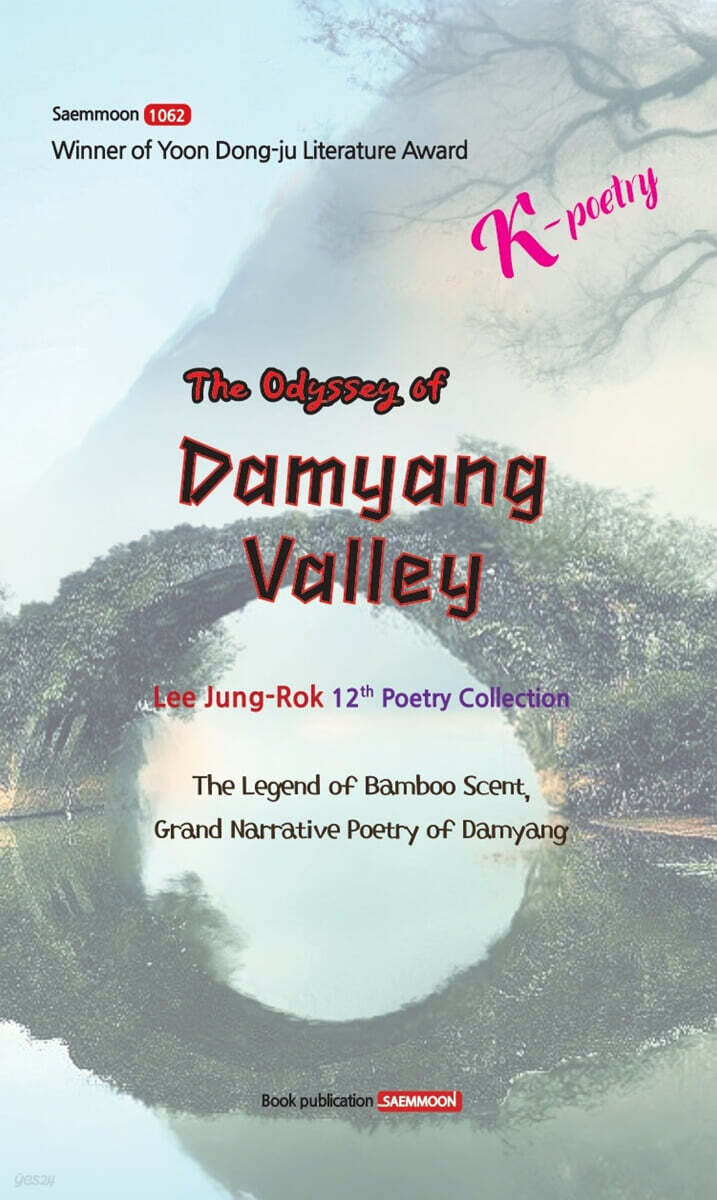
The Odyssey of Damyang Valley
담양골 오딧세이 Lee. Jung. Rok 12th. Poetry. Collection 이정록 제12시집 (영문판) Intention of Writing / 4 Summary / 6 Foreword … Kim So-yeop / 7 Part 1, The Legend of Songsoon The Legend of Songsoon / 16 The Magical View of Yeongsan River / 18 Climbing the Moonlight of Jewoldang / 19 Bamboo Tea Blends with the Scent of Poetry / 21 Spring Flower / 24 Falling Flower, Flowing Water / 26 My Boy, You are Full and Ripe / 28 Fairyland / 34 Wedding Day of a New Bride / 37 The Memory of Fairyland / 39 Sosaewon Embraces the Universe / 41 Sosaewon Becomes a Hermit / 43 Love Song of the Crescent Moon / 45 White Dream on a Summer Night / 47 Under the Light of Fireflies and the Snow / 48 Liverleaf in the Snowy Yongheungsa Temple / 55 Chuwolsan Mountain, Revelation of the Nature’s Secret / 56 Part 2, A Hundred-Year-Long Legend of the Bamboo Shoot Bamboo Drink, the Scent of Fairyland / 58 Food Stand at Juknokwon / 59 Bursting Bamboo Rice / 61 The Tale of Bamboo Rice / 62 Secret Love Affair at a Cabin in Chuwolsan Mountain / 65 Lovers of the Nature, Blooming the Flower of Talk / 66 The Window 1 / 68 The Window 2 / 70 Dream / 72 Legend of the Bamboo Sprout / 75 Apricot Flower in the Snow, Love of Spring / 77 Wanderer with a Barley Flute / 78 Market Day in Damyang / 80 Dream of a Father and Son in Wandong Valley / 82 Let Her Be the Wings of a God / 90 Waterfall of the Blue Mountain / 92 First Resolution / 94 Legend of the Bamboo Sprout / 97 Riverside Scene of the Market Day in Damyang / 99 Part 3, The Birch Tree Never Breaks A Small Shack / 102 Praise for Damyang / 103 Poetry, the Philosophy of Healing / 105 Heartless Love / 110 Hope / 111 The Birch Tree Never Breaks / 113 The Magical Castle of Damyang / 115 Universal Gravity / 116 Source Code to Heaven / 118 Uninvited Guest / 120 Love of a Red Apricot Flower / 121 White Dream / 122 Father’s Bamboo Brush, Forming the Eol / 123 Reunification of South and North / 127 That Year in May / 128 Running Life / 136 Spring Breeze / 138 The Graceful Path of Life / 139 I Love You / 140 |
품목정보
- 발행일
- 2024년 12월 17일
- 쪽수, 무게, 크기
- 142쪽 | 140g | 130*210*20mm
- ISBN13
- 9791194817024
책 속으로
|
A poet from an artistic village, who plants
the legendary hometown of Damyang into his bones to bloom a flower Kim So-yeop (Poet, Literary Critic, Chair Professor of Daejeon University, President of the Federation of Artistic & Cultural Organization of Korea) The poet Lee Jung-Rok, known by the pen name Saemteo, is a prominent poet in Korea who has been writing poetry for 36 years and made his debut in 1992. He has become a highly influential poet, ranking among the steady-seller and best-seller poets. Beyond being a poet, he also leads the literary group Saemmoon (formerly Saemteo Literary Group), showcasing his leadership and gaining significant recognition in the literary world. Currently, the Saemmoon Group has about 200,000 members, combining both offline and online communities. Additionally, the poet has personally garnered a loyal following of tens of thousands. The poet not only has tens of thousands of loyal readers but also operates the Saemmoon Lifelong Education Center, Saemmoon Arts College, and an academic research institute, all authorized by the Ministry of Education. These institutions focus on poetry, sijo, essays, and the study of poetry composition and recitation. Additionally, he established and manages the Saemmoon Translation Institute. He inherited Korea's premier literary magazine [Hangook Moonhak] (Korea Literature), founded in 1966 by esteemed figures Kim Dong-ri and Lee Geun-bae, and organizes the Korean Literature Award through it. Furthermore, with permission from the family of Han Yongun, he founded the Han Yongun Literature Award and the Han Yongun National Poetry Recitation Contest, which are held every fall. Every spring, he also holds the Saemmoon News New Year's Literary Contest and the Saemmoon Literature Award, which have been celebrated for 14 years. Additionally, he has received authorization by the government as a private qualification education institution and qualification issuing organization under national laws and the Basic Qualification Act. Through this, he has guided and nurtured many promising students, helping them enter the society and academia. We must admit that he is truly an outstanding figure representing Damyang. Now, let's further evaluate the poet. First, he has written poetry with high literary quality. As a result, he has attracted significant attention from the literary community and has expanded his literary activities in various ways. He has won numerous prestigious literary awards, including the Korean Literature Award, the Saemteo Literature Award Grand Prize, the Korean Story Literature Award, the Han Yongun Literature Award, and the Yoon Dong-ju Literary Award. His accomplishments have been recognized, and in 2019, he was listed in the National Distinguished Figures edition, in the sections dedicated to the key figures of modern history and cultural arts. His name appears alongside notable figures such as Jo Ji-Hoon, Yoon Dong-ju, Lee Jung-seob, Seo Jeong-ju, Jeong Bi-seok, Noh Cheon-myeong, Hong Nan-pa, Ahn Ik-tae, Kim Dong-in, Park Mok-wol, Yeom Sang-seop, and Park Jong-hwa. Secondly, he is a poet with a deep love for his hometown. As a poet devoted to his roots, his poetry is deeply connected to his hometown. He loves his hometown more than anyone else, embracing its history, legends, and culture. In particular, in the chapter “Market Day in Damyang,” his soul and spirit are infused with a strong sense of hometown pride, which is clearly reflected in the poems. In works such as [The Legend of Songsoon], [Market Day in Damyang], [Falling Flowers and Flowing Water], [The Magical View of Yeongsan River], and [The Tale of Bamboo Rice], he deeply expresses his love for his hometown. His affection for his hometown has led him to extract its history and legends, elevating them into poetry. Moreover, his ability to craft beautiful, almost fairytale-like poems while preserving the unique dialect of the Southern region suggests that his love for his homeland played a crucial role in this artistic achievement. Poems such as [That Person's Heart is Full, Truly], and [The Dream of a Father and Son in Wandong Valley] are truly beautiful, rustic, and full of affection, with a strong sense of local flavor. This deep connection to his hometown allowed him to nostalgically dream of Damyang for many years, even beyond his sixties. Places like Wandong Valley, Ganadang, Manseong-ri, Cloud Bridge, Eonggul Cave, Hyanggyo, and Jukmuljeon are not just remnants of the past or old place names; they are dynamic, living entities that continue to breathe in the poet's mind. They are essential sources of his lyrical, altruistic, and loving poetry. This is a testament to his deep love and longing for his hometown. Thirdly, as a poet with strong leadership in Korean poetry, he has mentored many students in the field of poetry and literature. Currently, he serves as the head professor at the College of Literature and Arts at Daerim University, where he continues to mentor and shape the next generation of literary talents. Through Saemteo Literature (now Saemmoon), he actively promotes poetry collections like Conversion Emotional Poetry, Saemmoon Poetry Selection, Korean Literature Poetry Selection, and Han Yongun Poetry Selection, alongside engaging in literary activities through multimedia. His ongoing efforts have earned continuous support from the Seoul Metropolitan Government and Jungnang District for the establishment of the Han Yongun Literature Award and the Han Yongun Poetry Recitation Contest. Fourthly, he is a person who will achieve significant cultural accomplishments for his hometown, society, country, and humanity. He writes poetry with more passion than anyone else and possesses the highest values and abilities to achieve great cultural accomplishments for both his hometown and society. For this reason, I believe that such a dedicated individual deserves support and recognition. For these four reasons, I strongly recommend Poet Lee Jung-Rok(Saemteo) to the people of South Korea and readers around the world, along with Lee Geun-bae, President of the Korean Academy of Arts, and Son Hae-il, Chairman of the International PEN Korea Center. Thank you. --- 본문 중에서 |
줄거리
|
Out of deep affection for my hometown, which gave me the blood and bones, I summoned all the history and legends of the city and poured them into my poems. The southern accent has been used as it is, adding beauty and a mood of fairy-tale, helping to visualize the poems.
My wish is to help readers feel and taste the role of poetry in human life and how it touches our hearts. Isn’t that the essence of poetic literature, after all? I believe that poetry is the tool that helps transcend our spirituality, making us live a life of talent and altruism. It is the deepest form of art created by human beings, and can be used as the path to our home and realizing our ideals. With lyricism, spirit of the age, universal value, humor, and Korean identity on the base, I have written this collection to console and heal this devastated humanity. I hope my poems can help purify the corrupt authority and capital. The poems are optimized to give compassion, protection, consolation, healing, and support to the grass roots who are weak and weary. Author, Saemteo Lee Jung-Rok |
리뷰/한줄평0
10,800원
총 1개
10,800원