

소득공제
수입
직수입양서
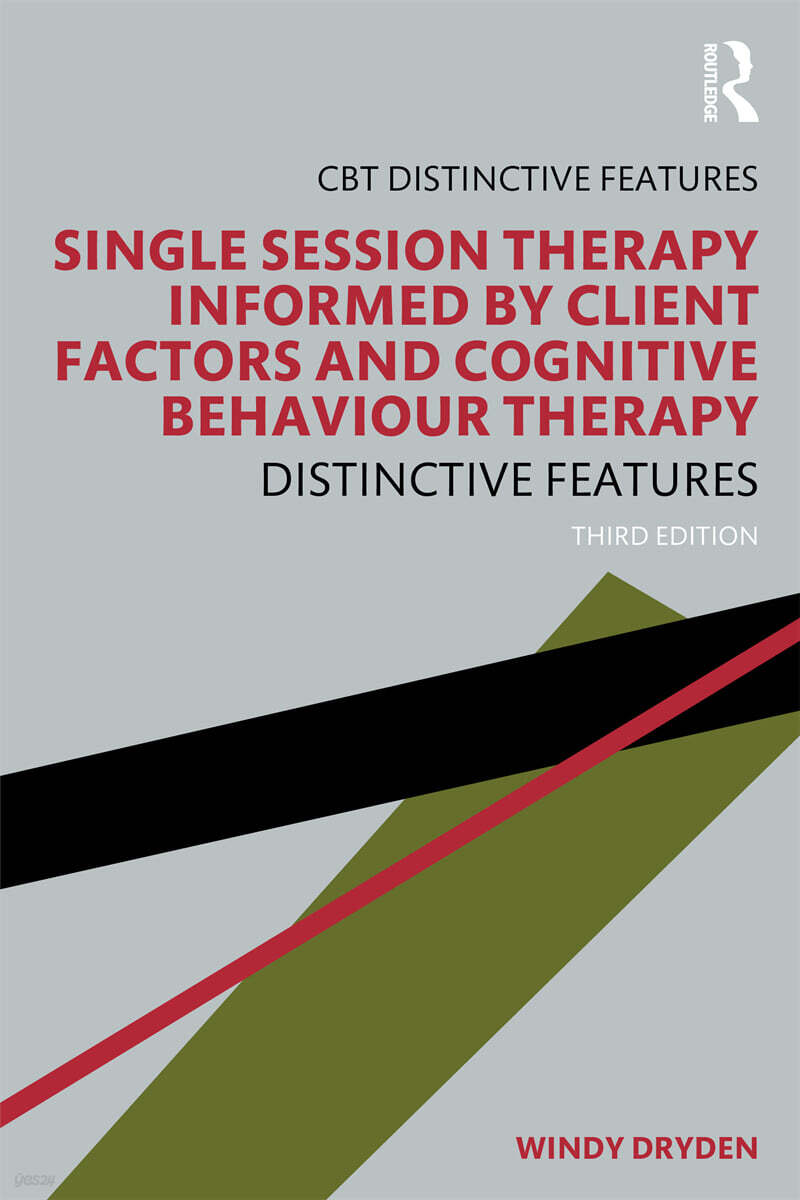
Single-Session Therapy Informed by Client Factors and Cognitive Behaviour Therapy
Distinctive Features
Paperback, 3rd Edition
Windy Dryden
Routledge
2026.10.19.
- 국내배송만 가능
- 예약도서와 함께 주문 시 도서 출간일에 함께 배송됩니다. (출판사의 사정으로 출간 지연 가능)
- 해외 거래처 사정에 의하여 품절/지연 가능
- 도서 정보 중 미표기 사항 안내?
- 문화비소득공제 가능
CBT Distinctive Features
-
 Single-Session Therapy Informed by Client Factors and Cognitive Behaviour Therapy 이동Single-Session Therapy Informed by Client Factors and Cognitive Behaviour Therapy10% 348,270원
 -
Single-Session Therapy Informed by Client Factors and Cognitive Behaviour Therapy 이동Single-Session Therapy Informed by Client Factors and Cognitive Behaviour Therapy10% 74,890원
-
Motivational Cognitive Behavioural Therapy 이동Motivational Cognitive Behavioural Therapy10% 40,470원
-
Motivational Cognitive Behavioural Therapy 이동Motivational Cognitive Behavioural Therapy10% 348,270원
-
CBASP as a Distinctive Treatment for Persistent Depressive Disorder 이동CBASP as a Distinctive Treatment for Persistent Depressive Disorder10% 295,620원
-
CBASP as a Distinctive Treatment for Persistent Depressive Disorder 이동CBASP as a Distinctive Treatment for Persistent Depressive Disorder10% 50,590원
책소개
목차
|
Introduction THEORY 1. Single-Session Therapy Informed by Client Factors and CBT (SST: ICF & CBT): What it is and some basic assumptions 2. The single-session mindset in SST: ICF & CBT 3. Working alliance theory: A generic framework for SST: ICF & CBT 4. Human beings have the capability to help themselves quickly under specific circumstances 5. It is important to privilege clients' viewpoints in SST: ICF & CBT - [ICF Focus] 6. It is important to draw upon a range of client variables in SST: ICF & CBT - [ICF Focus] 7. Dealing with the suitability issue 8. A focus on problems, goals and solutions is important in SST: ICF & CBT 9. People largely create and maintain their problems by a range of cognitive-behavioural factors – [CBT Focus] 10. As far as possible, clients should be helped to deal healthily with the adversity involved in their problem, whether real or inferred - [CBT Focus] 11. Carry out a full assessment of the client's nominated problem drawing on case formulation principles [CBT Focus] 12. In SST: ICF & CBT, it is possible to help clients identify and deal with a central mechanism responsible for the existence of their problems 13. The client's subsequent responses to their first reaction are often more important than the first reaction itself 14. Helpful client characteristics for SST: ICF & CBT 15. Helpful therapist characteristics for SST: ICF & CBT PRACTICE 16. Good practice in SST: ICF & CBT 17. An overview of the SST: ICF & CBT 18. The first contact 19. Pre-session preparation 20. The session: 1. Beginning well 21. The session: 2. Creating a focus 22. The session: 3. Understanding the nominated problem 23. The session: 4. Setting a goal 24. The session: 5. Identifying the central mechanism 25. The session: 6. Dealing with the central mechanism and finding a solution 26. The session: 7. Making an impact 27. The session: 8. Encouraging your client to rehearse the solution in the session and develop an action plan 28. The session: 9. Ending well 29. After the session 30. The follow-up session |
품목정보
- 발행일
- 2026년 10월 19일
- 쪽수, 무게, 크기
- 234쪽 | 130*200mm
- ISBN13
- 9781041357353
사락 별점0
혜택 및 유의사항밑줄0
혜택 및 유의사항상품정보안내
직수입외서의 경우, 해외거래처에서 제공하는 정보가 부족하여 제목, 표지, 가격, 유통상태 등의 정보가 미비하거나 변경되는 경우가 있습니다. 정확한 확인을 원하시는 경우, 일대일 상담으로 문의하여 주시면 답변 드리겠습니다.
(판형과 판수 등이 다양한 도서는 찾으시는 도서의 ISBN을 알려 주시면 보다 빠르고 정확한 안내가 가능합니다.)
해외거래처에서 품절인 경우, 2차 거래선을 통해 유럽과 미국 출판사로 직접 수입이 진행될 수 있습니다.
수입 진행 시점으로 부터 2~3주가 추가로 소요되며, 해외에서도 유통이 원활하지 않은 도서는 품절 안내가 지연될 수 있습니다.
해당 경우, 문자와 메일로 별도 안내를 드리고 있사오니 마이페이지에서 휴대전화번호와 메일주소를 다시 한번 확인해주시기 바랍니다.
(판형과 판수 등이 다양한 도서는 찾으시는 도서의 ISBN을 알려 주시면 보다 빠르고 정확한 안내가 가능합니다.)
해외거래처에서 품절인 경우, 2차 거래선을 통해 유럽과 미국 출판사로 직접 수입이 진행될 수 있습니다.
수입 진행 시점으로 부터 2~3주가 추가로 소요되며, 해외에서도 유통이 원활하지 않은 도서는 품절 안내가 지연될 수 있습니다.
해당 경우, 문자와 메일로 별도 안내를 드리고 있사오니 마이페이지에서 휴대전화번호와 메일주소를 다시 한번 확인해주시기 바랍니다.
74,890원
총 1개
74,890원