
소득공제
수입
직수입양서
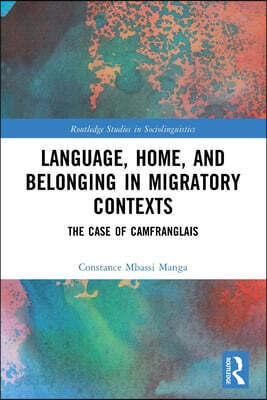
Language, Home, and Belonging in Migratory Contexts
The Case of Camfranglais
Paperback, 1st Edition
Constance Mbassi Manga
Routledge
2026.09.28.
- 국내배송만 가능
- 예약도서와 함께 주문 시 도서 출간일에 함께 배송됩니다. (출판사의 사정으로 출간 지연 가능)
- 해외 거래처 사정에 의하여 품절/지연 가능
- 도서 정보 중 미표기 사항 안내?
- 문화비소득공제 가능
Routledge Studies in Sociolinguistics
-
 Corpora and Complexity in English Language Research 이동Corpora and Complexity in English Language Research10% 361,810원
 -
Multimodal Approaches to Heritage and Minoritised Languages for Young People 이동Multimodal Approaches to Heritage and Minoritised Languages for Young People10% 361,810원
-
Translating Spanglish in US Latinx Audiovisual Stories 이동Translating Spanglish in US Latinx Audiovisual Stories10% 100,950원
-
Language, Home, and Belonging in Migratory Contexts 이동Language, Home, and Belonging in Migratory Contexts10% 100,950원
-
Language Policy and the Power of Linguistic Dynamics in the Arab World 이동Language Policy and the Power of Linguistic Dynamics in the Arab World10% 361,810원
-
‘Sanskrit-speaking’ Villages, Linguistic Utopias and the Metaphysics of Development 이동‘Sanskrit-speaking’ Villages, Linguistic Utopias and the Metaphysics of Development10% 361,810원
-
Yorkshire Dialect in the Nineteenth Century 이동Yorkshire Dialect in the Nineteenth Century10% 100,950원
-
Social Identity and Discourses in Chinese Digital Communication 이동Social Identity and Discourses in Chinese Digital Communication15% 95,340원
-
Language Attitudes and the Pursuit of Social Justice 이동Language Attitudes and the Pursuit of Social Justice10% 100,950원
-
Advocating for Sociolinguistic Justice in the United States 이동Advocating for Sociolinguistic Justice in the United States10% 100,950원
-
Power, Affect, and Identity in the Linguistic Landscape 이동Power, Affect, and Identity in the Linguistic Landscape15% 95,340원
-
New Directions and Challenges in Languages and Cultures in Australia 이동New Directions and Challenges in Languages and Cultures in Australia15% 341,720원
-
Sociolinguistic Approaches to Lexical Variation in English 이동Sociolinguistic Approaches to Lexical Variation in English15% 341,720원
-
Space-Time (Dis)continuities in the Linguistic Landscape 이동Space-Time (Dis)continuities in the Linguistic Landscape10% 100,950원
-
Translating Spanglish in US Latinx Audiovisual Stories 이동Translating Spanglish in US Latinx Audiovisual Stories15% 341,720원
-
Language, Home, and Belonging in Migratory Contexts 이동Language, Home, and Belonging in Migratory Contexts15% 341,720원
-
Language in Society in Bangladesh and Beyond 이동Language in Society in Bangladesh and Beyond10% 100,950원
-
Yorkshire Dialect in the Nineteenth Century 이동Yorkshire Dialect in the Nineteenth Century15% 341,720원
-
New Perspectives on Goffman in Language and Interaction 이동New Perspectives on Goffman in Language and Interaction10% 92,530원
-
Power, Affect, and Identity in the Linguistic Landscape 이동Power, Affect, and Identity in the Linguistic Landscape10% 361,810원
-
Language Attitudes and the Pursuit of Social Justice 이동Language Attitudes and the Pursuit of Social Justice10% 307,120원
책소개
목차
|
Contents List of figures List of tables Transcription conventions Chapter 1 – Introduction and background 1.1 Introduction 1.2 What do we call Camfranglais? 1.3 My personal interest in CFrA 1.3.1 My relationship to CFrA and other non-standard codes in my repertoire 1.3.2 Reasons that led me to research CFrA 1.4 Background 1.4.1 Colonial history & the link with CFrA 1.4.2 How decoloniality fits in 1.4.3 CFrA in the diaspora 1.4.4 Relevance of the topic 1.4.5 Research question 1.4.6 Ontological and epistemological position 1.4.7 Theoretical framework 1.4.8 Overview of indexical transformations undergone by CFrA in this context 1.5 Value and usefulness of the interdisciplinary lens to this topic 1.5.1 Introduction 1.5.2 (Linguistic) Ethnography 1.5.3 Online/digital ethnography 1.5.3.1 Introduction 1.5.3.2 Nomenclature 1.5.3.3 The online field, its context, and privacy 1.5.3.4 Insights from relevant online ethnographies 1.5.4 Critical Discourse Analysis 1.5.5 Decolonial approaches to CDA 1.5.6 Combining LE & CDA 1.5.7 Key points on data collection (on- and offline) 1.5.8 Life narratives as data 1.5.9 Researcher’s position and reflexivity 1.5.10 Data analysis: overview 1.6 Conclusion Chapter 2 – Key concepts 2.1 Theorising Cameroonian-ness 2.1.1 Diaspora 2.1.2 The deconstruction of diasporic Cameroonian-ness 2.2 Community 2.3 ‘Home’ and ‘belonging’, identity, and the migratory experience 2.3.1 (‘Home’ and) Belonging 2.3.2 Identity 2.3.3 Migratory experience 2.4 The functions of language 2.5 Translanguaging and its relevance to the project 2.6 Conclusion Chapter 3 – Historical and socioeconomic context 3.1 From colonial era to independence 3.2 Language ideologies of the new Cameroonian state 3.2.1 From independence to the late 1980s 3.2.2 From the 1990s onward 3.2.3 Practical example: Camfranglais in pop culture 3.3 Main trends in the study of CFrA 3.3.1 Introduction 3.3.2 Trends in the study of CFrA: late 1990s to mid-2000s 3.3.2.1 CFrA as a linguistic system 3.3.2.2 CFrA and other registers 3.3.2.3 CFrA as an unstable register 3.3.2.4 CFrA and official language ideologies 3.3.2.5 CFrA as a sociolinguistic asset 3.3.3 Trends in the study of CFrA: mid- to late 2000s onward 3.3.3.1 Socioeconomic context of emergence of CFrA 3.3.3.2 CFrA as a language practice 3.3.3.3 CFrA and the diaspora 3.3.3.4 CFrA and identity 3.3.3.5 ‘Home’ and ‘belonging’ in previous studies about CFrA 3.4 Conclusion Chapter 4 – Skype conversations: narratives and diasporic identities 4.1 Introduction 4.2 The conversations 4.3 Brief vignettes of participants 4.3.1. Adam 4.3.2 Freddy 4.3.3 Lovely 4.3.4 Craig 4.3.5 Thalia 4.3.6 Manuela 4.3.7 Trish 4.3.8 Boris 4.3.9 Conclusion 4.4 Analysis: introduction 4.4.1 Participants’ backgrounds and their impact on practices 4.4.2 Socioeconomic background 4.4.3 Age and time of arrival 4.5 Themes emerging from the conversations 4.5.1 Language and identity 4.5.2 Frenchness and Cameroonian-ness 4.5.3 Language and ‘race’ 4.5.4 Language ideologies about CFrA 4.5.5 ‘Home’ and ‘belonging’ 4.5.6 Insights from the conversations 4.6 Conclusion Chapter 5 – Facebook Group: an online community built around CFrA 5.1 Introduction 5.2 Overview of Facebook features and their impact on the data 5.2.1 Affordances of participation 5.2.2 Affordances of space 5.2.3 Affordances of personal expression 5.2.4 Affordances of connection 5.2.5 Impact of Facebook features on the project 5.3 General description of the group 5.3.1 Introduction 5.3.2 Organisation of the group 5.3.3 Engaging with the group 5.3.4 Data selection and download 5.4 Activity in the group 5.4.1 Introduction 5.4.2 Member interaction 5.5 Analysis: introduction 5.5.1 Overall content and style 5.6 Selected cases and themes 5.6.1 Diasporic migrant identity 5.6.1.1 Analysis 5.6.2 Community-building 5.6.2.1 Analysis 5.6.3 Cameroonian identity and patriotism 5.6.3.1 Prince 5.6.3.1.1 Analysis 5.6.3.2 Tebo 5.6.3.2.1 Analysis 5.6.4 Metadiscourses about CFrA 5.6.4.1 Analysis 5.6.5 Insights from the Facebook chats 5.7 Conclusion Chapter 6 – Findings and conclusion 6.1 Introduction 6.2 Overall findings 6.3 Global significance of the case study 6.3.1 Links with the Sociolinguistics of Migration 6.3.2 Links with the (updated) Sociolinguistics of Diaspora 6.3.3 Links with postcolonial theories 6.3.4 Why and why now? Timeliness and relevance 6.4 Limitations 6.5 Further areas of research 6.6 Final comments Appendix Index |
관련 분류
품목정보
- 발행일
- 2026년 09월 28일
- 쪽수, 무게, 크기
- 266쪽 | 520g | 150*230mm
- ISBN13
- 9781032751665
사락 별점0
혜택 및 유의사항밑줄0
혜택 및 유의사항상품정보안내
직수입외서의 경우, 해외거래처에서 제공하는 정보가 부족하여 제목, 표지, 가격, 유통상태 등의 정보가 미비하거나 변경되는 경우가 있습니다. 정확한 확인을 원하시는 경우, 일대일 상담으로 문의하여 주시면 답변 드리겠습니다.
(판형과 판수 등이 다양한 도서는 찾으시는 도서의 ISBN을 알려 주시면 보다 빠르고 정확한 안내가 가능합니다.)
해외거래처에서 품절인 경우, 2차 거래선을 통해 유럽과 미국 출판사로 직접 수입이 진행될 수 있습니다.
수입 진행 시점으로 부터 2~3주가 추가로 소요되며, 해외에서도 유통이 원활하지 않은 도서는 품절 안내가 지연될 수 있습니다.
해당 경우, 문자와 메일로 별도 안내를 드리고 있사오니 마이페이지에서 휴대전화번호와 메일주소를 다시 한번 확인해주시기 바랍니다.
(판형과 판수 등이 다양한 도서는 찾으시는 도서의 ISBN을 알려 주시면 보다 빠르고 정확한 안내가 가능합니다.)
해외거래처에서 품절인 경우, 2차 거래선을 통해 유럽과 미국 출판사로 직접 수입이 진행될 수 있습니다.
수입 진행 시점으로 부터 2~3주가 추가로 소요되며, 해외에서도 유통이 원활하지 않은 도서는 품절 안내가 지연될 수 있습니다.
해당 경우, 문자와 메일로 별도 안내를 드리고 있사오니 마이페이지에서 휴대전화번호와 메일주소를 다시 한번 확인해주시기 바랍니다.
100,950원
총 1개
100,950원