
이미 소장하고 있다면 판매해 보세요.
- 국내배송만 가능
- 문화비소득공제 가능
이 상품의 태그


목차
|
■ Publisher’s Greeting
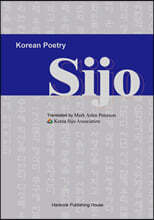
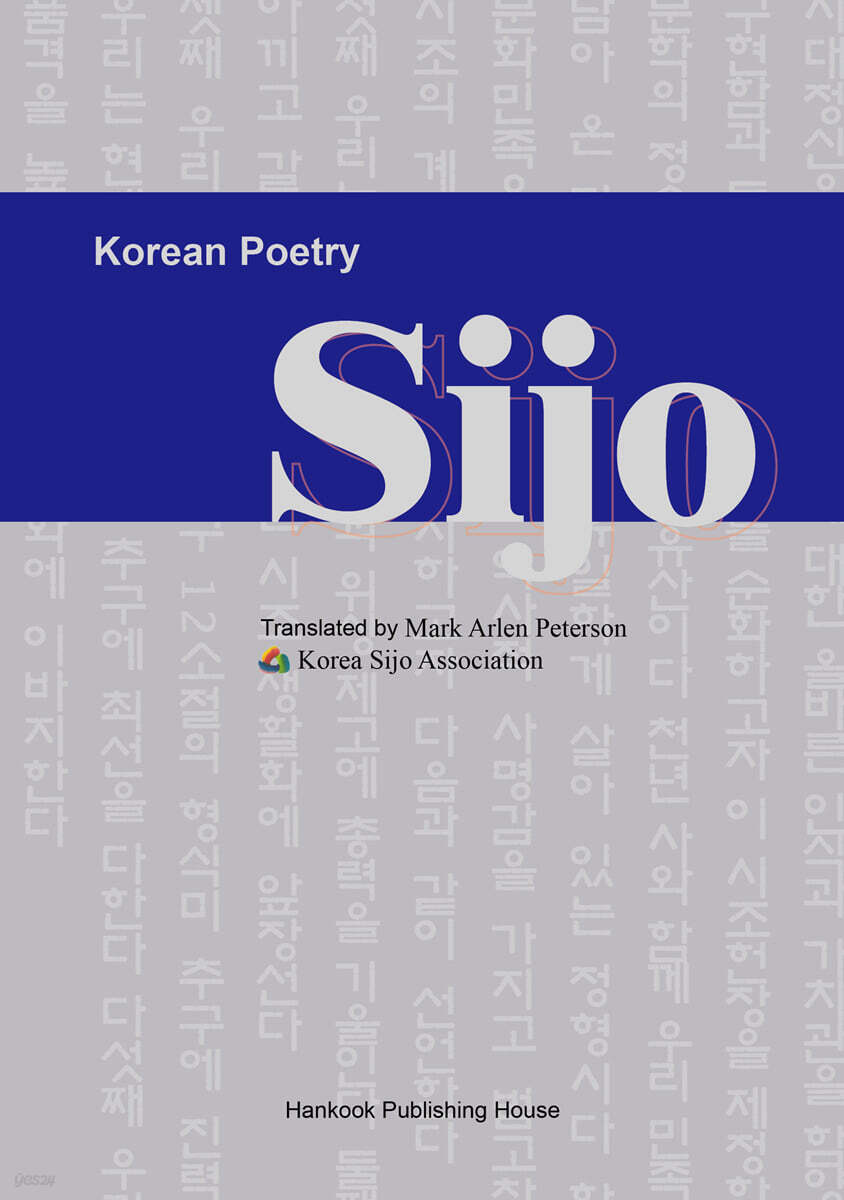
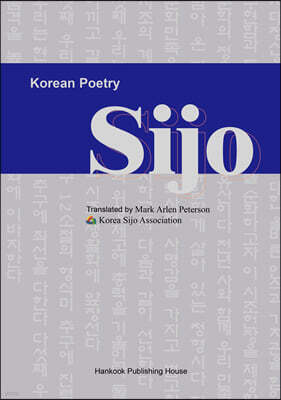
■ Prologue: About the Sijo Part 1 (about 700~ 1919) Though I Die, and Die again / Mongjoo Chung Punch a Hole in my Chest / Anyeol Byun The Sun Shines Bright through the East Window / Guman Nam I Return to the Five Century Capital / Jae Gil I Miss My Dear One Who Has Gone / Bangyeon Wang The Night Falls on the Cold Autumn River / Prince Wolsan The Blue Hills Are My Desires / Hwangjini Scops Owl! Crying on a Deserted Quiet Hill / Hyogwan Park A Lover Seen only in Dreams / Myeongok It’s Good for Me that We Don’t Do / Gyeryang Byun You Should Stay. Yet You Will Go? / The King Sungjong of Joseon Dynasty This Parting Is such Sadness / Duhyang Part 2 (about 1920~2022) Sitting Alone / Namseon Choi Spring in Wartime / The first Korean President-Syngman Rhee The Turtle Ship / The 5th~9th President - Chunghee Park Search / Cheondeuk Pi The Village Where the Apricots Bloom / Hou Yi The Wind Was also Chilly / Byunggi Lee Maple Leaf / Jonghwa Park With a New January / Gyuil Ha Ohryukdo / Dudong Go Dream / Gwangsu Yi One Day / Sangok Kim Early Spring / Gijae Kang Children / Unja Kang Spring Light / Jaeil Kang Flower Wind / Chunghoe Gu The Maid of Autumn / Ohak Gwon Drawing a Drawing of a Pine Tree / Taekbeom Gwon Pinetrees by the Hajodae Seacoast / Gwangsu Kim A New Spring / Giwon Kim The Farmer and the Bull / Gyeongu Kim Looking at the Ridgeline / Gwirye Kim Water Lily / Daleho Kim Comma / Bubae Kim Breaking the Silence / Sagyun Kim Stars / Seongdeok Kim The Spirit of the Poet / Seongsu Kim Pueraria Lobata / Sukseon Kim A Bunch of Magnolia Flowers / Sukhee Kim Morning Time / Yeonsu Kim The Empty House / Yeongae Kim The Day of a Gentle Breeze / Yeongjin Kim A Picture of a Poem / Okjung Kim A Weed Seed Blew this Way / Wolhan Kim Corona / Yunsung Kim The Sound of the River / Euisik Kim Painting in Black Ink / Ilyeong Kim Heart / Eunja Kim On a Spring Day / Jaebun Kim Tree Rings / Jaehwang Kim Self-portrait / Jeongi Kim Love / Jenghee Kim Lamentation of the Balsam Flower / Jiun Kim Reunion / Cheolhak Kim Memory of June / Taegyun Kim The Ear of a Needle / Taeook Kim Chupungnyeong / Taehee Kim You, I Long for / Hyeonja Kim Broken Heart / Hwain Kim The Flower Shop / Heungyeol Kim Waves Are My Faith / Jaeyeon Roh Sea Bells 3 / Hyeonja Ra Eyebrow Moon / Sukja Ryu Dharma Song / Sangcheol Mo When I Close My Eyes / Bokseon Moon Sleepless Night / Gyeonggyu Park Longing / Giljung Park The Banya Flower / Myeongok Park Little Dream / Baehoon Park Hwangjoga / Yongsu Park Flowers Blooming on the Subway / Inseon Park In April / Cheonggil Park Student Soldier / Heonsu Park Moonlit Donghaksa / Heono Park May / Gyujeong Song Pebbles / Gwiyeong Song Pomegranate / Soohyun Song Will / Gyejeon Shin Youth / Dongyeong Shin Starlight / Seunghwa Shin Small Spring / Seongbo Shim Making Winter Kimchi / Jaenam Shim Ulleungdo Outing 1 / Byeongdu Oh Azalea Blossoms / Seonghun Uh A Crescent Moon 1 / Suhyang Uh My Own Haven / Heewon Uh Moon Night / Suyeon Won Life Train / Yongu Won Living / Sangyong Yu First Love / Seongcheol Yu The Camellia Road to Seonunsa Temple / Junho Yu Honeysuckle flower / Seongho Yun A Salt Field Made of Tears / Jaenam Yun A Weed / Heeyuk Yun The Power of a Raindrop / Kwansu Lee A Crack / Kwang-nyeong Lee A Tree in Winter / Dohyeon Lee At My Library / Malyong Lee A Farmer's Love of Poetry / Myeongyong Lee Humble Hope / Myeongjae Lee The Path of the Poet / Seokgyu Lee New Year‘s Eve / Sujin Lee The Rose / Soonhyang Lee The Needle / Inhwan Lee Dokdo Island / Ilhee Lee Solitary Old Man / Jaeho Lee Life / Taehee Lee Muttering About Time / Hyeon Lee The Snail / Heungu Lee The Cricket / Mangyu Im Millennium Crane / Byeongung Lim Mother / Jaedong Im Enlightenment / Kyeongjin Jang Mugunghwa / Geumryeol Jang Early Spring / Seongdeok Jang Winter Hermitage / Seongu Jeon Barley / Gweonsik Jeong A Wound Deeper than a Wound / Jinsang Jeong Three Chapters of Life / Gukseong Jo The Horizontal Scale / Yeontak Jo Anquish / Yeonghee Jo My House / Cheolmuk Jo The Fence of Maternal Love / Pyeongjin Jo The Roof of the Palace / Gilja Jin Today, too / Yeongho Cha Beautiful Scenery / Yunbyeong Chae Maple Leaves / Hyeonbyeong Chae Evening Rain / Okhee Cheon To the Sole of the Foot / Eunhee Choi Arirang with My Love / Hotaek Choi Sunberry / Sangcheol Han The Red Golden Gate Bridge / Wonyeong Hyeon Entering Nirvana / Ikhwan Han Flower of Flowers / Yunseong Hong Double Standard / Gilsin Hwang Part 3 (Foreigner’s Works) Translated into Korean by Jaeyeon Roh On Sijo Writing / Lucy Park How to Write Sijo / Mark Arlen Peterson First Sijo: A Night in Andong / David McCann My Darling / Larry Gross Even Now / Elizabeth St. Jacques Breakfast / Linda Sue Park On Watching the Olympics / Mark Arlen Peterson Long Wait / Victor P. Gendrano Foggy Bridge / Chuck Newell Senses / Elizabeth Jorgensen Stars Sijos / Debra Woolard Bender Sound of Winter on a Quiet November Morning / Lucy Park ■ Chief Editor's Note ■ Sijo Charter ■ The Brief History of Korea Sijo Association Corp. |
저자 소개 2
The Brief History of Korea Sijo Association Corp. 2022 April: 10 Years History of the Korea Sijo Association Corp. and "Sijo Collection" in English version published. 2022 March: Revision of the Title Quarterly Publication of Sijo and Creation of the Logo of Korea Sijo Association 2021 April: National Assembly Passes Amendmen
The Brief History of Korea Sijo Association Corp. 2022 April: 10 Years History of the Korea Sijo Association Corp. and "Sijo Collection" in English version published. 2022 March: Revision of the Title Quarterly Publication of Sijo and Creation of the Logo of Korea Sijo Association 2021 April: National Assembly Passes Amendment to the Literature Promotion Act 2021 January: Sijo Webinar "The Present, Future and Globalization of Sijo" held between USA and Korea 2019 October: The Stone Monument to The Sijo Charter installed. 2019 October: The Sijo Film Documentary on Finding Hwangjini co-produced with Sijo Journal 2019 February: Declaration of the Charter of Sijo and the Code of Ethics and Enactment of the Society's Song 2016 December: Declaration of the Unification of the Sijo's Name and Form 2016 November: The Association was registered at the Ministry of Culture, Sports and Tourism. 2014 December: The Association has been converted into a Corporation. 2014 October: The Stone Monument of Origin of Sijo's Name installed. 2013 June: The Association Name changed to Korea Sijo Lover's Poets’ Association. 2012 December: The First Issue of Magazine Sijo Love published. 2012 April: Korea Sijo Love Movement Center was founded.
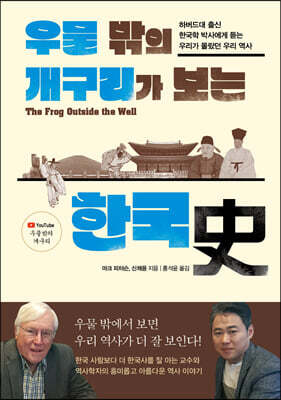
브리검영대학교를 졸업하고 하버드대학교에서 한국학으로 석사와 박사 학위를 받았다. 브리검영대학교에서 30년 이상 한국사를 강의했으며 현재 명예교수로 있다. 저서로는 《유교사회의 창출》(일조각, 2000년)이 있고 ‘우물 밖의 개구리’(The Frog Outside the Well)라는 유튜브 채널을 운영하고 있다.
마크 피터슨의 다른 상품
품목정보
- 발행일
- 2022년 04월 30일
- 쪽수, 무게, 크기
- 202쪽 | 153*224*20mm
- ISBN13
- 9791166850875
책 속으로
|
Sijo is the only surviving orthodox poem in Korea. Sijo has a history of about 700 years, and about 5,000 Gosijos (Old Sijos) have been handed down through records. The oldest Sijos handed down today are Woo Tak's 3 Sijos and Lee Jo-nyeon's 1 Sijo. Although there is no record of the date of the publication of these four Sijos, it is reasonable to regard the origin of the Sijo as the early 1300s, based on the dates of birth and death of Woo Tak and Lee Jo-nyeon.
On the other hand, there are opinions that the Sijos already existed before that, and there are claims that the history is more than 1,000 years, but the evidence is still weak. Various forms and types of songs before the Sijo, including Shinga (god songs), Shaman songs, Gosi (old poetry), Folk songs, Hyangga (Silla dynasty songs), Sokyo (old folk songs of Goryeo period), Gyeonggi chega (nobles’ songs of Goryeo and Joseon period), and Han poetry (Chinese poetry). Although there were poems of the same name, they were all sung only by special classes such as nobles, commoners, or shamans, and none of the people enjoyed singing poetry together. And all of these were prevalent in one era and then disappeared. Combining the views of various scholars on the origin of Sijo, Sijo has a point in common with each of the various poems presented above. In a word, it can be summarized as the best Siga(Old lylic) that is completely different from the previous types of Sigas and newly created by taking advantage of those Sigas evenly. --- 「About the Sijo」 중에서 |
출판사 리뷰
|
As a gift that we would like to give to everyone in the world who love Sijo, we are truly grateful and happy that the Korea Sijo Association has compiled a collection of Sijo in Korean and English.
We will present a great enlightenment to those who have not yet known how deep history Sijo has brought to us, how mysterious a poem that touches their heart it is, and how beautiful a literary work written in Hangeul. We, the Korean Sijo Association, have their roots in a poem called Hyangga in the Shilla Dynasty, about 1,400 years ago, and have properly inherited the legitimacy passed down 700 years ago in the same Sijo form as today. It is the 10th anniversary of the founding of a group of Sijo writers, formed to make efforts to globalize Sijo in the new era of the global village. We are publishing a collection of Sijo in English so that people can read and learn Sijo widely. Our hope is that this book will be widely used so that more people will know 'Sijo' correctly and use it effectively. Of course, we would like to continue to provide a space for people studying Sijo for foreigners. After hearing the news that the Sejong Cultural Society in Chicago, USA, has held the Sijo Contest every year since 2008, and it is developing into a successful contest with over 1,500 participants from all over the United States, our association also had great hopes. We feel infinitely grateful that professor D. McCann, professor M. Peterson, and members of the Sejong Cultural Society are working harder to teach and spread Sijo. To the members of the Korean Sijo Association, who contributed good works to the publication of this book of Sijo and paid a contribution to the publication, Professor Peterson who translated Sijo into English, and the Sejong Cultural Society for helping Americans participate. We hope that this publication of the Korean-English Sijo Collection will fulfill the role of a valuable seed for Sijo to expand its position into a new world culture. We hope that all those who learn and love Sijo will enjoy greater happiness. Thank you. |