
이미 소장하고 있다면 판매해 보세요.
- 해외배송 가능?
- 문화비소득공제 가능
우리공예 디자인리소스북
-
 Geumbak : Korean Traditional Gold Leaf Imprinting 이동Geumbak : Korean Traditional Gold Leaf Imprinting10% 14,400원
 -
Jewa : Korean Traditional Handmade Roof Tile 이동Jewa : Korean Traditional Handmade Roof Tile10% 14,400원
-
Soban: Korean Traditional Portable Dining Table 이동Soban: Korean Traditional Portable Dining Table10% 14,400원
-
Maedeup : Korean Traditional Decorative Knotting 이동Maedeup : Korean Traditional Decorative Knotting16,000원
-
Ipsa : Korean Traditional Silver or Gold Inlaying 이동Ipsa : Korean Traditional Silver or Gold Inlaying16,000원
상세 이미지

책소개
품목정보
- 발행일
- 2016년 01월 29일
- 쪽수, 무게, 크기
- 172쪽 | 384g | 152*210*12mm
- ISBN13
- 9788997252565
책 속으로
|
Hang-ari, or jars, show considerable regional variations, and are distinctive in each of the provinces of Gyeonggi-do, Chungcheong-do, Jeolla-do, and Gyeongsang-do. Among the different types of onggi, hang-ari jars show the most distinct regional characteristics. Onggi from the central region, including Gyeonggi-do and Chungcheong-do Provinces, are similar, being slender without a swollen belly, but jars from Chungcheong-do Province are wider than those of Gyeonggi-do. Jars from Gyeongsang-do and Jeolla-do Provinces are distinctive in that their bellies are swollen, although they vary in details. Gyeongsang-do jars have a big belly but the mouth is very small, tapering in rapidly from the shoulder. On the other hand, Jeolla-do jars have a large mouth with a diameter wider than the base, and the upper belly is swollen with wide shoulders and a round body. This feature of Jeolla-do jars, which have a larger capacity, may be related to the area’s fertile fields that produce abundant crops. ---「Chapter 1. Onggi: An Introduction」중에서
The glaze for onggi is an alkaline-based glaze. Wood ash is mixed with water and yakto. Yakto is a form of compost high in iron produced by fungal breakdown of tree leaves and roots. It is mostly obtained in mountainous areas with pine forests. Wood ash is made mainly from pine trees, and usually mixed with yakto in the ratio of 1:1, though it may be adjusted in certain cases. Good yakto melts thoroughly, but when yakto does not fully melt more wood ash is added to lower the fusing point. Onggi are covered with glaze, but jilgeureut and puredogi are not glazed and instead are surfaced with soot. In particular, when puredogi are fired, salt is introduced into the kiln and melts into the surface along with the soot, which creates a thin film and fills in the porous walls performing nearly the same as a glaze. This makes the vessel walls impervious to water. ---「Chapter 2. Materials and Tools for Making Onggi」중에서 The body of the onggi vessel is constructed by repeating the sequence of coiling (or slab-building), paddling and smoothing. When coiling, potters use their fingers to smooth and join the coils above with those below. As for slab-building, the slabs themselves are nearly in the form of the walls, so it only requires connecting them with the adjoining slabs. The first coil or slab on the bottom disk is called a cheong tarim, which means first coil or slab. It is very important to adhere securely the base with the cheong tarim, so clay is added and sealed to the inner area between the base and the coil or slab. ---「Chapter 3. Making Onggi」중에서 Onggi were widely utilized in our daily lives. During winter, family members gathered around an earthenware brazier and had fireside chats after dinner, and earthenware chamber pots were kept in a corner of the bedroom at night time. Onggi tiles were used to construct the roof, and onggi clay was also utilized to make a well or a bath tub. Sarangbang (men’s quarters) were furnished with scholars’ accoutrements including water droppers, ink stones, brush holders, brush rests, tobacco pipes, and spittoons, among others. Onggi clay was also made into beehives, loach traps, octopus traps, fishing net weights, yaknyo bottles, buhang danji, and baemiri. There were also ritual vessels and musical instruments made of onggi clay, including the janggu, wind instruments hun and kkureugi, and a percussion bu. Gansutong, a basin for collecting gansu (salted water) used in making bean curd, and semi-cylindrical shaped pillows filled with hot or cold water for winter and summer days were also made with onggi clay. ---「Chapter 4. Enjoying Onggi」중에서 |
출판사 리뷰
|
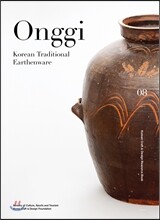
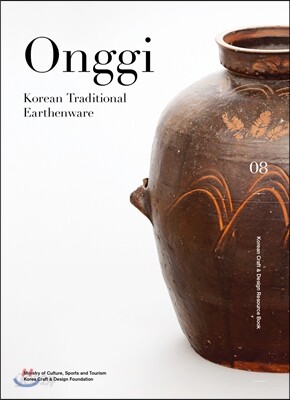
Onggi: Korean Traditional Earthenware is published as part of “Publishing Project of the Korean Craft & Design Resource Book Series,” sponsored by the Ministry of Culture, Sports, and Tourism and implemented by the Korea Craft & Design Foundation. Korean Craft and Design Resource Book series published by the Korea Craft & Design Foundation provides a repository of knowledge and information regarding traditional Korean craft and techniques. It was intended not only for those already familiar with the subject matter but also for laypersons.
Onggi: Korean Traditional Earthenware is divided into four chapters: The first chapter “Onggi: An Introduction” discusses the following topics ?the definition of onggi the characteristic features of Korean onggi and the types of onggi determined by the production method. The definition of onggi can be understood with a basis in its establishment and change over time. The first chapter reviews the historical flow from the emergence of onggi, which is in the same form as the present, of the Goryeo period, through to the onggi covered with yellow-brown glaze. Moreover, it explores the diverse types of onggi in accordance with their usage. The second chapter, “Materials and Tools for Making Onggi” presents the raw materials, tools, and kilns that are required for making onggi. It introduces not only conventional facilities and tools, but also modern-style machinery, tools, and facilities that are already widely used in the present day. As for kilns, the second chapter explores those featuring regional characteristics including the jodaebultonggama kiln of the west coast and the noranggul cave and geomeungul cave kilns built with rocks of the Jejudo Island region. The third chapter “Making Onggi” presents the overall production process of onggi with a focus on glazed onggi crocks together with other methods with different detailed processes. Onggi is generally produced through a four-step process: preparing the clay and glaze; shaping; decorating and glazing; and firing. The process of shaping and firing slightly differs according to form and type. The greatest difference in the production of jilgeueut (unglazed low-fire earthenware), puredogi (high-fire earthenware) and onggi lies in firing. This chapter presents a look into how kilns are fired differently. The fourth chapter “Enjoying Onggi” allows an opportunity to enjoy the past and present of Korean onggi. It lists onggi objects according to the place in which they were used, and also illustrates the onggi of Jejudo Island known for their unique color and designation. Also featured are dented and soldered onggi, and this is another characteristic of onggi ?using dented and broken ware in one way or another. The section “Onggi of Today” features works of potters maintaining tradition with the materials, technique, and style of traditional onggi in line with those produced by those designated as Intangible Cultural Property or Master Onggi Potter and also works that reflect a contemporary twist in shape and decoration while maintaining the materials and technique of traditional onggi. In order to reflect upon and to convey the value of Korean onggi, Onggi: Korean Traditional Earthenware is written upon discussion with many different experts. Notwithstanding its modest size, Onggi: Korean Traditional Earthenware seeks to offer a glimpse into all aspects of Korean onggi. It is hoped that this book will contribute to a better understanding of the past and present of Korean onggi and continuing the tradition. |