
이미 소장하고 있다면 판매해 보세요.
- 해외배송 가능?
- 문화비소득공제 가능
우리공예 디자인리소스북
-
 Geumbak : Korean Traditional Gold Leaf Imprinting 이동Geumbak : Korean Traditional Gold Leaf Imprinting10% 14,400원
 -
Jewa : Korean Traditional Handmade Roof Tile 이동Jewa : Korean Traditional Handmade Roof Tile10% 14,400원
-
Soban: Korean Traditional Portable Dining Table 이동Soban: Korean Traditional Portable Dining Table10% 14,400원
-
Maedeup : Korean Traditional Decorative Knotting 이동Maedeup : Korean Traditional Decorative Knotting16,000원
-
Ipsa : Korean Traditional Silver or Gold Inlaying 이동Ipsa : Korean Traditional Silver or Gold Inlaying16,000원
상세 이미지

책소개
목차
|
Chapter 1.
Chimseon: An Introduction Definition of Chimseon Characteristics of Chimseon History of Chimseon Arts and Types of Chimseon Chapter 2. Preparing Chimseon Materials and Tools of Chimseon Chimseon Methods Chapter 3. Crafting Chimseon Jeogori Chima Baji Baeja Jogak-bo Chapter 4. Enjoying Chimseon Subtle Wit Glistening in Dignity ? Po Asymmetric Yet Well-balanced ? Jeogori Aesthetics of Curves and Slits ? Dang-ui As Practical As It Is Beautiful ? Baeja Graceful Appearance from the Back ? Ceremonial Chima Delicate Dualism of Hiding and Exposing ? Undergarments Square Artistry of Daily Life ? Jogak-bo Born from Women’s Nimble Fingertips ? Sundries in Gyubang Creation of Motherly Devotion ? Children’s Clothing Appendix Masters Craft & Design Map List of Artifacts and Illustrations Bibliography Collaborators Index |
품목정보
- 발행일
- 2016년 01월 29일
- 쪽수, 무게, 크기
- 164쪽 | 368g | 152*210*12mm
- ISBN13
- 9788997252589
책 속으로
|
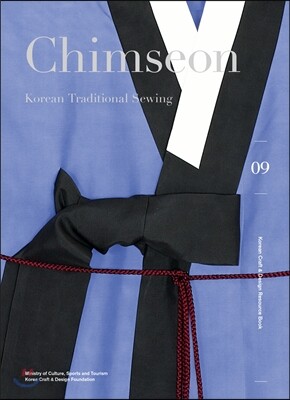
Chimseon(針線) stands for needle and thread, referring to the sewing of fabric such as the stitching or making of clothing, and in broad terms includes all sewn objects.
Besides clothing, bedding items such as blankets, pillows, sitting cushions, and various decorative storing items such as wraps, and cases for writing and eating utensils have also been made with Chimseon. Chimseon was an important virtue for women in the household. As the craftsmanship of items made in the women’s quarters called Gyubang(閨房) became increasingly acknowledged, the creations are now known as Gyubang Crafts. ---「Chapter 1. Chimseon: An Introduction」중에서 Jeogori The most basic upper garment of Hanbok, the open front is held together from both sides by Goreum, with no notable differences in shape between sexes and ages. Despite changes with trends over time, Jeogori worn by men are usually lengthy and plain. Meanwhile, Jeogori worn by women used to be lengthy and wide sleeved, but this became increasingly shorter and form fitting. Jeogori is usually decorated with either gilt or embroidery, and children’s Jeogori were also beautifully adorned with multi-colored stripes or embroidery. Jeogori with different colored stripes attached to the sleeves are Saekdong-jeogori. There are unadorned uni-colored Jeogori(Min-jeogori), Jeogori with different colored cuffs, neckband and Goreum(Banhoejang-jeogori), and Jeogori with different colored cuffs, neckband, armpits and Goreum(Samhoejang-jeogori). ---「Chapter 1. Chimseon: An Introduction」중에서 Various types of fabric were used to make clothing fit for each of the distinct seasons in Korea. As such, spring and fall is made from thin silk fabric, summer from ramie or hemp, winter are made of cotton or thick silk. Leather, fur, felt or wool were also great for the alternative materials. For summer , hemp or ramie cloth was sewn in a single layer, and for spring and fall, lining was inserted to make multiple layers. Winter was quilted with cotton filling or lined with fur. Equivalent kind of fabric and sewing technique were used for the main fabric and lining. Nowadays, synthetic materials similar to natural fabrics are used to lower cost and ease maintenance, while the incorporation of Western fabric such as velvet and lace creates a novel impact. ---「Chapter 2. Preparing Chimseon」중에서 Chimseon tools were of utmost importance in the past when clothing had to be self-made. Traditional Chimseon tools include rulers, scissors, needles, thimbles, hot and flat irons, which were stored in sewing boxes, pools and needle cases. Needles were considered the most precious of Chimseon tools, and needles of appropriate thickness were used for various fabrics. Hot irons were heated in braziers and used to fold and press seams or smooth out creases, while frying pan-shaped flatirons filled with hot coal were rubbed over fabric held tight by two people. Starched cloth was pounded on a fulling block with a bat. ---「Chapter 2. Preparing Chimseon」중에서 |
출판사 리뷰
|
It was only a century ago that sewing machines became available in Korea. Until then, everything from clothing to small items had to be hand-sewn. Chimseon, Korean traditional sewing, perfectly reflects the philosophy of life of Korean ancestors and the cultural identity, demonstrating stitch by stitch how elaborate work and the sense of aesthetics create a subtle beauty.
Today, Korean traditional sewing has made a comeback. The has captivated Western audiences since the 1990s, when designers began to introduce the flowing garments to the runways of Paris. Reflecting growing global interest in the boosted by the rising popularity of various Korean cultural contents in recent years, Karl Lagerfeld has presented a Hanbok-inspired line of clothing at the 2015 Chanel Cruise Collection. Traditional has thus been plunked out of obscurity and is becoming a sought-after source of novel inspiration for fashion designers around the world. Consequently, and items that had previously been forgotten have resurfaced in our daily lives as their new interpretations garner positive responses from younger generations. This book was written to make Chimseon readily available to a wider audience. As the creative possibilities born from needle and thread are virtually endless. This book is a valuable guide for designers seeking inspiration in traditional Korean. |